
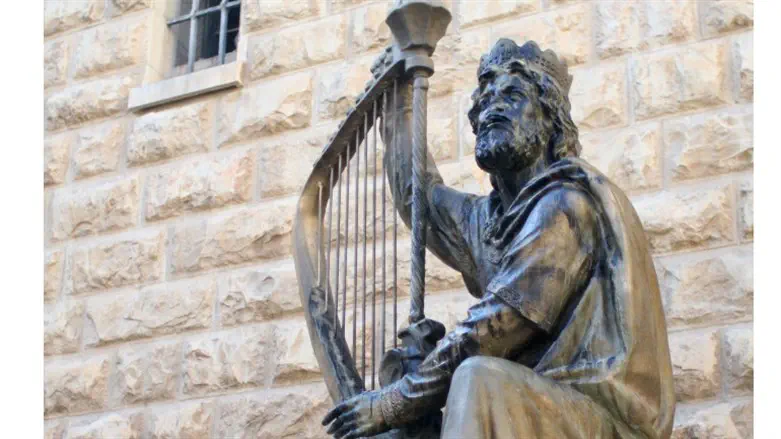
The Haftorah for Parshat Vayechi, drawn from the second chapter of the First Book of Kings, is a highly instructive meditation on leadership, continuity and the moment when one generation must hand the reins to the next. Like the Torah portion itself, it takes place at the edge of life, when a towering figure looks back, looks forward, and chooses words that will echo long after he is gone.
King David is old. His strength has waned, his body betrays him and the end is unmistakably near. The warrior-poet who slew Goliath, unified Israel and established Jerusalem as its capital now lies on his deathbed. And it is precisely there, in that vulnerable space between life and death, that King David delivers his final charge to his son Solomon.
“I am going the way of all the earth,” he tells him. “Be strong and be a man” (verse 2). Note how his first charge to his beloved son in this setting is neither sentimental nor comforting. It is the language of personal responsibility.
The Haftorah does not romanticize David’s reign. It does not present a sanitized version of history. Instead, it offers a sober reckoning. David reminds Solomon to walk in the ways of G-d, to keep His statutes and commandments, “so that you may succeed in all that you do and wherever you turn” (verse 3). Faith, David teaches, is not a matter of abstract theology. It is the foundation of personal and national success.
This mirrors Parshat VaYechi with striking precision. Jacob, like David, gathers his children around him at the end of his life. He blesses them, rebukes them, and speaks truths that could no longer be postponed. Both men understand something essential: the final words of a leader are not necessarily meant to soothe but to shape the future.
Yet King David’s charge goes further. He speaks not only of ideals but of unfinished business. He instructs Solomon on how to deal with figures who threatened the stability of the kingdom, men whose loyalty was suspect and whose actions undermined justice. These passages have often made readers uncomfortable. But discomfort is precisely the point.
Leadership is not limited to espousing lofty visions. It is about moral clarity. King David understands that a kingdom cannot endure if wrongdoing is ignored in the name of false peace. Justice delayed corrodes the soul of a nation. By addressing these matters openly, he teaches Solomon that mercy without accountability is not righteousness, but weakness.
This is a lesson that resonates powerfully today.
We live in an age that often confuses tolerance with virtue and restraint with strength. The Haftorah reminds us that true leadership requires discernment, courage and an unflinching commitment to truth. King David does not ask Solomon to be popular. He asks him to be faithful.
There is also a profound humility in King David’s words. For all his achievements, he frames his legacy not around military victories or political triumphs, but around covenant. His greatest hope is not that Solomon will surpass him in power, but that he will remain loyal to G-d and to the mission of Israel.
That humility stands in sharp contrast to the culture of ego that dominates so much of modern public life. Too often, leaders cling to office, manipulate systems and silence successors to preserve their own image. King David does the opposite. He prepares the ground for transition. He steps aside. He entrusts the future to the next generation.
And Solomon, young and untested, accepts the burden.
The Haftorah thus offers an important lesson. Nations survive not because of any single leader, but because values are transmitted intact from one generation to the next. Jacob passes the torch to his sons. King David passes it to Solomon. The message is clear: history is a relay race, not a solo act.
For the Jewish people, this message carries particular weight. We are a nation shaped by memory, sustained by tradition and bound by a covenant that transcends time. Our survival has never depended solely on strength or numbers but on fidelity to purpose.
In an era of profound uncertainty, the Haftorah of VaYechi calls on us to ask difficult questions. Are we preparing the next generation to lead with courage and conviction? Are we passing on the eternal values that have sustained us? Are we, like King David, willing to speak hard truths before it is too late?
King David’s final words are not a farewell. They are a summons. A summons to responsibility, to faith and to moral resolve.
As he goes “the way of all the earth,” he leaves behind more than a kingdom. He leaves a blueprint for leadership rooted in humility before G-d and accountability before history. And that blueprint remains as resonant today as it was on King David’s deathbed.