
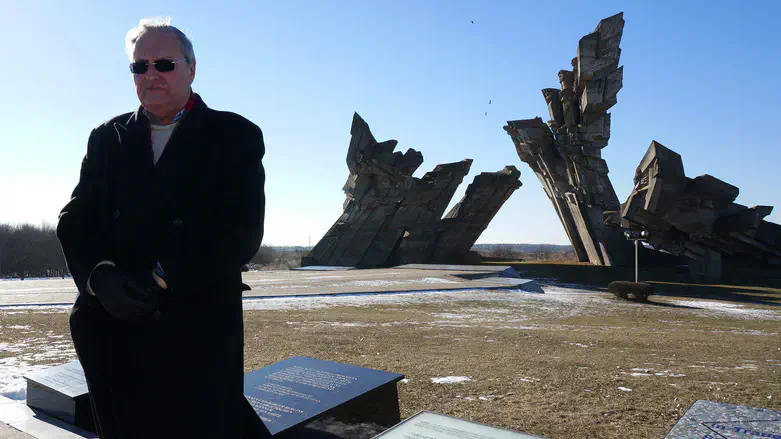
On the Tenth of Tevet, the Kaddish prayer is said for victims of the Holocaust whose date of death is unknown. My wife's mother, may she have a long and healthy life, asked me to recite the prayer for her parents who were taken away from her by the Nazis when she was a little girl. Usually, my 96 year-old father-in-law, may he have a long and healthy life, recites the Kaddish prayer for her parents, and over nine brothers who were murdered by the Germans, but he has difficulty lately getting to a minyan in synagogue.
He doesn't say the Kaddish on the Tenth of Tevet for his own parents because he knows the day that his parents were killed - the same day that they all arrived at Auschwitz. My wife, may she have a long and healthy life, helped him write a memoir of his youth which I turned into a novel that I haven't yet published. Here is the chapter about his first day at the death camp:
Auschwitz
We arrived at Auschwitz. The train-car door slid open. It took all of us time to adjust to the daylight. Guards shouted at us to get out: "Raus, raus, schnell, schnell, schnell..." run, run, fast, fast, fast, out, out, hurry. Nazi soldiers with rifles greeted us with shouting. Some clutched machine guns. “Leave your belongings on the train. You will get them later” an S.S. man yelled. Of course we never did. Dogs pulled at their leashes, growling like demons. Chaos. Shock. No chance to glance around to see where we were.
Getting off the train, the whole family, parents and children, gathered together, clinging to each other in the surreal reality around us. We walked in line as instructed. Guards yelled angrily. They kicked at us and pushed the frightened newcomers along the path with their rifles. “Line up five deep” we were commanded. At a certain spot on the ramp stood a German officer, who I later learned was Mengele. He stood straight as a ruler, a man of average height wearing a high-collared, tight-fitting uniform, observing the scene with a nonchalance as if he were well-accustomed to the sight of Jews being herded off train cars meant for cattle. All of the time he kept a hand between the buttons of his uniform jacket. “Stay in line!” he called out loudly.
While we were walking, camp workers who were Jewish inmates in striped jackets came up to us, yelling for us to stay together and walk in a row. As we continued, one of them approached my sister, who was holding my little brother Yehuda in her arms. In a warm voice he asked her in Yiddish: “Is that your child?” She said: “No.” Then he shouted at her: “Give him immediately, immediately to his mother, do you hear?” My sister Sarah didn’t know what to do. She appeared confused, not understanding what was happening around her. Quickly she handed the toddler over to my mother.
We approached Mengele. Because Sarah was alone and now childless, the grim-face man directed her to the right - to life. He stood on a platform above us, directing people right and left. To the left went the elderly, people with families, and small children. They still didn’t know where they were being sent. We didn’t yet understand the reason for the right or left directions. The young and strong were sent to the right.
To the left went my father, my mother, and my younger brothers. Not far from them, I spotted Rabbi Brisk in the crowd which was herded to the left. To the right went my sister Sarah, my brother Mordechai, and me. My eldest brother Eliezer was already in a labor camp somewhere. Shimshon was dead.
That was the last time I saw my parents and my brothers. There was no time to say goodbye. Guards yelled at us to keep moving. Everything happened under terrible confusion and mayhem.
Later we learned that those sent to the right were meant to stay alive and those sent to the left were destined for the gas chambers and from there to the crematoria which operated day and night.
That was how we arrived at Auschwitz. That was the reception... We were no longer humans.
Quickly I glanced around to see whatever I could see. Watchtowers, barbed wire fences, guards with whips and giant Alsatian dogs, lines and lines of barracks, and crowds of terrified people. “Keep moving! Keep moving! Line up five deep. No talking. Walk. Walk. Hep, hep!”
We were marched through gate after gate, yard after yard. Stone barracks and red brick buildings. Across the way, flames ascended from a small chimney atop a brick building. The snarling dogs and S.S. men kept us in line. When a youth bolted as if to escape, one of the giant dogs leaped at him and knocked him to the ground. A man, perhaps his father, yelled out “Chaim!” and rushed to help. A gunshot cracked through the air. The man fell to the ground. “Walk! Walk! Forward! Forward!” came the incessant shouts. Another shot rang out behind us. “Halt!” Everyone stopped marching. Again we were counted while machine guns pointed down at us from watch towers.
We were herded into a large empty hall and ordered to take off our clothes. S.S. men yelled at us all the time, “Faster, faster!” Jewish inmates, kapos, in their white and blue striped prison uniforms collected watches and rings. Carrying our shoes we had to stand before S.S. officers and bend over to enable them to inspect our buttocks for hidden valuables. In a different hall, we had to sit on a small wooden chair while inmate barbers shaved our heads with clippers and our body hair with a razor. In another hall we were showered with boiling water which sprayed down on us from nozzles attached to the ceiling. At least it was boilng water and not gas. After the anguish of the boiling water came a downpour of cold water. Then boiling water again. Then once again we were pushed and shoved into another chamber where buckets of ammonia were splashed upon us.
Concluding the process, standing on line with other naked Jews, stripped of my clothes and hairless, I felt that I had been stripped of my identity as well. Then we were numbered. We all stood in line to receive a number tattooed into our arm. I recalled the verse regarding tefillin from the Torah: “Set me as a seal upon your arm.” Since then, I became a number… inside a massive machine that crushed values, beliefs, morals, the joy of life, and which erased the Divine and human spark within.
From the moment the number was branded into my arm, I instantly became a slave without freedom, a youth who could be subjected to anything at the whim of anyone. Anyone could beat me or kill me without any rhyme or reason. Where was the God of Jews, I wondered for the hundredth time? If the Jews were His Chosen People, why was He letting this happen?
Life became harder and harder to bear but some inner strength accompanied me throughout the ordeal, like an inner voice commanding me to stay alive. Perhaps it was the voice of my murdered brother, Shimshon. I had to survive for him. Perhaps it was the thought of my parents. I had to remain alive so I could see them again.
“Run! Faster!” guards shouted as they pushed us forward toward tables piled with clothes. The camp workers, Jews, threw prison uniforms at us. Sizes didn’t matter to them. Then we were given a minute to dress.
Once again we had to march. “Left, right, left right…” At first, they put us in the Gypsy camp, “Zigeunerlager,” Camp C, which still had families. We learned that Gypsies had been there before us. After a few days, we were transferred to Camp D - “D-Lager,” a camp only for Jews.
I was with my brother Mordechai for about a week in Auschwitz. In Camp D, every morning there was an “appel” - a roll call and count. During one such count, they took my brother Mordechai and said he was going to a labor camp. I wanted to go with him, but they wouldn’t allow it. I tried again and asked to join him, and in response, I received a hard blow. A Nazi officer said to me: “You’re not joining him, so shut up you pig!” That was the last time I saw my brother. Mordechai was 16 and a half, and I had just turned 15. We arrived at Auschwitz on the 14th of Sivan. On the 21st of Sivan, I turned 15. After that, time lost all meaning.
I remained alone in the Auschwitz without family.
Tzvi Fishman is a longtime contributor to INN. He has published over twenty books and novels on a wide range of Jewish themes. Two of his recent publications, "Like Father, Like Son," and the "Torat Eretz Yisrael Anthology" are available at Amazon Books and bookstores in Israel.