

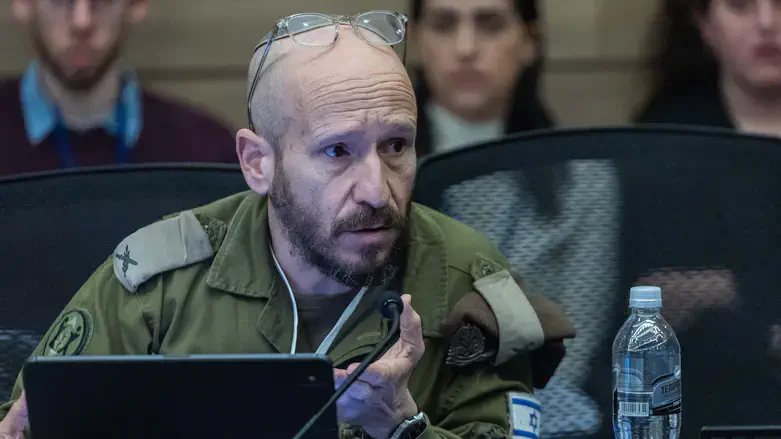
Brig. Gen. Shay Taib, head of the IDF’s Manpower Planning and Management Division, warned Sunday that the targets plan included in the proposed haredi conscription bill falls short of meeting the military’s operational needs in the near future.
Speaking at a hearing of the Knesset Foreign Affairs and Defense Committee, Taib said that IDF assessments show no meaningful increase in manpower under the current outline over the next two years. “From the moment the plan was presented, we have been running calculations. Looking ahead from the passage of the law until mid-2027, the figure remains 8,160,” he said. Even if implementation proceeds smoothly, he added, only up to 35% of those enlisting are expected to be suitable for combat roles.
Taib noted that combat enlistment rates among the haredi public are significantly lower than in the general population. “In the general public, 45% of men enlist for combat service. In the haredi public, the situation is more complex due to age distribution, and reaching 35% is very difficult,” he said.
Outlining a possible scenario, Taib estimated that around 10,000 people could enlist over the next two years, including approximately 2,200 who already enlist annually through existing channels. This would translate to about 1,500 additional enlistees per year. “At best, this could stabilize current haredi plans and create the equivalent of two Hashmonaim battalions,” he said. “But even then, the answer to whether the proposed targets will meet the IDF’s needs in the next two years is no - far from it.”
Taib added that even with full, gradual implementation of the plan, the numbers projected by 2030 would amount to roughly the size of one full brigade. “That still would not replace the reserves if the operational model remains as it is today,” he warned.
He stressed that meeting combat targets depends not only on numbers but also on the quality and suitability of recruits. “To reach 35% combatants, we must ensure those arriving are fit for combat service. Without proper screening, I cannot guarantee they can be trained as combat soldiers,” Taib said.
To address this, Taib outlined three possible approaches: counting only confirmed combatants toward targets, guaranteeing a defined percentage of recruits who are fit for combat in terms of medical and service profiles, or setting age-based targets. Under the age-based model, he said, the IDF estimates it would need 50% of enlistees to be under 21 and 75% under 23 to meet operational requirements.