

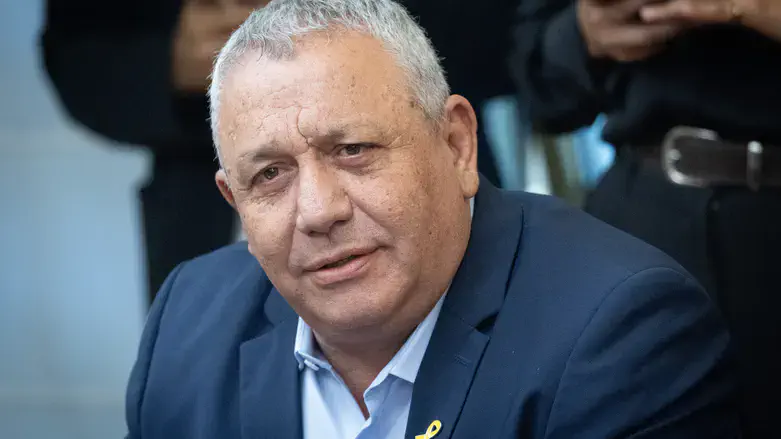
Chairman of the "Yashar!" party, Gadi Eisenkot, was interviewed on Channel 12 News on Saturday night and hinted at the possibility of forming a narrow government with the support of Arab parties.
"I think Netanyahu, after everything he has done, still reaches a coalition of 52 to 53 seats and is now moving toward a blocking bloc," Eisenkot said in the interview, referring to the political map. "If he believed the polls on Channel 14, he would already be rushing to elections."
Regarding the opposition, Eisenkot said he does not believe it is gradually losing strength in the polls, noting it currently stands "at a stable position of 57 to 58 seats." He added, with a further hint, "If that’s where it ends, a political solution can be found." Eisenkot refrained from elaborating but clarified, "You need 63 seats to build a national Zionist government. That is the goal."
MK Benny Gantz responded, "Gadi, my friend, we’ve already been in that movie of trying to swear in a minority government. It wasn’t realistic then, and it’s even less realistic after October 7. What Israel needs, as you said, is a broad Zionist government of 70 MKs, not a transitional government dependent on Arab parties, which would bring upon us Ben Gvir with 20 seats."
Likud issued a statement in response: "The dangerous alliance: the opposition is once again joining forces with the Muslim Brotherhood. Eisenkot tonight exposed the opposition’s real plan - relying on the Muslim Brotherhood and anti-Zionist Arab parties to form the next government. Whether they join the government or support it from outside, such a government would once again be dependent on the Muslim Brotherhood."
"The opposition is repeating the same dangerous pattern - a political alliance with elements undermining the foundations of the State of Israel. It seems the opposition has not internalized the lessons of October 7."
Eisenkot also addressed MK Boaz Bismuth’s Draft Law during the interview. "I received the draft a week ago and summoned myself to the Foreign Affairs and Defense Committee. I was horrified by what I saw. They presented delusional goals, claiming the aim is to reduce the burden of service and strengthen Torah study. The goal must be one - to strengthen the IDF’s mission to defend the state and win wars."
"Beyond that, they are presenting a law that is one big bluff. It won’t bring soldiers," he continued. "Politicians caused the great damage 48 years ago, and politicians must fix it. To fix it, the law must mandate service for all - military, national, or civilian. The exemption from rabbis must be returned to the state. Those who serve must be rewarded and honored, and those who evade must be punished."
Nevertheless, Eisenkot said that "out of great respect for the world of Torah," 3 percent per year should be allowed to continue Torah study. Still, he warned, "What is currently on the table weakens the IDF at its most difficult hour, when it needs 12,000 soldiers. We are heading into years of very tough emergency routine, and I don’t see this government caring. I think it’s a threat to the people’s army and to the future of the state if the law Bismuth proposes is adopted."
Eisenkot also commented on a one-million-shekel lawsuit he filed against Channel 14. "I’m doing this for the first time in my life," he said. "The reason is harm to my good name, to my reputation, in order to damage me politically and strengthen someone else."
He added that Channel 14’s claim that he was chairman of an energy storage company and inflated its value is "a lie and slander." He continued, "This is a channel that lies every day about many things - about downsizing the army, about Qatari money. This time they messed with the wrong person." When asked what he would do with the money, he said he intends to donate it to an organization for disabled IDF veterans.
Later in the night, Eisenkot responded to the uproar caused by his remarks and criticized Prime Minister Benjamin Netanyahu.
He claimed that Netanyahu supported the idea of two states for two peoples, preferred Hamas rule in Gaza for years, and worked to recruit Arab Knesset members to pass the Draft Law. He further accused him of leading Israel into “the severe rift that brought about the worst failure since the establishment of the state.”
Eisenkot emphasized that, in his view, there is no “secret plan” but rather “a clear plan that will guarantee Israel’s future as a Jewish and democratic, secure and prosperous state.” This includes replacing the current government with “a clear Zionist majority” and forming “a coalition of those who love the state, serve it, and are its true patriots.”