

In the realm of counter-insurgency, terminology is rarely accidental. When Basem Naim, a senior member of Hamas’s political bureau, told the Associated Press on December 7 that his organization is willing to "freeze or store" its weapons, he was not offering a concession. He was articulating a doctrine of force preservation.
For Western policymakers eager to unlock "Phase 2" of the stabilization process, Naim’s overture appears to be a breakthrough-a signal that the group is transitioning from a governing military power to a political entity. However, a rigorous analysis of this proposal reveals it for what it is: a strategic maneuver designed to replicate the "Hezbollah Model" in Gaza.
The distinction between true disarmament-known in UN parlance as DDR (Disarmament, Demobilization, and Reintegration)-and "storage" is the difference between ending a war and suspending it. By proposing to cache their arsenal under "Palestinian guarantees" rather than surrender it for destruction, Hamas is seeking to institutionalize the very "strategic ambiguity" that allowed Hezbollah to effectively annex southern Lebanon despite the presence of UNIFIL.
We must look to the precedent of UN Resolution 1701 (2006) to understand the mechanics of this trap. The resolution was predicated on the assumption that if Hezbollah’s weapons were not visible south of the Litani River, they did not exist. Hezbollah complied by moving its infrastructure from above-ground launchpads to subterranean bunkers and "nature reserves," effectively shifting from an overt militia to a covert stay-behind force.
Naim’s proposal of a five-to-ten-year truce based on "storage" is a direct appeal to this failed paradigm. It relies on a "passive enforcement" model where international observers verify the absence of open carry, while the capability to wage war remains intact in hardened, subterranean caches.
If accepted, this model would convert Gaza’s terror infrastructure into a latent asset, shielded by diplomatic agreements. The weapons would not degrade; they would be preserved in a state of operational readiness, immune to IDF interdiction because any strike on a "stored" site would be framed as a violation of the truce.
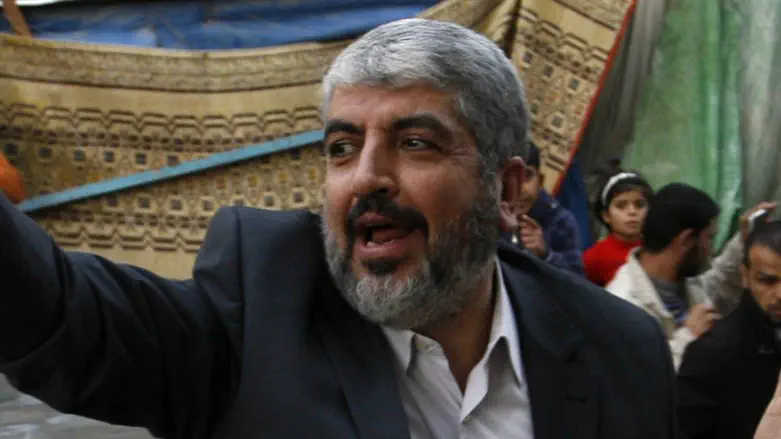
The danger is compounded by the coordinated diplomatic decoupling currently visible within Hamas’s leadership. While Naim engages Western interlocutors with the language of pragmatism in Doha, Khaled Mashal’s December 6 address in Istanbul outlined the group’s true strategic intent. Mashal’s explicit rejection of "international trusteeship" and his framing of weaponry as a "holy right" serves two purposes: it maintains the ideological cohesion of the base, and it creates a negotiation floor where "storage" is sold to the West as the only viable compromise between total war and impossible surrender.
This is not confusion; it is a synchronized effort to separate the political timeline from the military reality. Naim buys the time; Mashal keeps the gun.
The crux of Hamas’s strategy is to use the "storage" offer as leverage to dismantle Israel’s operational control over the "Yellow Line"-the de facto security perimeter and segmentation corridors like Netzarim.
It is crucial to understand that the Yellow Line is not merely a border; it is a filtration mechanism. In a theater as dense as Gaza, preventing re-armament requires total control over the flow of dual-use materials and the segmentation of the territory to prevent the movement of cached assets.
If Israel accepts a "storage" deal, the operational logic for the Yellow Line collapses. The IDF would be forced to withdraw to the pre-October 7 perimeter, ceding the internal battlespace back to Hamas’s "civilian" administration. Without the ability to physically inspect and interdict within the Strip, the "stored" weapons would inevitably be unlocked, serviced, and eventually used.
The United States and its partners must reject the "storage" framework entirely. Aceasefire that leaves the enemy’s order of battle intact is a strategic failure.
-Meaningful stabilization requires an Active Kinetic Disarmament regime, not a passive monitoring mission.
-This necessitates the verified destruction of infrastructure-the structural collapse of tunnels and the public demolition of rocket stockpiles-rather than their mere sealing or warehousing.
-Furthermore, any viable agreement must mandate intrusive, "anytime, anywhere" inspections by a force willing to engage kinetically if access is denied-a capability UNIFIL famously lacks.
-Finally, policy must explicitly reject any "dual-status" framework that allows Hamas members to "retire" into a civil administration while maintaining access to cached weaponry.
Amine Ayoub, a fellow at the Middle East Forum, is a policy analyst and writer based in Morocco. Follow him on X: @amineayoubx