
The 19th of Kislev is often called the "New Year for Hassidism," but it is also a landmark for Religious Zionism in the State of Israel. A story in three parts.
The history is inspiring and depressing in equal parts. And inescapably relevant for our times. As we will say on Hanukkah next week: בַּיָּמִים הָהֵם בַּזְּמַן הַזֶּה - in those days, at this time.
Our story begins in the early 18th century, when Rabbi Yisrael Ba’al Shem Tov, "the Master of the Good Name", began to revolutionise Judaism with his teachings of Hassidism: that every Jew has a personal, intimate, direct, indeed desperate connexion with G-d; that fervour in service of G-d is a form of prayer; that a Jew serves G-d through song and dance and rejoicing no less than by prayer; that what a Jew feels is more important than what he knows intellectually; that to serve G-d, a Jew must yearn for Him with every fibre of his being.
The Ba’al Shem Tov’s teachings took the Jewish world by storm, spreading like a fire through a field of dry grass. Within a generation, half of European Jewry would have been ignited by his spiritual revolution.
Among the Ba’al Shem Tov’s earliest disciples was Rabbi Dov-Ber, born in Volhynia in 1704. Originally and ardent opponent of this new theology of Hassidism, he became one of its greatest acolytes and proponents after meeting the Ba’al Shem Tov. Having absorbed his teachings, Rabbi Dov-Ber quickly became an acknowledged Rebbe, a master in his own right, universally known and revered as the Maggid (wandering preacher) of Mezeritch.
A generation later, when another great Master, Rebbe Levi Yitzchak of Berditchev (1740-1809), was asked: “What great new teaching did you learn at the Yeshiva of the Maggid of Mezeritch?”, he answered: “I discovered that G-d exists, that He is of this world, of all worlds”.
His disciples were puzzled, and asked him: “Rebbe, surely everyone knows this!”
“No”, retorted Rebbe Levi Yitzchak. “Everywhere they say it - but in Mezeritch they know it!”.
The Maggid of Mezeritch, who continued the Ba’al Shem Tov’s mission, fell sick shortly after Rosh Hashanah 5533 (October 1772). On 18th Kislev (14th December) of that year he called the members of the Hevra Kadisha (“Holy Society”, the Burial Society) to his sick-bed, bidding them to stay united at all times: “And if you do”, he told them, “you will never be defeated, you will overcome all your enemies”.
The next day, Tuesday 19th Kislev, he returned his soul to its Maker. The era of the Ba’al Shem Tov had ended, and a new era had begun.
Hence the 19th of Kislev became Rosh Hashanah for Hassidism.
One of the greatest Masters of all, Rebbe Shneur Zalman of Liadi, was born on 18th Ellul 5505 (4th September 1745) - the same date that the Ba’al Shem Tov had been born 45 years (maybe 47 years) earlier.
Rebbe Shneur Zalman would found Chabad-Lubavitch in 5533 (1773): Chabad, the acronym of Chochmah (Wisdom), Binah (Understanding), and Da’at (Knowledge), the first of the ten “Emanations”, characteristics or dispositions which define human character.
Rebbe Shneur Zalman would earn renown as author of the Tanya - the most central and fundamental word of Hassidism, among the most important works of Judaism. He is today known as the Ba’al ha-Tanya, literally “the Master of the Tanya”, more idiomatically the Author of the Tanya. Although Rebbe Shneur Zalman never claimed to be the author of the Tanya: in his great humility, he claimed only to be the melaket (“compiler”), having drawn on the wisdom of the Masters who preceded him.
Within the ranks of Chabad, Rebbe Shneur Zalman is often called simply the Alter Rebbe - the Oldest Rebbe, recognising his status as the founder of the Chabad Dynasty.
After the death of Rabbi Dov-Ber, Hassidism’s mission fell upon several Masters of the new generation. Each one in his direction, each one in his community, each one to his place, each one to his intended disciples.
Rebbe Shneur Zalman had the hardest mission of them all: to bring Hassidism to Lithuania, the fortress of the Mitnagdim, the opponents of Hassidism, led by Rabbi Eliyahu ben Shlomo Zalman, the Ga’on (Genius) of Vilna.
In the early years Rebbe Shneur Zalman wasn’t alone: he ventured to Lithuania with his friend and colleague Rebbe Menachem Mendel of Vitebsk, the talmid muvhak (closest disciple) of the Maggid of Mezeritch. But in 5537 (1777), Rebbe Menachem Mendel and Rebbe Avraham Kalisker (another close disciple of the Maggid of Mezeritch), together with 300 followers, made Aliyah and settled in Tzfat (Safed) in the Galilee, in the north of Israel, which was then part of the Turkish Ottoman Empire.
Interestingly, hundreds of the Vilna Ga’on’s disciples made Aliyah to Israel at about the same time. The Land of Israel united Hassidim and Mitnagdim in common cause.
Rebbe Shneur Zalman devoted much of his energies to raising funds for his disciples in Israel: life was hard for everyone under Islamic colonialist occupation, harder yet for Jews. The entire country was existing on the meagrest subsistence farming, famine an ever-present threat; marauding Bedouin struck wherever and whenever they wanted, pillaging almost at will in this slovenly-governed colony of the Islamic Empire.
Added to these ubiquitous hardships was the Muslim persecution of the Jews: in 1783 the Turkish imperialist government expelled all the Jews from Tzfat, so Rebbe Menachem Mendel and his disciples relocated to T’veriyah (Tiberias), another of Judaism’s four Holy Cities, also in the Galilee.
Meanwhile in Europe, hostility to Hassidism was growing, and in 5558 (1798), a rabbi from Pinsk - apparently a prominent and influential rabbi - denounced Rebbe Shneur Zalman to the Russian authorities. Pinsk was part of the Russian Empire, and this “rabbi” decided to exploit the traditional anti-Semitism of the Czarist royalty and the Russian Orthodox Church to combat Hassidism.
The charges that this “rabbi” levelled against Rebbe Shneur Zalman were that he was sending money to the Turkish Ottoman Empire, which was an enemy of the Russian Empire (and would remain so until the First World War in which both Empires would collapse); that he was a heretic by introducing new ideas to Judaism; and that he was undermining Judaism by encouraging his disciples to spend so many hours in prayer that they had little time left to study.
The first of these charges is outrageous; the second and third sound absurd. After all, what business was it of the Russian Government how Jews believed and practiced their faith?!
Nevertheless Rebbe Shneur Zalman was arrested and imprisoned in St Petersburg, then the capital of the Russian Empire (the capital would be moved to Moscow with the Communist Revolution in 1917).
Rebbe Shneur Zalman answered the first charge with unflinching honesty: Yes he was sending money to Jews living in a province of the Turkish Ottoman Empire, but not to the Ottoman authorities.
Rebbe Shneur Zalman explained to his interrogators the situation that his disciples faced in Israel, and that the funds he was sending to them was for them personally. The Turkish Empire derived no benefit whatsoever from these funds.
Indeed, the Turks who occupied Israel regarded all the Jews with deep suspicion and hostility - and all the more so Jews from Russia, whom they suspected of being Russian agents.
Rebbe Shneur Zalman completely turned the tables, showing how Turkey was the common enemy of the Jews and the Russians.
As for the charges of heresy against Judaism - Rebbe Shneur Zalman patiently explained both Judaism and the Hassidic interpretation to his interrogators, disposing of those suspicions as well.
At some stage, Czar Paul I himself decided to test Rebbe Shneur Zalman’s loyalty to Russia. Dressed as a regular peasant, he had himself led into the same cell, as though a common prisoner. Rebbe Shneur Zalman immediately stood up, honouring this new “prisoner”.
The Czar, still playing the role of arrested peasant, asked the Rebbe why he rose to greet him, and the Rebbe explained: Everything that happens in this world is a reflection of the Higher World. He, the Rebbe, was so intimately connected with the Upper World, with the supreme King of kings, that he recognised royalty in this lower world, even when concealed.
The Czar was so impressed and moved by the Rebbe’s perceptiveness and honour to his own royal person that he ordered that the Rebbe be exonerated and released.
He was released on the 19th of Kislev and rejoined his disciples. Hassidism, and especially Chabad, have celebrated the 19th of Kislev every year since.
On his release, the Rebbe invoked the verse: “He redeemed my soul in peace from approaching battles, for the sake of the many who were with me” (Psalms 55:19), implicitly giving recognition to the uncountable Jews who had supported him during his incarceration.
בַּיָּמִים הָהֵם בַּזְּמַן הַזֶּה - in those days, at this time. How little has changed in the intervening centuries.
More than two-and-a-quarter centuries ago, the Jewish world was grappling with internal debate. This was nothing new: the Talmud is saturated with debates between different Sages. We are perfectly capable of maintaining our unity even while disagreeing among ourselves.
Until some “rabbi” from Pinsk decided to bring in the Czarist authorities to slander his fellow-Jews. And worse yet - to use Rebbe Shneur Zalman’s support for Jews in the Land of Israel for that slander.
Sounds familiar? - How many self-professed “anti-Zionist Jews” run to the most viciously anti-Semitic elements to denounce their fellow-Jews in Israel? How many has-been IDF officers and government figures will go anywhere and say anything to be in the limelight?
For sure, there are legitimate criticisms of Israel, of the policies of Israeli Governments.
There are even ostensibly legitimate Torah-arguments against Zionism per se. Those arguments are wrong - but Jews have the right to be wrong. Groups such as Satmar believe that we are forbidden to return to Israel before Mashiach comes. They’re wrong, those arguments rely upon misinterpretations - but again, they have the right to be wrong.
It is not groups whose ideology differs with Zionism, but those who go farther and make alliances with the most vicious anti-Semites, march with open neo-Nazis, and collaborate with Iran, groups like Neturei Kharta who become openly treasonous.
There is no end to Jew-hatred in the world, amplified beyond all reason in the echo-chamber of social media. And it is sickening beyond description to see how these Jew-haters draw their inspiration from Neturei Kharta and their fellow-misfits.
It is instructive to look at the Jew-haters of today, who disguise their hatred as “anti-Zionism”, as if they hate only Jews who live in Israel. They preach to us that our Talmud forbids us to establish a Jewish state before the Messiah comes - a distortion which they learn from Jewish traitors and misfits like Neturei Kharta.
As if those Jew-haters care about Judaism, as if they have even the slightest idea of what the Talmud is. But they can still draw their inspiration and their pathetic attempts at legitimacy from their anti-Zionist Jewish collaborators and radical Jewish leftists.
But as in those days, so too at this time. All of Jewish history, from Abraham our father’s struggle against idolatry and tyranny until today, is an unequivocal guarantee that good will prevail.
Just as the name of this “rabbi” from Pinsk has been lost to history, just as his collaboration with the Czarist government was doomed to fail, so too with all those who collaborate with our enemies today in their desperate attempt to thwart our return to Zion: they are doomed to fail, and we will rebuild the Land of Israel.
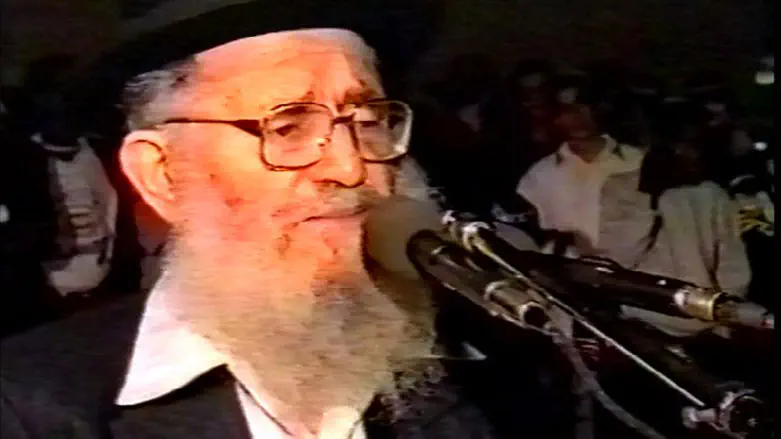
And part three - the yahrzeit of one of the greatest of these builders, Rabbi Moshe-Zvi Neria, also falls on the 19th of Kislev. A memorial day for this 30th yahrzeit is to be held at Kfar Haroeh today.
The World Bnai Akiva website tells us about this larger-than-life Torah sage:
Rabbi Moshe-Zvi Neria (Hebrew: משה צבי נריה) was an educator, writer, rosh yeshiva, and Knesset member. Rabbi Neria established and headed the Bnei Akiva yeshiva in Kfar Haroeh, and was one of Rabbi Abraham Isaac Kook's most influential disciples. Due to his far-reaching influence on Religious Zionism, he is known as "the father of the kippah sruga generation."
Born in Łódź in the Russian Empire (today in Poland), Rabbi Neria was educated at yeshivot in Minsk and Shkloŭ. He made Aliyah in 1930, and studied at the Merkaz HaRav Yeshiva with Rabbi Abraham Isaac Kook, receiving certification as a rabbi.
He helped establish the Bnei Akiva youth movement, and edited its publication Zra'im. In 1940 he established the first Bnei Akiva yeshiva in Kfar Haroeh, serving as its headmaster and teaching Talmud and Jewish thought. He later established several yeshiva high schools and Hesder yeshivas for IDF soldiers. In addition, he founded the Hapoel HaMizrachi Rabbinical Association. In 1969 he was elected to the Knesset on the National Religious Party list for one term. He left the party in 1983 to establish the Religious Zionist Camp (also known as Mazad).
Rabbi Neria died on the 19th of Kislev, 5756 (1995), at the age of 82. Rabbi Neria and his wife Rachel had eight children.
His last words were:
"Give me kedushah (holiness), it is kedushah that I seek! The holiness of the Land of Israel, the holiness of the love of Israel, the holiness of the Nation of Israel."
May we continue in his path of light - leoro nelech.