
Tzvi Fishman co-authored this article.
Merkaz HaRav Yeshiva’s Centennial Celebration - two years late:
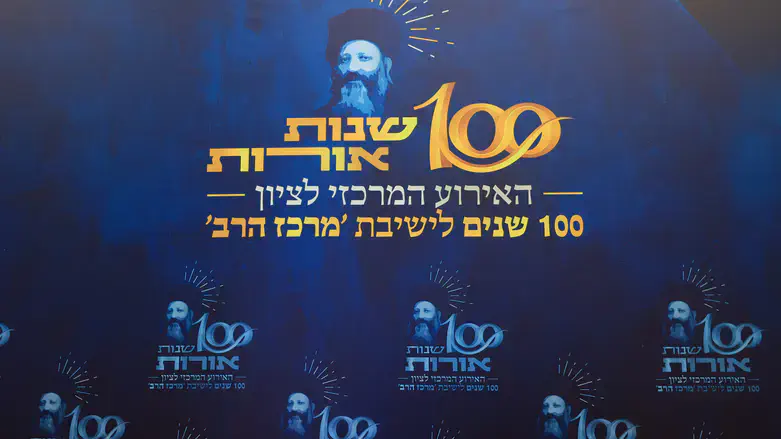
The centennial evening honoring Merkaz Harav, the flagshipyeshiva of Religious Zionism, took place last week during the yeshiva’s 102nd anniversary year and not, as planned, at the start of its 100th. One of the yeshiva's guiding principles is that the defense of the Jewish State is a mitzva and that meant that many of its students and alumni spent hundreds of days in active IDF service over the past two years of war and would not have been able to attend had the evening been held on time.
Full Disclosure: On October 7th, 2023, I was davening shacharit at the yeshiva, anticipating the joyful hours ahead watching as rabbis would be called up for each hakafa and hold the Torah Scrolls close to their hearts as they circled the bimah in the innermost ring of concentric circles made up of hundreds of singing and dancing men and boys. Suddenly, however, sirens sounded, and down in the shelters to which we went in orderly fashion, we watched in shock as minute by minute, more and more of the talmidim disappeared - in response to army callups, as we later found out.
And last week, two years later, thousands of rabbis, alumni and students filled the Jerusalem Convention Hall auditorium, first enjoying an informal hour during which the alumni who travelled from all over the country met old friends and former Ra’mim (Gemara teachers), exchanged memories and reconnected.
The evening’s program began with an unforgettable film of rare footage depicting the late Rabbi Avraham Kook, his son HaRav Tzvi Yehuda, HaRav haNazir, HaRav Yisraeli, HaRav Charlap, Rav Avraham Elkana Shapira and others- a hundred years of a yeshiva filled with illustrious Torah luminaries whose holy presence and enlightening shiurim enriched the students' long hours of intensive learning, laying the foundation for the spiritual growth of Religious Zionism, guided by the leaders of the Torah of Eretz Yisrael.
Alumnus Rabbi Hillel Horwitz switched his army uniform for a suit and emceed along with Channel 14's Oded Harush, introducing the state-of-the-art multimedia presentation depicting the yeshiva and its alumni’s impressive accomplishments in building the spiritual and educational world throughout Israel over the past hundred years, in establishing other yeshivas, new communities, social welfare endeavors and more.
Merkaz HaRav Alumni make their mark in Israeli society:
It was Merkaz HaRav alumni who founded Beit El and the Beit El Yeshiva - Rosh Yeshiva Rabbi Zalman Melamed shlita, a close talmid of Rav Tzvi Yehuda, attended and filmed a message, - and it was alumnus Rav Moshe Tzvi Nerya zt"l who established the Bnai Akiva Yeshiva and Ulpena network. Alumni founded other institutions such as Yeshivat Hagolan, the Morasha Talmud Torah, the Noam-Tzvia school network, the Yeshiva Letze’irim high school (whose choir peformed Rav Kook’s famous song “Ben Adam”), even Arutz Sheva, initiated the awareness campaigns for annexing the Golan (Ha'am im Hagolan) and staying in Hevron (Chevron Ir Haavot) and much much more.
It is Merkaz HaRav alumni who are leading members of Garinim Toraniyim (Torah outreach communities in development towns), who have attained high ranking IDF positions and have made their mark in many other fields. General (res.) and former MK Effie Eitam, Finance Minister Bezalel Smotrich, actor and playwright Hagai Luber were some of the well known alumni who took part in the evening.
Photo: Front row l. to r.Rav Eitan Eisman, Rav Yochanan Fried, Rav Yaakov Ariel, Rav Yaakov Shapira, (empty seats awaiting Chief Rabbis), Rav Zalman Melamed and behind him in 2nd row Min. Bezalel Smotrich
Also attending were Israel’s two Chief Rabbis, Jerusalem’s Mayor Moshe Lion and other celebrities, while Prime Minister Netanyahu and President Herzog sent filmed greetings. Throughout the evening, Avraham Fried and Akiva Margolis had the current yeshiva students who filled the balcony jumping up and down in song, and once the program was over, dancing in the aisles, bringing the older participants to their feet as well.
Woven tightly into the fabric of the yeshiva’s history is its part in the sacrifices the people of Israel have made to reestablish a Jewish homeland. The 90 alumni of the yeshiva who sacrificed their lives in battle and terror attacks were memorialized as the audience sat in utter silence while their pictures and names, along with the date each one fell, were shown one after another in the presentation, along with the pictures of the eight young men murdered in the tragic 2008 Merkaz HaRav massacre on Erev Rosh Chodesh Adar.
Rosh Yeshiva Rav Yaakov Shapira Shlita, thanked Hakadosh Baruch Hu, for the yeshiva’s growth and success.
Numbering 30 students in its early years, it now has close to 700 talmidim, with the plans for expansion and renewal of its current inadequate premises authorized and waiting for implementation.
What led to the miraculous growth and spiritual guidance felt in so many spheres of Israeli endeavors? It all began with Rav Kook’s unique, all-encompassing Torah outlook based on the return to Eretz Yisrael in contrast to the Torah of exile. Read about it here:
A brief history:
From the time he arrived in the Holy Land in 1905, Rabbi Avraham Yitzchak HaCohen Kook pondereda matter which gave him no rest. He felt that at the time of the Jewish People’s revival in Eretz Yisrael, there was a pressing need to establish a Central Universal Yeshiva in Jerusalem, in order to restore the crown of Torat Eretz Yisrael to its former glory.
In announcing the founding of the yeshiva, Rabbi Kook called upon prospective students to rise up to “a life of creativity.” He said that students of Torah, the building blocks of the Nation, were called upon to seize the powerful forces of life and creativity being released in the great awakening to Redemption inherent in the return of the Israelite Nation to its Land, “the Land of life.”
He wrote that the Central Universal Yeshiva in Jerusalem would rise to the challenge by returning the learning to the sources in the Torah which predicted this national rebirth and the new light of Geula destined to shine on Zion.
Rabbi Kook began to establish his new yeshiva, appointing Rabbi Yaakov Moshe Charlap, Rabbi David Cohen (known as HaRav HaNazir), Rabbi Yitzchak Azieli, and Rabbi Shalom Natan Ra’anan to stand at it helm. His only son, HaRav Tzvi Yehuda would come aboard later, eventually becoming the Rosh Yeshivaafter the deaths of his father and Rabbi Charlop. The Rabbanit Reiza Rivkah Kook volunteered to run the dining room and kitchen.
In his writings, Rabbi Kook indicated that a distinguishing feature of the yeshiva, known as MercazHaRav today alluding to its founder who his talmidim called "HaRav", would be to emphasize the areas of study which would uplift the Nation to a more universal vision of Israel’s role in the world. This study of what he called “the inner Torah,” would infuse the Nation with the understandings needed to weather the stormy spiritual forces inherent in the time of the “Birth pangs of Mashiach.” This deeper learning, along with the study of Emunah, were the keys to revitalizing the true understanding of Torah which was distorted by almost two-thousand years of exile in foreign and spiritually polluted lands.
Rabbi Kook declared that we should return tolearning Emunah, Mussar, and all the inner spiritual branches of the Torahthat had been neglected in the Exile. He emphasized that all the problems and difficulties of our times stem from the neglect of this learning, and that its renewal is the root of the remedy for all our generation’s ills. This course of study must be steady and systemized without setting it aside for even a day.
The Torah of Eretz Yisrael:
In a letter he writes:
“Things which stand at the apex of the world in the matter of knowing the Name of G-d, Blessed Be He, and in the depths of the spiritual realms of the Torah… were very neglected, to the great sorrow of all those who love G-d’s Name, and who love His Nation and His Heritage in TRUTH; this neglect, this is the source of all of our ruin. In our return to it, to these spiritual wells, He will shine His light and salvation upon us, and a NEW LIGHT ON ZION shall appear…
“If it were in my power, I would not stop, even for a moment, to cry out in a loud voice to every servant of Hashem, who is faithful to His Covenant, to all the Sages of Torah, especially those to dwell in our Holy Land, to hasten with great strength and valor …to return to this abandoned portion of the Torah, which is the edifice of our life, for precisely in it, and because of it, there will be watered each “Tree of Life” of the entire gamut of the learning of Torah and its observance and, out from this, the service of G-d. All the length and lowliness of the Exile is solely because we turned the Torah into a parched land….
“And this will be the beginning, awakening the sound of the Great Shofar to bring the lost and scattered from Ashur and Mitzrayim to bow down to Hashem on the Holy Mountain in Jerusalem (a verse from the prophets, ed.). And out of this strengthening of the encompassing spirit of the Nation to the heights of holiness and wisdom… there will come an influx of wisdom, dressed in a clear language and a revitalized literature, encompassing and cherished, penetrating every aspect of life and society, so that everyone will honor it and succumb before the splendor of its richness, its truth, and its mighty prowess… for even the betterment of the material side of the lives of the Torah Sages in Eretz Yisrael, and of the general material life of Eretz Yisrael itself, and the material life of all the Nation, on this matter it all depends” (Letters of Rabbi Kook, Part 1, Letter 95).
It is important to emphasize that while Rabbi Kook believed that the time had arrived to open the treasure chests of the inner Torah in order to illuminate the path to Redemption, the major focus of yeshiva learning was still to be the mastery of the Talmud and the Halakhah. He himself dedicated a large portion of his own writings toa multi-volume commentary on the Talmud, which he called the HalachahBerurah, which cites the final Halakhic decisionon every Talmudic discussion, as codified by the Rambam and the ShulchanAruch. His outlook on a proper course of required learning can be seen in this excerpt from a letter to his son in yeshiva:
“Strengthen yourself, my dear son...You should learn every Talmudic passage with the proper measure of precision. First learn it with the commentaries of Rashi and Tosafot, followed by the Rosh and the Rif (and the commentaries written on his work). After that, see what the poskim (Halakhic authorities) have to say on the matter at hand: i.e., the Rambam and the Shulchan Aruch, along with the commentaries written on their works. When learning with young students, make sure to mention, as much as possible, the varying opinions [on each issue], as well as the major ramifications that result from them. In addition, it would be very beneficial to study the relevant passages in the Vilna Gaon’s gloss on the Shulchan Aruch. It would also be a good idea to get into the habit of writing a summary of the Talmudic discussion, along with its varying interpretations, even without any novel insights. And if you do come up with such insights (as I hope you will, with God’s help), you should certainly write them down. If your students are advanced enough, you should certainly familiarize them with expositions on lofty concepts and endow them with a refined sense of holiness, a love for spiritual knowledge in the light of the Torah, and a holy mindfulness".
(Letter translated by Rabbi Moshe D. Lichtman, from the biography, “An Angel Among Men.”)
Rabbi Kook believed that a Torah scholar should strive for a mastery of all branches of Torah, both the revealed and the esoteric, the Peshat, Remez, Drash, and Sod. Throughout a substantial portion of his writings, he stressed the necessity of learning the secrets of Torah at the time of Israel’s Redemption. His thoughts and discourses on the inner wisdom of the Torah can be found in his Letters, and in his books, Orot, Orot HaTorah,Orot HaT’shuva, ShemonaPrachim, and in his four volumes exploring the mystic dimension and inner life of the soul, Orot HaKodesh.
“The revelation of the secrets of Torah in the last generation, in order to purify the hearts and to fill the minds with noble thoughts, whose source lies in the secrets of Torah, this is an absolute necessity in the last generation to insure the survival of Judaism” (Orot HaKodesh, Part 1, Pg. 141).
"The Great Call:"
“Dear brothers, Sages of Torah, and influential scholars! We too acted foolishly and sinned! We studied and researched the sources; we debated the fine points of the Talmud and discovered new insights; we wrote and explained; but we forgot Hashem and His might. We failed to hear the words of the true prophets, the exalted voice of our eternal sages, to hear the voice of the Tzaddikim (righteous ones) and Hasidim (saintly ones), the sages of Mussar, and the possessors of the secrets of Torah, who called out and proclaimed in the most strident of voices, that in the end, the river of Talmudic analysis would turn arid and dry if the deep ocean of Kabbalah, and the Torah’s inner understandings, weren’t constantly drawn into the learning - the waters of the knowledge of Hashem, the pristine waters of pure faith which flows from our inner souls, and which stream forth from our life source,” (Orot, pg. 101).
Elsewhere in the book Orot, Rabbi Kook writes:
“The secrets of Torah bring the Redemption and return Israel to its Land, because the Torah of truth in its mighty inner logic demands the complete soul of the Nation. Through this inner Torah, the Nation begins to feel the pain of Exile and to realize the absolute impossibility for its character to fulfill its potential as long as it is oppressed on foreign soil. As long as the light of the supernal Torah is sealed and bound, the inner need to return to Zion will not stir itself with deep faith.”
The vital importance of this “new” type of yeshiva learning was reasserted by the teachings of HaRav Tzvi Yehuda Kook regarding the uniqueness of the Mercaz HaRav Yeshiva when he served as Rosh Yeshiva. Sometimes visitors to the yeshiva wrote that the essential distinguishing innovation at the yeshiva was that it is was a Zionist yeshiva which recognized the value of the State of Israel in the Redemption of our Nation. However, HaRav Tzvi Yehuda was wont to answer that the great innovation was the learning of Emunah, adding that it wasn’t enough to dance and sing “Ani Maamin” (I believe) but rather one has to learn what “ani maamin” really means.
Each year, he would address new students with this explanation:
“Among every new class of students who come to our yeshiva, there are those who ask, ‘What is Mercaz HaRav?’ What is the special innovation of the yeshiva? They aren’t referring to innovations in the field of Halakha, but to the ‘chidush’ in the course of learning... In addition to the learning of Gemara and Halakha, the true learning of Torah also demands the learning of Emunah... Emunah demands study. We must learn and strengthen within our souls the foundations of our faith and belief, until its knowledge and complete understanding fill all of our being, in every breath of our lives, and out from this inner absorption it will be revealed in our feelings, our intellectual expression, and all the rest of our senses” (See “Torat Eretz Yisrael Anthology” Ch. 1, article by Rabbi Moshe Bleicher).
It is this study of Emunah that led the students of the yeshiva to reach new heights of Torah study, take an active part in raising the spiritual level of the Land of Israel, to accept all Jews with love, and going forth to its defense.
(These matters as well as a comprehensive overview of Rabbi Kook’s revolution in Torah education are set forth in the new “Torat Eretz Yisrael Anthology” published in honor of the hundred-year anniversary of the Mercaz HaRav Yeshiva, now available in bookstores in Israel and coming to Amazon shortly.)