

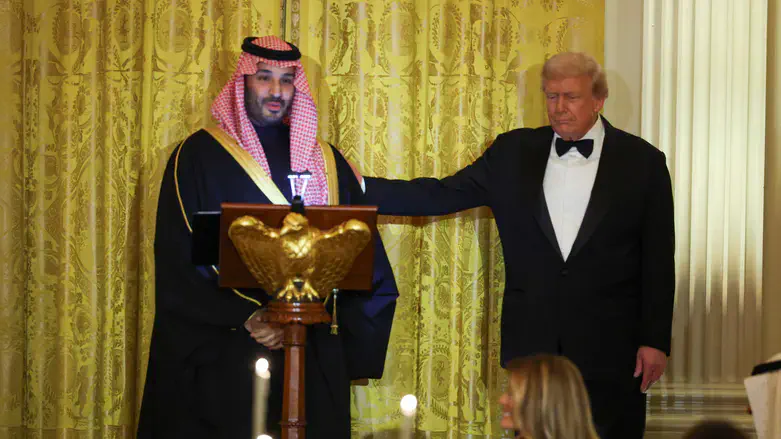
The return of Saudi Crown Prince Mohammed bin Salman (MBS) to Washington-his first visit in seven years-was not a goodwill tour. It was the purest demonstration of Saudi Arabia’s new foreign policy doctrine: transactional leverage.
The central question for the Jewish state is whether MBS is genuinely invested in a viable "Palestinian" Arab state or if he is simply using the cause to extract maximum concessions, potentially compromising Israel's indispensable security requirements. From Jerusalem's perspective, the Crown Prince has brilliantly fused his strategic goals, treating the "Palestinian" Arab issue not as a foundation for genuine peace, but as a political key to unlock maximum national security and economic demands from the global community-demands that could fundamentally threaten Israeli defense posture.
MBS cares about the role of the Kingdom of Saudi Arabia (KSA) in Islam insofar as that role provides the strategic legitimacy required to execute his grand plan for national power and modernization, irrespective of the security consequences for Israel.
The True Price of Normalization: A Security Compromise?
The core agenda of the Washington summit centered on securing hard, transactional gains for Vision 2030 and Saudi national interests.
MBS seeks unprecedented diplomatic and technological concessions: formal support for a civilian nuclear program, access to advanced AI chips, and securing massive commercial deals.
These are the non-negotiable prizes. The "Palestinian" Arab cause, therefore, functions as the perfectly tailored political pressure point-the single condition Saudi Arabia can enforce that delays the normalization coveted by major Western powers and, more critically, by Israel. Riyadh has firmly maintained that normalization requires a clear, credible path toward "Palestinian statehood."
For Israel, this demand rings hollow, as it risks imposing a deeply unstable and unreliable entity on its most vulnerable borders. As many Israeli security experts believe, "Returning Israel to its indefensible nine-mile waistline would once once again place us in mortal danger."
By linking normalization to the difficult, politically charged issue of "statehood," MBS guarantees that international partners must remain engaged until his technological and commercial demands are met, potentially overlooking the severe security risks inherent in creating a new state that might become a launchpad for hostile actions, echoing the failed experiment of Gaza.
The "Palestinian" Arab cause is not an end in itself; it is the most effective means to the end of securing Saudi Arabia’s economic and geopolitical advancement, even at Israel's expense.
The Religious and Political Firewall: Ignoring Peace Partner Reliability
For decades, the legitimacy of the Saudi monarchy has relied on its stewardship of Mecca and Medina, requiring a careful alignment with the sentiments of the broader Arab and Islamic world. This sentiment, especially following times of conflict, is overwhelmingly focused on "Palestinian" rights.
By insisting on a plan with practical steps defining the creation of a "Palestinian" Arab state, Saudi Arabia manages two strategic requirements:
First, it secures the necessary regional and domestic consent. The fact that "Palestinian leadership has already praised MBS’s efforts in support of Palestinian rights" is viewed from Israel as merely an affirmation that Saudi Arabia is fulfilling its religious and political obligation, preserving its soft power while deliberately overlooking the lack of a unified, consistent peace partner capable of controlling a future state. As is often argued, the "Palestinians have made every mistake possible," rendering the current push for statehood highly premature.
Second, it provides the ultimate negotiating leverage. Saudi Arabia is the largest Arab economy and the birthplace of Islam. Its normalization would spur a major geopolitical shift. By tying this historic prize to the resolution of the "Palestinian" Arab issue, MBS ensures that Riyadh controls the pace of negotiations. He dictates that the region’s stability-and the West’s desired integration-can only proceed on Saudi terms, terms that fail to account for the primacy of Israeli security.
The True North: Vision and Control, Regardless of Israel's Safety
Ultimately, MBS’s actions reveal that his highest priority is not satisfying the traditional religious establishment, but achieving the modernization and geopolitical security defined by Vision 2030. The Crown Prince has systematically demonstrated a willingness to confront the conservative religious elements, having cracked down on dozens of prominent Islamic scholars since 2017 while simultaneously pushing through dramatic social liberalization.
If MBS were truly concerned with regional stability, he would prioritize securing a peace agreement that provided guaranteed security for the current dominant regional military power, Israel, rather than merely using the "Palestinian" narrative as a convenient diplomatic shield.
Therefore, MBS's position on "Palestine" is not evidence of a spiritual revival, but of calculated political genius. He uses the Kingdom's religious stature as a strategic shield and a diplomatic cudgel, ensuring that Saudi Arabia’s massive national interests are secured before he provides the international community with the regional peace dividend they desperately crave.
In the Riyadh calculus, the "Palestinian" cause is simply the transactional currency of geopolitical advancement, a currency Israel must be wary of accepting at the cost of its fundamental self-defense.
Amine Ayoub, a fellow at the Middle East Forum, is a policy analyst and writer based in Morocco. Follow him on X: @amineayoubx