

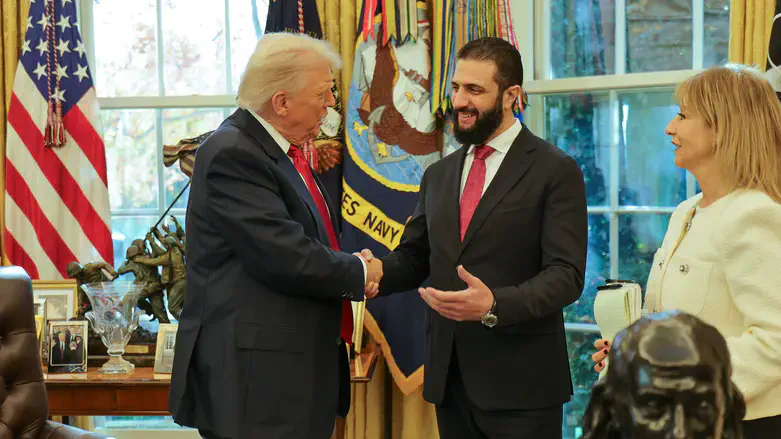
Last week saw a dizzying turn in Middle Eastern diplomacy: the American President met with Ahmad al-Sharaa, the de facto new leader of Syria. To many, this appeared to be a catastrophic surrender of principle, a dangerous embrace of an Islamist figure whose political roots lie in Al Qaeda affiliates. They condemn the U.S. for offering legitimacy to a man whose ideological foundations should disqualify him from the international community.
They are strategically mistaken.
President Trump’s decision to engage with Sharaa is not a moral compromise but a calculated masterstroke of geopolitics. It is a necessary tactical move to surgically dismantle the Iran-Russia axis of influence in the Levant. The strategic objective is clear and vital: we must seize the opportunity created by the collapse of the Assad regime to starve Tehran and Moscow of their most crucial Arab asset and anchor American influence in the process.
This is the Great Game in its rawest form. While Sharaa must be treated as an enemy in disguise, the administration is using him as a temporary lever to check the true, long-term threats to American and Israeli security.
The administration suspended the Caesar Act sanctions to facilitate counterterrorism, security, and economic coordination with the new Syrian government. But here is the genius of the move: the waiver explicitly and rigorously excludes transactions involving Russia and Iran.
This is a brilliant strategic chokehold. It forces Sharaa’s Islamist regime to turn West for the critical aid needed to rebuild his war-torn state while simultaneously preserving the full weight of sanctions on Moscow and Tehran, thereby crippling their ability to exploit the security vacuum. The goal is to make Syrian reconstruction contingent on cutting ties with the U.S.’s primary adversaries-a chess move that strategically isolates the mullahs in Tehran.
However, the necessity of this strategic move must never be confused with trust. We must deliver this aid and coordination with open eyes and a permanently closed fist, because Islamists do not shed their ideology; they simply shift their tactics.
Ahmad al-Sharaa’s pedigree is immutable. He led Hayat Tahrir al-Sham (HTS), a group whose history is inextricably linked to global jihad. Though he has traded his fatigues for a diplomatic suit in a cynical attempt to gain legitimacy, his foundation was built on being the leader of a jihadist group. Analysts are right to be suspicious. His attempts to show a "modified look" are not an ideological conversion but a tactical pivot designed to secure the billions of dollars needed for postwar reconstruction and to escape the crushing designation of a terrorist regime.
The international community must recognize this calculated deception.
Sharaa and his interim interior minister, Anas Khattab, remain listed under the U.N.’s most stringent sanctions regime. Yet, the U.S. authored a draft U.N. Security Council resolution this week seeking carve-outs to these sanctions to facilitate economic engagement. This push by Washington, while strategically necessary to avoid total state collapse and humanitarian disaster, must be viewed with intense vigilance. It risks the political laundering of jihadism, telling other terrorist groups that state capture is the ultimate route to international acceptance.
Israel and its allies must therefore treat the Trump administration’s strategic engagement as a military advance against Iran and not a diplomatic endorsement of Sharaa.
The President is leveraging a temporary window of opportunity to gain a foothold against Russia and Iran, a move that previous administrations resisted. This is a strategic dividend that must be pressed aggressively to secure the border and isolate Hezbollah’s logistical arteries through Syria.
The ideological threat, however, remains constant. The moment American money flows and political legitimacy hardens, the core commitment that built Sharaa’s movement will resurface. The burden now falls on Israel and the Free World to ensure that while the U.S. strategically counters Iran, the intelligence and security apparatus maintains absolute zero trust in Syria’s Islamist regime.
This is not about trusting the enemy; it is about skillfully outmaneuvering America’s true rivals. President Trump has played a necessary hand, but perpetual suspicion of the Islamist core is the only guarantee of long-term security.
Amine Ayoub, a fellow at the Middle East Forum, is a policy analyst and writer based in Morocco. Follow him on X: @amineayoubx