

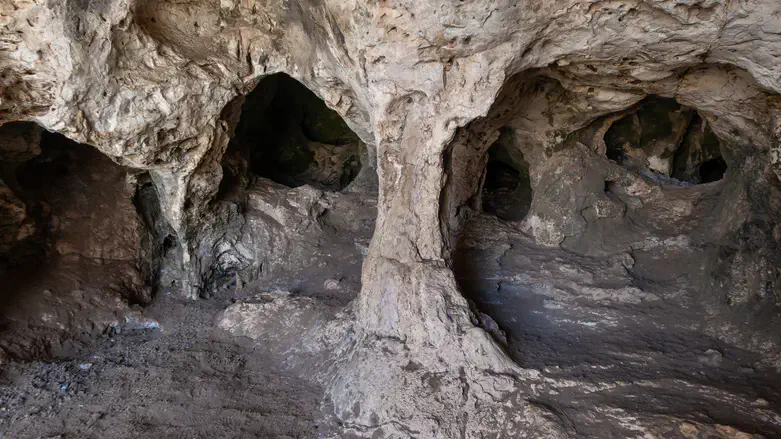
A study conducted at University of Haifa and published in the International Journal of Osteoarchaeology found that some 15,000 years ago, when the inhabitants of the Carmel Caves looked westward, they saw not the Mediterranean Sea but a landscape of lakes and marshes teeming with migratory waterfowl.
The hunter-gatherers of the Natufian culture left their homes in the el-Wad Cave on the Carmel slopes during the winter for short trips to the coastal plain, where they hunted flocks of ducks and geese that gathered in the freshwater lakes at the foot of the mountain.
“Our findings show for the first time that members of the Natufian culture - hunter-gatherers who lived on Mt. Carmel some 15,000 years ago - systematically hunted in the coastal lakes that existed here at the end of the Ice Age,” said Prof. Reuven Yeshurun of University of Haifa, one of the study’s authors.
The el-Wad Cave, located in the Nahal Me’arot Nature Reserve of the Israel Nature and Parks Authority, is one of the most important sites for understanding the transition of humans from mobile to sedentary life. It is among the first places in the world where hunter-gatherers began to settle permanently and build round stone structures. The site, part of the Natufian culture that flourished 15,000-11,700 years ago, has yielded dwellings, storage installations, burial grounds, and tools that attest to a complex and developed way of life. For decades, researchers from Israel and abroad have excavated the cave, offering a rare glimpse into the daily life and environment of ancient Carmel residents.
In the current study, Dr. Linda Amos, Prof. Mina Weinstein-Evron, and Prof. Yeshurun of the Zinman Institute of Archaeology at University of Haifa’s School of Archaeology and Maritime Cultures examined bird bones discovered at the site to learn more about the Natufian hunters’ lifestyle and environment. The research was supported by the Israel Science Foundation.
To study the birds hunted by the ancient Carmel residents, Dr. Amos analyzed hundreds of bones from the Natufian layers of the el-Wad Cave terrace. She identified the species and skeletal elements and examined each under a microscope for signs of cutting, charring, or polishing. These marks revealed hunting methods, how the birds were prepared for food, and other uses of the bones. Together with Prof. Yeshurun and Prof. Weinstein-Evron, who led the excavations, she compared the bird finds with other animal remains to understand their place in the diet and daily life of the site’s inhabitants. The researchers then divided the finds into four successive settlement phases, comparing them to identify changes in hunting practices, environmental conditions, and the seasons in which hunting took place.
The results show that the bird bones discovered on the Nahal Me’arot terrace belong to 43 different species, including ducks, geese, partridges, quail, and raptors. Many bones bore cut marks from hunting, cleaning, and processing, while others were charred, indicating cooking. Some bones were even shaped into small beads used for adornment. These findings suggest that waterfowl were not only an important food source but also a material for creating beads and ornaments.
“The hunters on Mt. Carmel during the Natufian period lived at the end of the Ice Age, when sea levels were much lower than today. The coastal plain was wide and contained lakes and seasonal marshes,” explained Prof. Yeshurun. “Migrating ducks and geese provided them with rich and varied food, as well as materials for beads and ornaments. These findings allow us to reconstruct the way of life of these ancient inhabitants of Mt. Carmel,” the researchers concluded.