

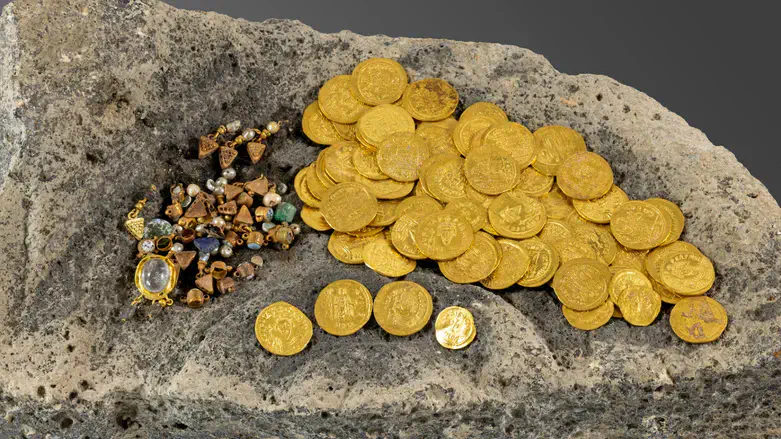
Archaeologists from the University of Haifa uncovered a rare Byzantine-period gold hoard at Sussita National Park, consisting of 97 pure gold coins and dozens of gold earring fragments set with pearls, semi-precious stones and glass.
According to the researchers, the hoard was buried out of fear of the Sasanian-Persian conquest and is dated to the sixth or seventh centuries CE.
"This is one of the largest hoards from the Byzantine period discovered in the land of Israel, and its uniqueness is the combination of jewelry with gold coins from the reigns of different emperors. In addition, some of the coins even bear traces of fabric, a remnant of the cloth pouch in which the hoard was buried," said Dr. Michael Eisenberg, co-director of the excavation mission for the University of Haifa.
Among the finds was a tremissis probably minted in Cyprus at the end of 610 by Emperor Heraclius the Elder and his son, during the revolt against Emperor Phocas. It is only the second coin of its kind ever found in Israel.
"This is a rare find that adds an important layer to understanding the political and economic history of the period," explained Dr. Danny Shayon.
The discovery itself occurred at the end of July, when Eddie Lipsman, a metal-detector operator accompanying the expedition, identified an unusual reading near a large stone. "The device went crazy, I couldn't believe it — gold coins began to be exposed one after another," Lipsman recounted. The researchers delayed publishing the find until completing an initial round of tests and ensuring there were no additional artifacts in the area.
According to the researchers, the state of preservation of the gold items is particularly impressive. "Gold is a valuable metal and when you find coins and jewelry about 1,400 years old that look like new, it is a rare experience," said Dr. Eisenberg.
Dr. Arleta Kowalewska added that the quality of the goldsmithing is striking: "The earrings are the big surprise for me. Fine metalwork combining semi-precious stones and pearls — I hope contemporary goldsmiths will recreate this beauty," she said.
Sussita, overlooking the Sea of Galilee to the east, was during the Byzantine period a significant Christian center and a bishop's seat with at least seven churches. In recent years, remains related to the Sasanian conquest have been exposed there, including evidence of the burning of the martyr Theodore's church. The researchers note that these finds fit into a broader historical picture of religious, military and economic processes in the region at that time.
The Nature and Parks Authority, which manages the national park, emphasized the site's contribution to understanding the multiplicity of communities and traditions in late antiquity in the Land of Israel. Dr. Dror Ben-Yosef, archaeologist and heritage commissioner for the North District, said, "Sussita National Park is a mountain of surprises a thousand years high in history. The site's excavation shed new and surprising light on both the pagan and Christian worlds. The story of Sussita teaches about the cultural and religious currents and sub-currents present in the land in parallel and about the diversity of its inhabitants. To understand the complexity of the area some 1,400 years ago, it is enough to ascend to Sussita's hill and look west toward the Jewish city of Tveryah. While in Sussita a wealthy Christian community developed around seven churches, the residents of Tveryah maintained a Jewish way of life centered on synagogues."