

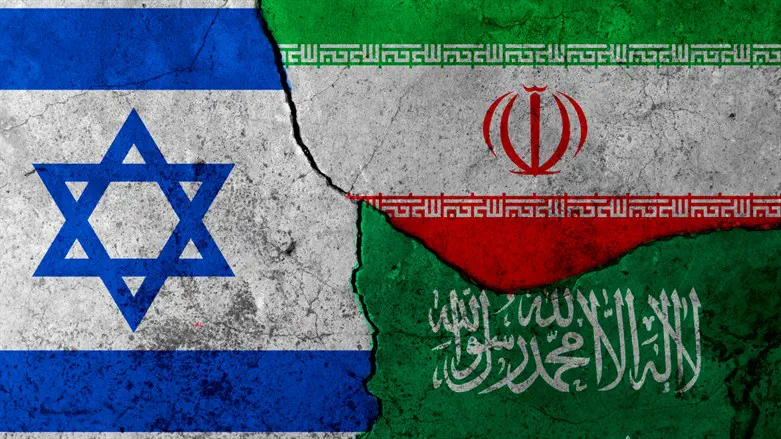
This week, as Crown Prince Mohammed bin Salman prepares to arrive in Washington, the illusion of a grand strategic bargain-normalization with Israel in exchange for an American defense pact-has shattered.
Riyadh has publicly drawn a clear, unambiguous red line: there will be no diplomatic relations with Israel without a concrete, time-bound roadmap to a Palestinian Arab state.
This is not diplomacy; it is extortion by means of political ransom.
At a moment when the region demands a unified front against the clear and present danger posed by Iran’s nuclear ambitions and its terror proxies, Saudi Arabia has chosen to leverage the strategic needs of the United States to secure unilateral gains while actively obstructing the singular diplomatic breakthrough that would truly secure the Middle East.
President Trump and his administration must reject this conditionalism.
Riyadh's demand is a self-interested stall that risks empowering the axis of instability, validates the October 7 aggression, and weakens the very American security guarantees MBS seeks to extract.
The news reported this week confirms that Saudi priorities are strictly transactional and self-serving. Ahead of the crucial White House meeting, Saudi officials signaled to Washington that normalization is effectively off the table. Their reasoning is political: the opposition of Israeli leadership to Palestinian Arab statehood and the return of the Palestinian Authority to Gaza leaves no immediate prospect of satisfying the Saudi prerequisite.
The message is clear: MBS refuses to pay the domestic political price. Recognizing Israel is a deeply sensitive national security issue tied to their role as custodian of Islam's holy sites, and the high Arab public mistrust remains due to the scale of Israel's military offensive.
Instead of facing that political cost, the Crown Prince is focused on steering the agenda toward defense cooperation. He is expected to seal a limited defense pact with the US, loosely modeled on the recent agreement with Qatar. This is an attempt to secure US military protection and advanced weapons sales while conveniently avoiding the difficult commitment of full peace.
Riyadh demands the security shield but treats normalization as a negotiable accessory. True regional leaders pay the price of peace; they do not hold it for ransom.
The conditionalism articulated by Saudi officials this week is a strategic failure that risks validating the resumption of violence. Riyadh demands a clear, time-bound Israeli withdrawal from Gaza, the deployment of an international protection force, and the empowerment and return of the Palestinian Authority.
These demands are either naive or intentionally maximalist, designed to fail. They grant political cover to the aggressors by suggesting that the path to regional acceptance runs directly through the brutality of the recent war.
Furthermore, the demand for a swift return of the weak and opposed Palestinian Authority makes the entire package an intentional diplomatic impasse. It guarantees the negotiations stall, thereby securing MBS the political breathing room he craves while simultaneously undermining the US administration’s primary foreign policy objective.
While Saudi Arabia stalls and leverages American security needs for self-interest, the region's true adversaries are accelerating their operations. This past week, news broke that the Iranian Revolutionary Guard Corps planned an assassination attempt against the Israeli Ambassador in Mexico. This is not a distant proxy skirmish; this is Tehran actively escalating its global terror footprint against a US ally on the doorstep of North America.
Simultaneously, Hezbollah is rearming in violation of the recent ceasefire agreement, a defiance that prompted Israel to step up airstrikes in recent days. A senior Israeli official warned that these strikes were “just a preview” of a broad operation if the terror group is not disarmed. By delaying normalization, Saudi Arabia allows this terror axis to operate without the crushing weight of a fully integrated US-Israel-Sunni partnership.
The lesson of this week is that transactional conditionalism must cease.
Washington must reject the Saudi political ransom.
American security and stability in the Middle East cannot be contingent upon the Crown Prince’s political maneuvering. Riyadh must be told that the era of obtaining unilateral US guarantees while simultaneously stalling essential regional alignment is over.
Normalization with Israel is not a reward for Saudi Arabia; it is the necessary strategic anchor for the entire anti-Iran axis and the only credible path toward long-term regional stability. To let MBS hold that anchor for political ransom is a strategic failure that neither America nor Israel can afford. The administration must proceed by decoupling security from political ransom and demand a unified alliance now.
Amine Ayoub, a fellow at the Middle East Forum, is a policy analyst and writer based in Morocco. Follow him on X: @amineayoubx