
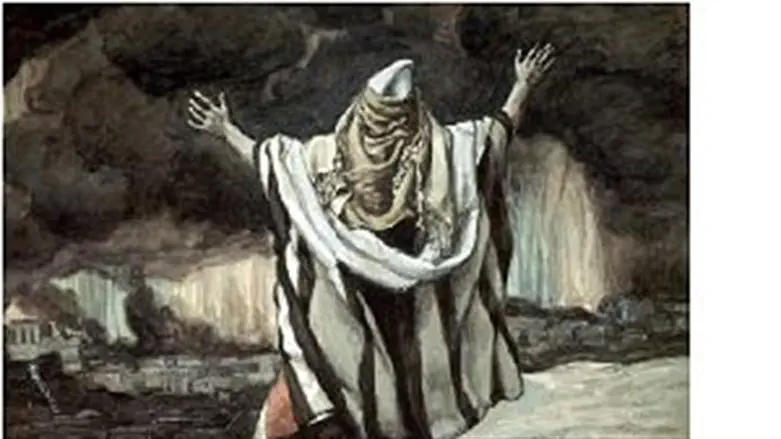
The Torah introduces us to G-d’s judgement on the great metropolis of Sodom and Gomorrah by recording His informing Abraham of His intentions.
“Hashem said: Shall I conceal from Abraham what I’m doing, when Abraham is going to become a great and mighty nation, in whom all the peoples of the world will be blessed?... And Hashem said: The outcry of Sodom and Gomorrah - because it is great; and their sin - because it is terribly heavy; I will descend now and see. If it is according to its cry which has come to me - then obliteration! And if not, then I will know” (Genesis 18:17-21).
Abraham’s innate sense of natural justice was outraged, and he challenged G-d Himself:
“Will You eliminate the righteous together with the wicked? Maybe there are fifty righteous people in the city; will You even so eliminate and not spare the place for the sake of the fifty righteous people in its midst? Far be any such action from You, killing the righteous along with the wicked, and the righteous will be treated no different from the wicked! Far be it from You! Will the Judge of all the world not do justice?!” (vs. 23-25).
G-d agreed, and Abraham immediately continued: If there are just 5 missing from the fifty?
G-d agreed: If there are 45 tzaddikim in Sodom, then He would spare the entire metropolis.
Abraham continued his haggling, bargaining G-d down from 45 to 40 tzaddikim, to 30, to 20, and finally to 10.
G-d agreed: If there are but ten tzaddikim in Sodom, then He will spare everyone for the sake of those ten.
It is crucial to understand that Abraham was emphatically not pleading for G-d to spare the evil sinners in Sodom: he was pleading for the lives of whatever tzaddikim might be there. He couldn’t possibly have known yet that there weren’t ten tzaddikim in Sodom; he only argued that if there were, then they deserved to be saved from destruction.
Then the majority of Sodomites would have been incidental beneficiaries of these tzaddikim - if such existed.
Abraham was not arguing to use these hypothetical tzaddikim as human shields to protect the evil majority of Sodomites from destruction. After all, had his intention been to protect the evil Sodomites, G-d had given him a simple method: he could have taken ten of his students and relocated them to Sodom, and then there would indeed have been ten tzaddikim in Sodom.
In the event, as we well know, the sole tzaddikim in Sodom whom G-d deemed worthy of life were Lot and his immediate family - his wife, their two daughters, and their husbands. Only six people in all Sodom.
And even those husbands didn’t believe their father-in-law Lot when he warned them that Hashem was about to destroy the city, “he seemed like a clown to them” (Genesis 19:14). They chose to remain in Sodom, they chose to tie their fate to their city, so they were destroyed along with the rest of the Sodomites.
The Kli Yakar (Rabbi Shlomo Efrayim, Luntchitz, Lvov [Lemberg], and Prague, 1550-1619) offers an interesting insight, analysing Lot’s precise words to his sons-in-law:
קוּמוּ צְּאוּ מִן־הַמָּקוֹם הַזֶּה כִּי־מַשְׁחִית ה' אֶת־הָעִיר
“Arise, get out from this place, because Hashem is destroying the city”.
The Kli Yakar notes that Lot used שם הויה, the Name Hashem, the Name which denotes Hashem in His attribute of mercy, rather than אֱלֹקִים, G-d, the appellation which denotes G-d in His attribute of strict justice.
“This is why ‘he seemed like a clown to them’, because they said: Would He then destroy and exterminate in the name of mercy?!”
And the Kli Yakar clarifies:
“The truth is that yes, He would, because evil people transform the attribute of mercy to the attribute of strict justice”.
In several places, our Sage tell us that “the death of evil people is beneficial for them and beneficial for the world” (Sanhedrin 8:5, Avot de-Rabbi Natan 40, Tanchuma Ki Teitzei 1 et al.).
Rabbi Ovadiah of Bartenura explains:
“Beneficial for them, because they no longer sin; and beneficial for the world, because the earth is then left in peace” (commentary to Sanhedrin 8:5).
So yes, destroying the unadulterated evil that Sodom and Gomorrah had become was indeed wrought by Hashem, by G-d in His attribute of mercy.
And this explains why the Torah depicts the destruction of Sodom and Gomorrah with the words:
וַֽה' הִמְטִיר עַל־סְדֹם וְעַל־עֲמֹרָה גָּפְרִית וָאֵשׁ מֵאֵת ה' מִן־הַשָּׁמָיִם:
“Hashem rained brimstone and fire down on Sodom and Gomorrah, from Hashem, from the Heavens” (Genesis 19:24).
Twice the Name Hashem, denoting the attribute of mercy; from the Heavens, the all-good place of reward. And - less obvious, particularly in English translation - the verb הִמְטִיר, “rained down”, from the root מָטָר, matar (rain).
Hebrew has a few synonyms for rain, the most frequent of which are גֶּשֶׁם (geshem) and מָטָר (matar). Geshem denotes the purely physical form of rain; matar denotes rains of blessing (vide Deuteronomy 11:11, 11:14, 28:24, 1 Kings 8:36, Isaiah 30:23, Zechariah 10:1 et al.).
The brimstone and fire which Hashem rained down on this metropolis was indeed “rains of blessing”, destroying the evil people and making the world a better place.
With their evil, with their cruelty to each other and to outsiders, the denizens of Sodom and Gomorrah had forfeited all rights to life.
Every morning in our prayers, we refer to G-d as
הַמֵּאִיר לָאָרֶץ וְלַדָּרִים עָלֶיהָ בְּרַחֲמִים
“He Who illuminates the earth and those who dwell on it in mercy”.
Now this is usually understood to mean that G-d, in His mercy, illuminates the earth and its dwellers.
But it can also mean that G-d illuminates both the earth, and also those who dwell thereon in mercy. That is to say, the term בְּרַחֲמִים, “in mercy”, applies to the earth-dwellers, not to G-d. He gives light to those who dwell in mercy.
The Sodomites had eliminated all mercy from their society - so G-d, in His mercy, eliminated them from His earth.
Just ten tzaddikim in that vast metropolis would have saved them all. G-d would still have illuminated the entire region just for those few who dwelt in mercy.
But what the whole sorry episode of Sodom and Gomorrah teaches is that yes, there can be an entire metropolis, and entire region, in which every single man, woman, and child, down to the new-born baby, is judged and found to be evil.
Not a single innocent soul among them.
And then, the truest mercy of all is complete elimination.