
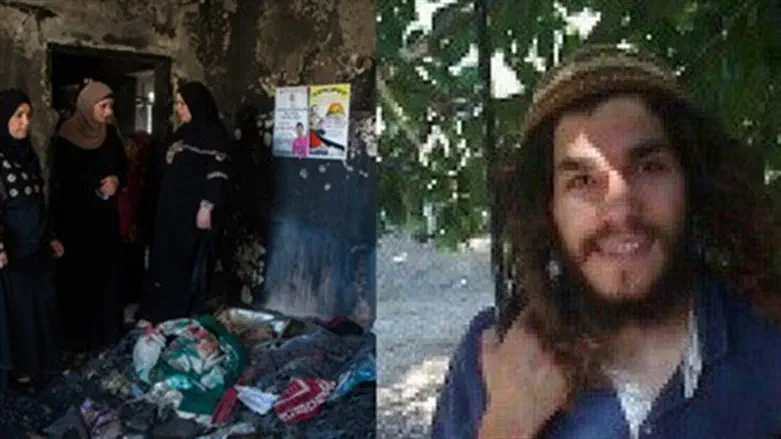
(Note: For those who are not famliar with the topic, a synopsis of the Duma Case can be found here.)
I read a large portion of the verdicts in the Amiram ben Uliel case as well as those of “Accused number 2,” who was a minor at the time their trial took place. I must admit that it is extremely difficult for me to rely on the Shabak’s Jewish Division ever since the tapes confirming the head of the service’s misdeeds were exposed by Avishai Muallem. (Ed. Note: See what Muallem exposed here.)
My opinion of the Israeli courts is not much better, and independent of that, I find myself shaken after reading the non-classified material in the verdict regarding the inquisition - yes, not interrogation, inquisition - to which the two young men were subjected.
On the night of December 17, 2015, I slept peacefully in my bed when Amiram was subjected to “a necessary interrogation” by one interrogator after another, using “special procedures (a euphemism for torture, ed.),” this from 11:40 pm to 7am. “After the ‘necessary interrogation’, the accused underwent two more interrogations without ‘special procedures’ during which he repeated his confession” (I wonder why…,Y.E.).
“On December 19 (Shabbat) another interrogation took place which was recorded up front. During the next two days there were further Shabak interrogations, and on the afternoon of December 21, another recorded interrogation in which the accused once again confessed to the charges. Soon after the second recorded interrogation another ‘necessary interrogation’ began during which ‘special procedures’ were employed (wait a minute - why? Had he not confessed already and was he not filmed doing so? E.Y.) and right after that, close to midnight, he met with his lawyer.”
There are no doubts about the Shabak’s ability to employ torture as well as to gain information by using interrogators posing as violent, dangerous criminals as well as its ability to manipulate both the accused and the court.
On February 11, 2018, I turned to then Justice Minister Ayelet Shaked. The following is part of our correspondence: “I request that you act to free or at least improve the conditions under which the two young people arrested two and a half years ago in the Duma affair are held. As is now known, Amiram ben Uliel’s confession was achieved through torture, and it is extremely doubtful that it reflects the truth.”
On February 28, the minister’s chief of staff responded: “A week ago, the minister met with all the relevant professionals involved and received an update on the conditions under which they are being held. This meeting was a continuation of the ongoing updates the minister receives on the subject so that she can closely follow the situation and help as much as she can. However, as you must clearly know, the minister cannot interfere regarding the interrogation.”
His response did not allay my fears. I wrote to the minister again, saying among other things: “When this is compared to the case of Ezra Nawi, who is free to continue his iniquities after confessing to them of his own volition and who was filmed saying leeringly that information he revealed brought about the death by [PA] torture of an Arab (who sold land to Jews, ed.) in addition to everything else he did that harmed the state of Israel - how can one remain silent? You promised me that because of my letter you will act to see that justice is served in the [Duma] case. I fear that silence in cases like this is like taking part in the injustice. Like many others, I highly appreciate the important things you do with perseverance and wisdom in your role as Justice Minister, for the benefit of the State and our people. The email address of the ministry includes the word “justice”. I ask you, Justice Minister, to see that this applies to those in sitting in utter darkness (a quote about prisoners from Psalms 107, ed.).”
I am not certain that Amiram did not do the deeds to which he confessed after extreme torture. I am certain that the reasons for his conviction are unconvincing. One strange story is that only part of Ibrahim Dawabsheh’s testimony was accepted. According to him, “on the night of the attack at 2:09, as he was sitting on his porch.” (who sits on his porch at that hour? Y.E.) he saw Amiram, and added that there were two people standing there who also watched the burning! The court decided that this was probably his own supposition (pp119).
The Shabak, as is widely known, hates the hilltop youth and considers them terrorists, and thinks their long sidelocks - called guzambot - should be pulled out. The judges generally dislike them as well. Add to that the fact that Amiram is a somewhat odd hilltop youth, who won’t look at women and sits in court with his face covered. At one point the justices punished him for that behavior and cancelled a session of his appeal.
Amiram is not a member of Chabad, so that the graffiti “Long live the King Messiah”, a Chabad quote, that was found written at the site, does not quite suit his world. An expert graphologist brought by the defense, found that it is not in his handwriting. The prosecutors did not bring opposing testimony on this issue, and the justices invalidated the expert’s testimony, for what I consider weak reasons. The graffiti was written in a "curly” style similar to Arabic writing. There was a previous incident in the northern Bedouin village of Tuba Zangariyye that was proven to be a result of an internal Arab conflict, but had been camouflaged by false “price tag” graffiti. And crucially, in Kfar Duma in general and the Dawabsheh family in particular, there were several incidents of arson before and after the one we are dealing with, all stemming from family disputes. Is that just coincidental?
Unfortunately, a delegation of Jews, even some residents of Judea and Samaria, went to Duma [to show solidarity for the residents]. This added legitimacy to the Shabak Jewish Division’s sadism against the hilltop youth, evinced until they achieved their objective of convicting a “settler” and blackening the entire sector’s name. Amiram Uliel’s case was handled in a way much worse than that of Roman Zadorov who was imprisoned for life and jailed for years until found innocent and freed.
We cannot ignore the fact that while the worst Arab murderers were freed just recently in deals made with the Hamas Satan, those in charge refuse to consider the just claims made in Amiram’s favor.
I turn to Justice Minister Yariv Levin and to President Isaac Herzog, asking them to put an end to the ongoing terrible miscarriage of justice in Amiram ben Uliel’s case and grant him an immediate pardon.
Professor Yoel Elitzur is a researcher of the Hebrew language and biblical and historical geography, a member of the Academy of the Hebrew Language.
This article appeared in the Hebrew Besheva weekly, October 23, 2025, Parshat Noach and was translated by Rochel Sylvetsky.