
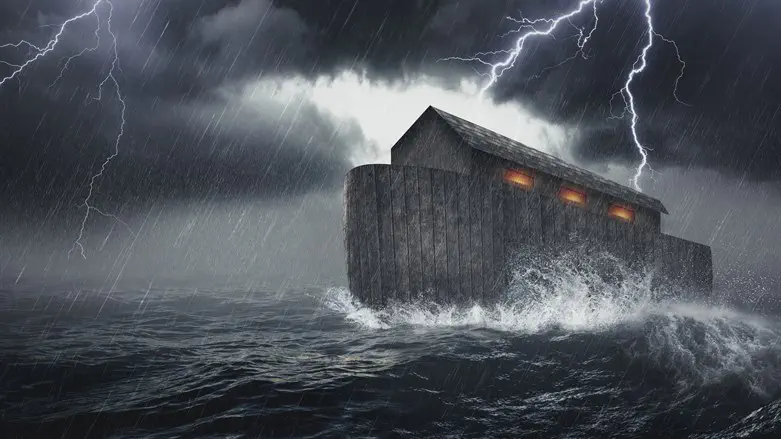
The year was 1056 from Creation (2704 B.C.E.), and Lemech, the ninth-generation descendant of Adam, begat a son, “and he named him Noach [נֹחַ], saying: This one will comfort us [יְנַחֲמֵנוּ] for our deeds and for the sorrow of our hands, from the ground that Hashem has cursed” (Genesis 5:29).
Was Lemech, then, a prophet, that he foresaw that his son Noach and his family would be the sole survivors of humanity, and that they alone would preserve the human race?
The Midrash suggests that Lemech was not a prophet:
“How did he know to say that ‘this one will comfort us’? Was he then a prophet? Said Rabbi Shimon ben Yehotzadak: They had all learned that when G-d said to Adam ‘The ground is cursed because of you, in sorrow you will eat of it all the days of your life’ (Genesis 3:17), Adam said: Sovereign of the World! For how long? He said to him: Until a person will be born circumcised. When Noach was born circumcised, Lemech immediately knew, and said: This one will surely comfort us!” (Tanhuma, Bereishit 11).
Rashi, the Rashbam (Rashi’s grandson and close student) and the S’forno (Rabbi Ovadyah S’forno, Italy, c.1470-1550) all interpret Lemech’s phrase to be not a prediction but a prayer: “May this one comfort us…”.
The Midrash Tanchuma (Noach 5) notes that in the first verse of Parashat Noach, the name “Noach” appears three times:
אֵלֶּה תּוֹלְדֹת נֹחַ: נֹחַ אִישׁ צַדִּיק תָּמִים הָיָה בְּדֹֽרֹתָיו, אֶת־הָאֱלֹקִים הִתְהַלֶּךְ־נֹחַ:
“These are the generations of Noach: Noach was a righteous and perfect man in his generations; Noach walked with G-d” (Genesis 6:9).
And the Midrash explains the significance:
“Why is he mentioned three times in this one verse? - Because he was one of three men who saw three worlds: Noach, Daniel, and Job.
“Noach saw the world when it was inhabited, and he saw it destroyed, and he saw it inhabited anew.
“Daniel saw the first Holy Temple, and he saw it destroyed, and he saw it rebuilt as the second Holy Temple.
“Job saw his house and family established, he saw them all destroyed, and he saw them all restored”.
I offer the observation that Rabbi Shimon ben Yehotzadak was a Tanna - one of the last of the Tanna’im, who lived and taught on the cusp between the Tanna’im and the Amora’im.
The Tanna’im were the earlier and greater Masters, the generations from Hillel and Shammai around the year 10 until the year 200 when Rabbi Yehudah the Nasi (“Prince”, meaning Head of the Sanhedrin) redacted the Mishnah. The Amora’im were the later Masters, the generations from 200 until the year 500 when Ravina and Rabbi Ashi redacted the Talmud.
As great as the Amora’im were, the Tanna’im were greater yet. They were the earlier generations, therefore closer to the source of the Torah in Sinai.
Rabbi Shimon ben Yehotzadak bridged the gap: though he was a Tanna, in his latter years he was contemporaneous with the first of the Amora’im. He lived when the Holy Temple and its destruction by the Romans was still a comparatively recent memory - as close to him as the First Zionist Congress, Rabbi Chaim ha-Levi Soloveitchik of Brisk, Rebbe Shalom Dov-Ber Schneersohn and the Tomchei Temimim Yeshivah, and the Wright Brothers’ inaugural flight are to us.
Though he had not seen three worlds, as had Noach, Daniel, and Job, he had seen two worlds - the greater world of the Tanna’im and the diminished world of the Amora’im - and had detailed knowledge (albeit second-hand knowledge) of the earlier, vanished world, the world of the Holy Temple.
Maybe this gave Rabbi Shimon ben Yehotzadak an especially poignant understanding of Noach and his experiences. And he yearned to see a third world, a world which would restore the lost glories and magnificence and sanctity of a world in which the Holy Temple stood.
Noach, Daniel, and Job each witnessed disaster - but after disaster the third world which each experienced was greater than the first from before the disaster.
The world before the Flood had been living on borrowed time: “There were ten generations from Adam till Noach, to indicate how patient He is; because all those generations were increasingly provoking Him until He brought the flood-waters upon them” (Pirkei Avot 5:2).
After the Flood, humanity was still committing the same sins - but G-d had sealed His covenant never to repeat universal destruction (Genesis 9:8-17). Individuals, even entire nations, would still be judged and could be destroyed, but never again all humanity.
As the Mishnah continues, “There were ten generations from Noach till Abraham, to indicate how patient He is; because all those generations were increasingly provoking Him until Abraham came and accepted the reward of them all”.
The difference is vast: that first world which Noach saw, the world of before the Flood, was completely destroyed. The third world, the world of after the Flood, could never be destroyed. Just that ten generations didn’t receive their reward.
The third world which Noach experienced was better than the first.
Daniel, too, lived in three worlds. His third, that of the second Holy Temple, was greater (in some ways) than his first:
True, the first Holy Temple had greater sanctity than the second, as evidenced by the phenomena it contained which were absent from the second: the Ark containing the Tablets of Stone with the Ten Commandments; the Kapporet (כַּפֹּרֶת), the pure gold Cover for the Ark (Exodus 25:17); the Cherubs; the Heavenly Fire on the Altar; the Shekhina (Divine Presence); רוּחַ הַקּוֹדֶשׁ, Ruach ha-Kodesh, Divine Inspiration (a lower form of prophecy); and the Urim and Tummim (Yoma 21b).
Nevertheless G-d Himself had promised that “greater will be the glory of this later Holy Temple than the first” (Haggai 2:9). It was greater in physical dimensions, 40 cubits high whereas the first Holy Temple was only 30 cubits high, and it stood for 420 years whereas the first Holy Temple stood for only 410 years.
And in the second Holy Temple’s final decades, Herod carried out such massive building-work that the Talmud records a popular aphorism from the time, “Whoever has never seen Herod’s Holy Temple has never seen a beautiful building in his life” (Bava Batra 4a).
Rabbi Shimon ben Yehotzadak’s vicarious knowledge of the vanished world of the Holy Temple was of the magnificence of its final years - and this was the world which he yearned to restore.
And Job’s third world, whose life was devastated to test his loyalty to G-d, was better than his first:
“Hashem restored everything to Job…Hashem gave Job more than double what he had had…and Hashem blessed Job’s end more than his beginning;… he had seven sons and three daughters…nowhere on earth were any women more beautiful than Job’s daughters… And Job lived after this a hundred-and-forty years, and saw his sons and his sons’ sons - four generations; and Job died old and full of years” (Job 42:10-17).
This is potentially infinitely comforting and inspiring. However terrible the disasters which strike us, whether as individuals (like Job), or as a nation (as with Daniel), or with all humanity (as with Noach), G-d will eventually grant a better time ahead.
Of course nothing could ever compensate any of them for the terrible losses they suffered…and yet, recompense awaited them.
Two generations ago, we as a nation suffered and endured the most terrible disaster and destruction since the Roman Empire destroyed Israel and the Holy Temple. Nothing will ever bring the lost world of pre-Holocaust Jewry back. The destruction was irreversible.
Yet the world after it was - and is! - a world in which we have Jewish national sovereign independence in our homeland for the first time since Queen Shlom-Tziyyon (Salome Alexander) reigned in Jerusalem from 76-67 B.C.E.
Two years ago in Israel we endured the most horrific attack on Jews since the Holocaust. Nothing will ever bring back the thousands of our people murdered and soldiers killed in the battlefields. Nothing will erase the trauma. The pain of loss and destruction will remain with us for generations.
Yet Israel has emerged from this horrendous attack and the subsequent war stronger and more secure than before. We can truly say that we have seen three worlds: we have seen Israel from before the attacks of two years ago; we have seen Israel during this war, Swords of Iron; and now we are beginning - just beginning - to see Israel after the war.
Parashat Noach, the Midrash’s understanding of the Flood, Rabbi Shimon ben Yehotzadak’s poignant observation, and 3,300 years of Jewish history all guarantee us better days yet to come.
Noach, Daniel, and Job all lived realities which showed them that innocence lost cannot be entirely recovered. But they also lived realities which showed that they - and we! - can rebuild after disaster strikes.
The narrative of this week’s Parashah shows how the complete annihilation of evil is the way to rebuild a better world. A world which, ten generations on, at the very end of our Parashah, was at last ready for an Abraham to enter.