

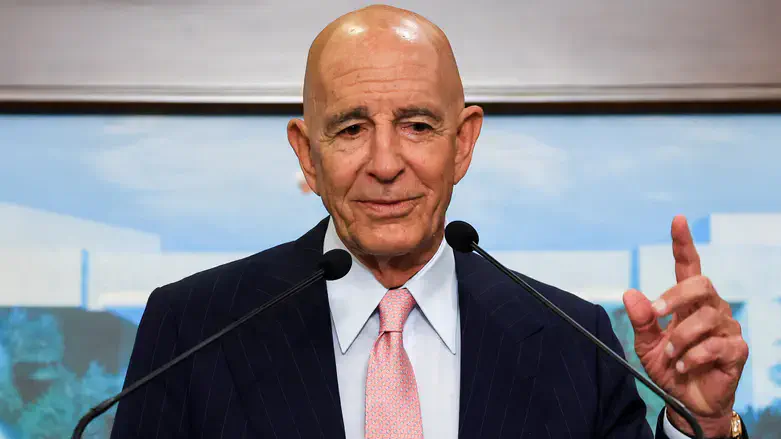
US Ambassador to Turkey and Special Envoy for Syria Thomas Barrack published a detailed statement on Monday outlining what he called the next critical stages in President Donald J. Trump’s regional peace initiative, focusing on Syria and Lebanon - two key fronts that directly affect Israel’s security and the ongoing expansion of normalization across the region.
In his post titled “A Personal Perspective - Syria and Lebanon Are the Next Pieces for Levant Peace," Barrack described the October 13 Sharm el-Sheikh summit as “a defining moment in modern Middle Eastern diplomacy." He credited President Trump’s leadership for transforming a ceasefire and hostage release into “the beginning of a renewed mosaic of partnership."
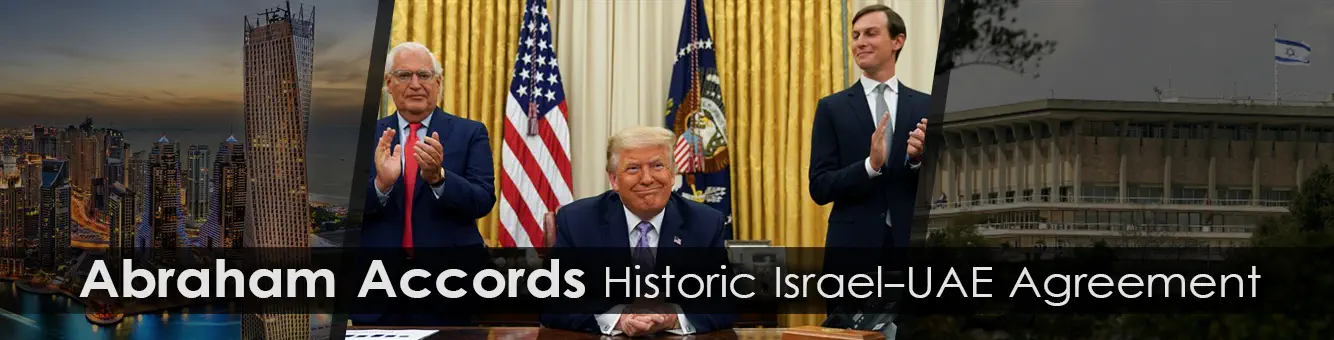
According to Barrack, the summit marked the endorsement of President Trump’s “bold, twenty-point vision for renewal, reconstruction, and shared prosperity across the region." He said the initiative has brought together Arab, Muslim, and Western nations “to replace paralysis with progress and isolation with inclusion," creating what he described as a new phase in the Abraham Accords process.
Barrack emphasized that the renewed momentum from the Sharm el-Sheikh gathering reflects “the Abraham Accords for the entire region" - a vision he said now includes Syria and Lebanon as potential future participants in normalization efforts with Israel. He described the process as “a historic turning point where political will, economic necessity, and public hope are aligned."
Barrack called on the US Congress to repeal the Caesar Syria Civilian Protection Act, arguing that it now stands in the way of Syria’s recovery and reintegration into the regional order and the expanding circle of normalization. He noted that the US Senate has already voted to repeal the act, and urged the House of Representatives to complete the process.
He wrote that President Trump’s June decision to lift most US sanctions on Syria marked a shift “from coercion to cooperation," describing the policy change as “not charity, but strategy." According to Barrack, lifting sanctions would enable regional partners and private investors to rebuild Syria’s infrastructure, strengthen its economy, and support reconciliation efforts that include dialogue with Israel.
“Repeal, then, is not appeasement. It is realism," Barrack stated, adding that Christian leaders from Syria have appealed to Congress to end sanctions that they say are harming their communities. He said that these steps would allow Syria to “join the region’s march toward stability and normalization with Israel."
Turning to Lebanon, Barrack identified Hezbollah’s disarmament as the next major objective in securing Israel’s northern frontier and restoring Lebanese sovereignty. He said the stabilization of Syria and the removal of Iranian influence from Lebanon would form “the two legs of Israel’s northern security framework."
Barrack criticized the 2024 Cessation of Hostilities Agreement as a “fragile calm without peace," pointing to Hezbollah’s political control and the weakness of the Lebanese Armed Forces. He warned that Lebanon’s inability to separate itself from Hezbollah’s grip was preventing it from joining the region’s growing network of peace and normalization.
He noted that a US- and France-backed plan for phased disarmament and economic incentives had been declined by Lebanon’s government under Hezbollah’s influence, saying that the opportunity remains open “for Beirut to align with the regional rhythm of the Abraham Accords." Barrack warned that if Lebanon fails to act, Israel “may act unilaterally," emphasizing that such a confrontation could further delay Lebanon’s reintegration into regional cooperation frameworks.
“Disarming Hezbollah is not only Israel’s security imperative; it is Lebanon’s opportunity for renewal," Barrack wrote. “For Lebanon, it means sovereignty restored, normalization with Israel within reach, and the chance for economic revival."
Barrack concluded that the stabilization of Syria and the disarmament of Hezbollah are essential steps in completing the architecture of President Trump’s “20-Point Plan," expanding the Abraham Accords, and advancing the broader regional vision of peace and prosperity centered around Israel’s secure and normalized regional standing. Barrack also noted that Iran now stands "terminally weakened - politically, economically, and morally - while Saudi Arabia stands at the precipice of formal accession" to the expanding Abraham Accords framework. He predicted that as Riyadh moves forward, other nations in the region will follow suit, accelerating the process of normalization and cooperation across the Middle East.