

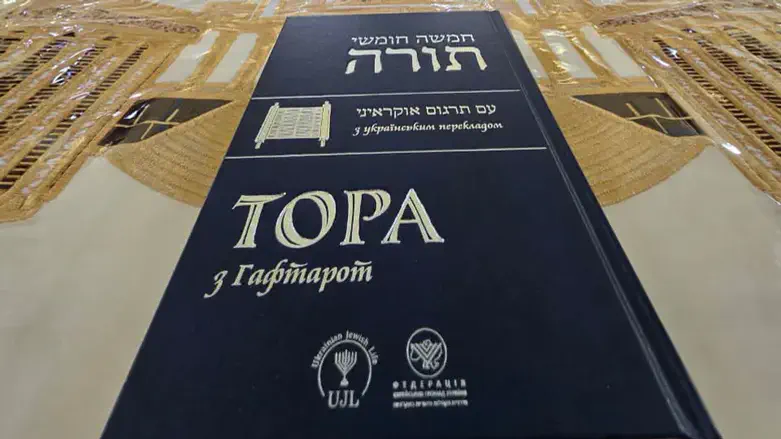
Amid the ongoing war between Russia and Ukraine, whose end remains out of sight-and as part of the country’s broader shift from Russian to Ukrainian-an unprecedented project has just been completed: the full translation of the Five Books of Moses into Ukrainian.
Hundreds of copies have already been printed in honor of Simchat Torah and distributed to major Jewish communities across the country. Thousands more are on their way to towns and cities throughout Ukraine ahead of the upcoming Shabbat Bereshit, when Jews begin reading the Torah anew from the Book of Genesis.
The initiative was led by Mikhail Shifrin, 53, a native of Kharkiv and owner of one of the city’s largest printing houses, together with Rabbi Mayer Stambler, chairman of the Federation of Jewish Communities of Ukraine (FJCU). Shifrin became connected to Judaism through Kharkiv’s Chief Rabbi and Chabad emissary Rabbi Moshe Moskowitz. In 2005, after several years in the printing equipment business, he established his own large printing plant in Kharkiv-spanning 12,000 square meters and employing around 200 workers.
After meeting Rabbi Stambler at a refugee camp for Ukrainian Jews on the shores of Lake Balaton in Hungary (organized jointly with EMIH, led by Hungary’s Chief Rabbi Shlomo Köves), Shifrin decided to join the effort to print Jewish literature in Ukrainian. He also enlisted his close friend Mark Vinersky, also from Kharkiv. The FJCU financed about one-third of the project, while Shifrin and Vinersky covered the rest. So far, they have invested over one million dollars-along with additional donors brought by the Federation-into what is a non-profit, purely educational endeavor.
The project itself was not spared by the war: two Russian missiles struck Shifrin’s printing house about two years ago, causing over $3 million in damages and destroying many machines. Nevertheless, the Torah translation continued as planned.
Shifrin serves as the project’s director, overseeing a team of translators, linguists, and rabbis. According to Rabbi Stambler, “It was very difficult to find rabbis fluent in Ukrainian, but we succeeded in assembling a top-level professional team. Sometimes they would spend an entire day discussing how to translate a single word correctly. They relied on existing Torah translations in English and Russian to assist in the process. Beyond the Torah, we have already translated Psalms, a prayer book, and Jewish children’s books.”
Rabbi Levi Engelsman, who coordinates the project on behalf of the Federation, said: “More than ten translators and editors worked on translating the Torah into Ukrainian, a process that altogether took about two years. We made a major effort to complete the printing before Simchat Torah, and I’m proud that we met our deadline. This is a historic moment and a great help for many Jews who no longer speak Russian or any other language besides Ukrainian.”
The translation project was initiated in part at the request of Ukraine’s Jewish president, Volodymyr Zelenskyy. A few months before the war began, the president met with city rabbis and Chabad emissaries at the initiative of the Federation. During the meeting, Rabbi Stambler shared the idea of translating the Book of Psalms into Ukrainian, and Zelenskyy expressed interest in receiving a copy once it was completed.
Indeed, in February 2023, as a gift for his 45th birthday, the president received the first Ukrainian-language edition of Psalms, bound in leather and personalized with his name. In the months that followed, additional Jewish books were translated.
Just days later, in a speech before foreign diplomats, Zelenskyy quoted from Psalm 3: “But You, O Lord, are a shield around me, my glory, and the One who lifts my head. I call out to the Lord, and He answers me... I will not fear the tens of thousands drawn up against me on every side.”
He added: “We are standing against evil. We are united as we have not been for years. We are brave-our soldiers have struck at evil on the battlefield. Did this happen only through human effort, or did God hear our prayers?”
Rabbi Moshe Moskowitz, Chief Rabbi of Kharkiv and a partner in the project, explained: “It is written that in the final month of his life, Moses translated the Torah into seventy languages. That itself shows how important this work is. To translate the Torah into a language in which it has never been published before is a tremendous privilege-it allows hundreds of thousands more Jews to access the Torah. It’s both a great honor and a responsibility. Moreover, it’s crucial that a Jewish, religious translation exists; otherwise, Jews might rely on a Christian or church-based version, which could be inaccurate or intentionally misleading. Whoever translates first-defines the narrative.”