

This past weekend, the largest Jewish library in Manhattan was inaugurated, established within the campus of the “Shuva Israel” yeshiva, headed by Rabbi Yoshiyahu Pinto.
The initiator and funder of the project is the Jewish billionaire Jay Schottenstein, who was present at the inauguration ceremony alongside Rabbi Pinto.
The new library already houses more than 20,000 sacred books, including foundational works in Bible, Talmud, and Halacha, alongside writings of Hasidism, Jewish thought, and Torah commentary. In addition, it contains rare editions of ancient books and research volumes in various areas of Jewish philosophy. The magnificent library was designed with accessibility for the wider public in mind, with the goal of serving as a center of scholarly study for New York residents and visitors from all over the world.
At the event, Rabbi Pinto emphasized that the establishment of the library stems from the desire to deepen the presence of Torah in the heart of one of the world’s major cities.
In his words, “Thousands of Jews live in Manhattan and its surroundings, and already now we see how this place becomes a hub of study, where the public can sit and engage in Torah at any time.”
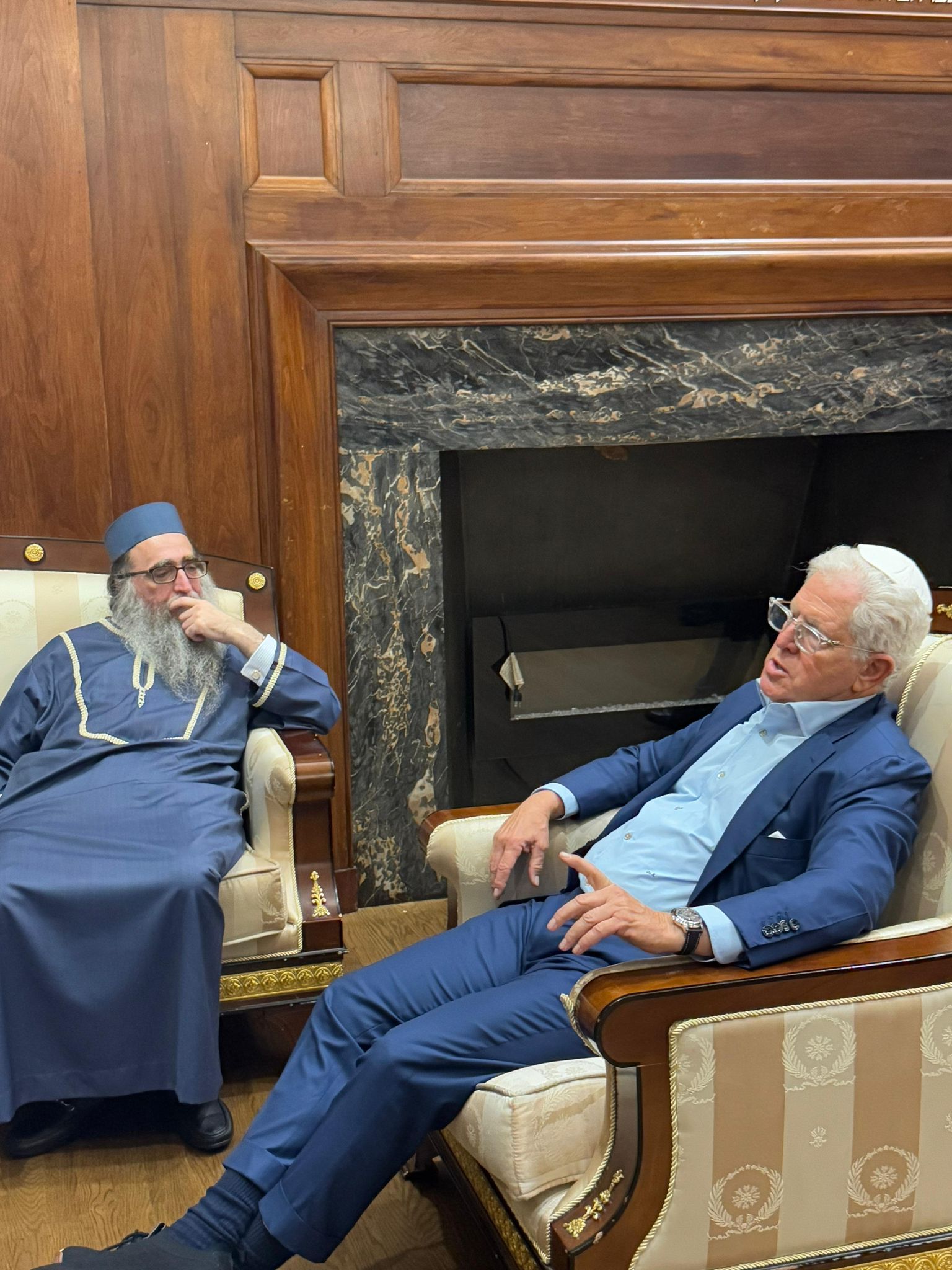
During his remarks, Rabbi Pinto praised Schottenstein for his many years of contribution to the dissemination of Torah in the Jewish world. He recalled the “Schottenstein Shas” project - the famous Talmud edition with commentary and translation - which has become a central tool for Torah study in the past generation. “In recent generations, no one has created such a broad Torah revolution as Jay Schottenstein,” said Rabbi Pinto.
According to him, “The edition with commentary became a permanent fixture in study halls, yeshivot, and Jewish homes around the world. Torah scholars, householders, Haredim, religious Jews, and even traditional and secular Jews - all make use of it.”
Rabbi Pinto added, “It is impossible to measure the impact of this project on the entire Jewish people. It is a tremendous enterprise that gave every Jew the ability to open the Talmud and study it in an accessible way, and through this to draw closer to the Creator of the world.”

In an unusual statement, Rabbi Pinto declared, “Jay Schottenstein is the Abraham of our generation, spreading the light of Torah in the broadest way. Tens of thousands of Jews have discovered the light of God thanks to Jay Schottenstein.”
The library itself was planned to serve as an ongoing center of activity: beyond the collection of books, it is expected to operate as a daily study center, a place for lessons and lectures, as well as a platform for collaborative Torah research. Educational projects for Jewish communities throughout New York are also planned, with the aim of connecting the local public to Jewish heritage.
Those responsible for the library note that “the new library will be open to the general public from all sectors and will offer a high-level study and accessibility experience. The books were selected carefully and also include works in English, French, and Spanish, alongside halls furnished to a high standard and private study rooms. The site will feature ten computers with the ‘Otzar HaHochma’ database and computers designated for transcribing the teachings of Rabbi Pinto. In addition, a professional librarian will be available to assist visitors in locating materials and using the databases.”
The establishment of the library is considered another milestone in the activities of the “Shuva Israel” yeshiva in Manhattan, founded years ago by Rabbi Pinto and serving as a spiritual center for many of New York’s Jewish residents.
Jay Schottenstein was born and raised in Columbus, Ohio, in a traditional Jewish family. He built his fortune mainly through real estate, yet his name in the Jewish world is tied first and foremost to his extraordinary philanthropic activity. In the 1980s he established the “Artscroll Schottenstein Edition,” a broad series of sacred books with English translation and commentary, which brought the Babylonian and Jerusalem Talmud, halachic works, and Jewish thought texts to wide audiences who did not master the original language.
The project, which began as his personal initiative in memory of his father, changed the map of Torah study among Jews in the Diaspora and became a central tool in Israel as well. The Schottenstein editions of the Talmud and Mishnah are today found in every study hall, making the sources accessible also to younger generations and to Jews who do not speak Hebrew.
Beyond the world of publishing, Schottenstein is involved in dozens of educational, communal, and medical initiatives, primarily in the United States and Israel. His donations to Torah institutions, hospitals, and charitable organizations are estimated at hundreds of millions of dollars. At the same time, he has maintained a relatively low public profile over the years, always stressing that all his activity is intended “for the strengthening of the Jewish people.”

