

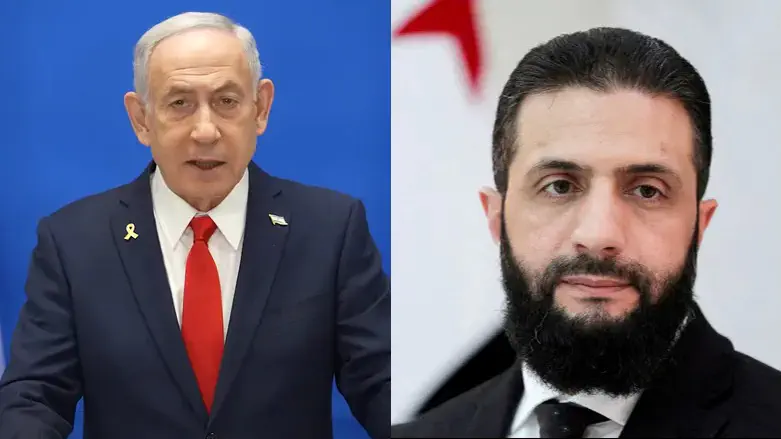
Israel has presented the new Syrian government with a comprehensive and detailed proposal for a new security agreement, Axios reported on Tuesday, citing two sources with knowledge of the negotiations. The plan includes a detailed map of the proposed security zones stretching from Damascus, southwest to the Israeli border.
This development is of critical importance, given the historically tense relationship between Israel and Syria. The Trump administration has taken a more favorable stance towards the new Syrian leader, Ahmed Al-Sharaa, who toppled and replaced Bashar al-Assad last December, and has been quietly facilitating the direct diplomatic channel between Jerusalem and Damascus.
While Syria has not yet formally responded to the Israeli proposal, which was made several weeks ago, they are reportedly working on a counterproposal, according to the Axios report.
A meeting to discuss the proposal is scheduled for Wednesday in London, involving Strategic Affairs Minister Ron Dermer, Syrian Foreign Minister Asaad al-Shaibani, and US envoy Tom Barrack, who has been mediating the talks. This would be the third such trilateral meeting, and while sources describe progress, a final agreement does not appear imminent.
The negotiations aim to replace the obsolete 1974 disengagement agreement, which became irrelevant after the collapse of the Assad.
The Israeli proposal is modeled after the 1979 peace agreement with Egypt, which successfully divided the Sinai peninsula into three zones- A, B, and C - with varying security arrangements and levels of demilitarization based on their proximity to the Israeli border.
This current proposal for Syria sets out maximalist demands. It calls for a broad demilitarized and no-fly zone on Syrian territory, with no reciprocal changes on the Israeli side. The area southwest of Damascus would be divided into three zones, with varying limitations on Syrian forces and weaponry. The plan also seeks to extend the existing buffer zone by 2km on the Syrian side.
Within the strip closest to the border, Syria would be prohibited from stationing military forces and heavy weaponry, although police and internal security forces would be permitted. According to a source, the proposal also designates the entire area from southwest of Damascus to the Israeli border as a no-fly zone for Syrian aircraft.
In exchange for these significant limitations, Israel has proposed a gradual withdrawal from all Syrian territories it has taken over in recent months, with the crucial exception of a strategic outpost on the summit of Mt. Hermon. A senior Israeli official stated that Israel insists on maintaining a presence there in any future agreement.
An intriguing element of the proposal, a source noted, is the principle of maintaining an aerial corridor over Syria to Iran, which would preserve Israel's ability to conduct potential future strikes against Iranian targets.
A recent report stated that the Trump administration is actively working to broker a preliminary security understanding between Israel and Syria ahead of the United Nations General Assembly meeting this month.
However, Barrack later clarified that Israel and Syria are not close to signing a security agreement, adding that “there is still more work to do.”