

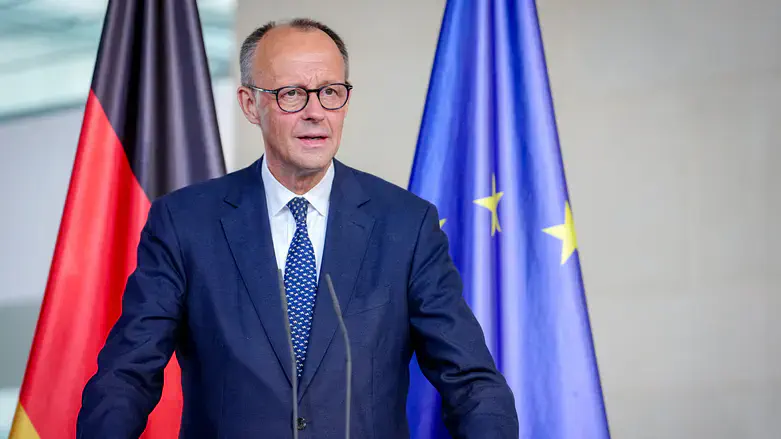
German Chancellor Friedrich Merz was on the verge of tears yesterday (Monday) during an emotional speech at the reopening of the Reichenbachstrasse Synagogue in Munich. Wearing a kippah and speaking with a choked voice, Merz addressed the painful history of the synagogue, remembered the horrors of the Nazis during the Holocaust, and voiced his shock at the renewed rise of antisemitism in Germany.
The ceremony, attended by senior public figures including Charlotte Knobloch, president of the Munich Jewish community, Israeli Ambassador Ron Prosor, and Josef Schuster, chairman of the Central Council of Jews in Germany, was not only a memorial event but also a declaration of the Chancellor’s commitment to combating anti-Semitism and ensuring a safe Jewish life in Germany today, invoking the pledge: “Never again.”
“We are reopening the synagogue for the third time, again under extremely difficult conditions,” Merz said, referring to the current state of antisemitism in Germany. “Police officers stand guard outside the synagogue. All celebrations today will, without exception, be under police protection. The police are present across Germany, guarding kindergartens, schools, restaurants, and Jewish cafés. Antisemitism has never disappeared from the Federal Republic of Germany, and many of you know this from your bitter experience.”
“This means,” Merz continued, “that an entire generation of Jews in Germany knows public Jewish life only under the most stringent security measures. And yet I wanted to believe, as many Germans do, that perhaps one day it would be better.”
“Then came October 7, 2023 - the largest mass murder of Jews since the Holocaust, a monstrous and barbaric act. And we are still grappling with that day. In some streets in Germany, people celebrated. That day made it clear that in politics and society, we have for too long closed our eyes to the fact that a significant portion of those who arrived in Germany in recent decades were raised in countries where antisemitism is nearly a state doctrine - and where hatred of Israel is taught to children in schools,” Merz said, speaking of antisemitic behavior among Muslim and Arab immigrants in Germany.
“Since October 7, we have all witnessed a new wave of antisemitism in an old-new guise, openly and covertly, in words and actions, on social media, in universities, and in public spaces,” the Chancellor continued. “I want to tell you how ashamed I am, as Chancellor of the Federal Republic of Germany, but also as a German citizen, a child of the post-war generation, raised with ‘Never again’ as a mission, duty, and promise.”
“Ladies and gentlemen,” Merz concluded, “on behalf of the federal government, I want to say that we will do everything in our power to ensure that Jews across Germany can live, celebrate, and study without fear, so that a generation of Jewish children can grow up here and proudly share their Jewish identity anytime and anywhere. I want to say to all citizens of our country: it is our duty, more than ever, to give real meaning to ‘Never again’ - our shared historical obligation.”
The synagogue, first inaugurated in 1931, marked a milestone in the history of Munich’s Jewish community. The tensions of that period, at the height of the Nazi rise to power, shaped the atmosphere of the original ceremony. Seven years later, during Kristallnacht in November 1938, the synagogue was largely destroyed, though not completely burned - allegedly due to concerns about damage to neighboring buildings, which the Nazis claimed did not belong to Jews.
After World War II, the synagogue was temporarily restored and served as a Jewish center until 2006, when the Jewish community moved to the new Ohel Yaakov Synagogue at Jacobplatz. In 2011, Jewish writer and activist Rachel Salamander founded an organization to preserve the synagogue and restore its religious and communal purpose.