
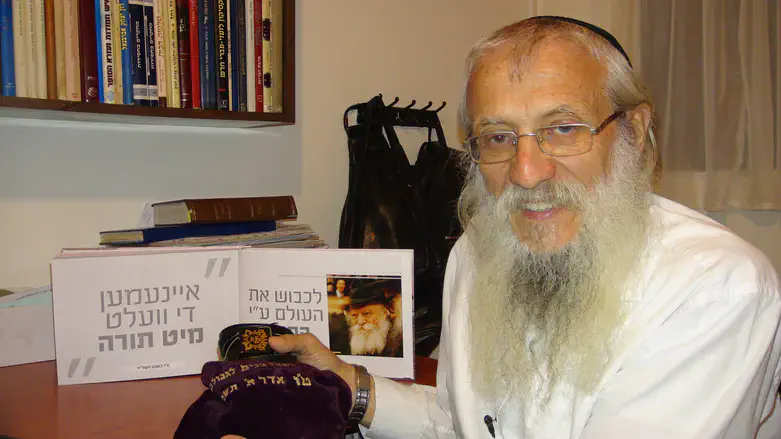
While Yosef Mendelevich is most known for having spearheaded the Struggle for Soviet Jewry when he and comrades in the Jewish Underground in Russia tried to hijack an airplane to fly to freedom in Israel, his struggle to keep the Torah during his eleven years in Siberian work camps and prisons stands out as a beacon of Jewish faith and resilience in modern times.
Were you raised in a religious family?
My father and mother received a Jewish education in Latvia before the Second World War. But they believed that Communism was the future of the world. Therefore, they did not observe commandments or traditions. While Stalin effectively erased the practice of Judaism, there were still beautiful synagogues, but only the elderly attended them. Children and youth knew nothing about Judaism because all Jewish schools were closed. There was only the system of government education and they taught us that there is no God.
The few brave souls who remained faithful to the Torah at home hid their religiosity in fear of losing their jobs. In the Soviet Union, anti-Semitism was forbidden by law, but this was only formal. It existed on all levels of society, especially at the university, where only a small percentage of Jews were allowed to be accepted, even if they passed the entrance exams. For example, I passed all the entrance exams to study medicine at Riga University, but they did not accept me.
What was your first encounter with Judaism?
I had a religious aunt. I saw her praying at home, and this seemed very strange to me. I should mention that my grandfather and grandmother were aligned with Chabad. My grandfather had been the shamash of the Rogatchover Gaon, a well-known scholar. But they passed away before I was born.
So as a youth you had no connection with God?
Not exactly. Although we were taught in school that there is no God, already from childhood it was clear to me that there is some higher power in the world. I had no opposition to God. But although there was a synagogue in Riga not far from my home, it did not interest me because I thought going to synagogue was only for old, primitive people.
How did your return journey begin?
The miracle of my life as a teenager was that I met some people who belonged to the Zionist underground. It was a very small circle, because Zionism was considered a crime. By chance, my cousin lived with us in the apartment. He was doing a post-doctorate at the university: Dr. Menachem Mendel Gordin. He became an example for me. Although he did not keep the commandments, he was traditional, respectful of Torah and mitzvot.
After he immigrated to Israel, he began to fully observe the Torah. Through my cousin I met his friends, some of them were early Prisoners of Zion who had been arrested at the time of the establishment of the State of Israel. When I reached the age of 16 they were released from prison. Meeting them, I developed a greater knowledge of Jewish History and Judaism.
At the age of conscription to the Soviet army, I was already active in the Zionist underground. By the time I was twenty, I was teaching groups in the underground. I thought that the meaning of returning to the Land of Israel was to return to our Jewish roots. I understood this to mean that I had to be religious. I did not know exactly what it meant to be religious, but I understood that my life would have to change completely. And that frightened me.
When I received a draft order to the Soviet army, I felt that if I wanted to avoid it I had to bring some kind of sacrificial offering to God. I thought, what could this sacrifice be? I said to myself, “Look, Yosef, you understand that to be a full Jew you must become a religious person, but this is uncomfortable for you. So let this be your sacrifice. God, if You exist, save me from the Soviet army. I promise that I will be Your servant.”
To summarize, I had three reasons for deciding to become religious. First of all, I felt no opposition to religion or to God. The second reason was Zionism. I felt that Zionism meant returning to the roots of the forefathers, and to the land of the fathers. The third reason was the understanding that if I wanted salvation from God, I had to sacrifice something. I sacrificed the easier path that most Jews chose of a life without the obligation and danger of the commandments.
Can a Jew create a direct connection to God without having an active attachment to the Jewish People?
Yes, at the first stage of drawing close to God it can be on an individual level. But a true return to God means forming a commitment to the Jewish People as a whole. When I was arrested for attempting to hijack a Soviet plane and placed in prison, even before the verdict, I decided to place special emphasis on keeping the commandments. For two reasons.
Firstly, I was standing opposite the Soviet regime. In their eyes, I was a representative of the Jewish People. Therefore, I had to emphasize to them that my struggle wasn’t private, but rather that of the Jewish People against the Soviet regime. The symbols of the Jewish People are the Torah, the commandments, and the Land of Israel. Therefore I had to show them that I truly represented the Jewish People and was not just someone who wanted to escape the Soviet Union.
In addition, a person who suffers, like sitting in prison for many long years, needs deep meaning (as Viktor Frankl wrote). For me the meaning was to be a Jew. To be a complete Jew, faithful to the forefathers, to the Land of Israel, to the Torah, and to the commandments. Wearing a kippah was one of the expressions of clinging to these principles. To keep the commandments, to be faithful to the Torah of Israel, that was what gave me the strength to withstand the trials and punishments I faced, to survive all of the long terms in isolation cells and my 50-day hunger strike.
Before our trial, my interrogators tried to convince me to squeal on other Jews in the Jewish Underground movement, whereupon they could be arrested as traitors to the Soviet regime. Of course, I refused.
‘Mendelevich, don’t be a fool,’ the investigator told me. ‘You are still a young man. You have your whole life ahead of you. Don’t throw it away. Give us the names of the other members of your group, admit that you made a mistake in betraying your Motherland, and we will lighten your sentence. Otherwise, you may be sentenced to spend the rest of your life in prison, or even be executed.’
I kept silent, unwilling to betray fellow Jews.
‘You are a Russian,’ the investigator continued. ‘You were educated as a Russian. Give up your foolish insistence on being a Jew and on immigrating to Israel. There is no God. Your Torah is just a make-believe fairytale that no enlightened Russian can accept, and you will only suffer for your stubborn rebellion.’
‘I am a Jew, and I am proud to be Jewish,’ I answered, not flinching from the look of hate in his eyes. ‘It is true that I was born in Russia, but my Motherland is Israel. And the laws of the Torah are the laws that I must follow, not the unjust and immoral laws of the Soviet State.’
The interrogator growled and sent me back to my cell. I felt a great turmoil inside of me, enraged that the Russian authorities were trying to strip me of my Jewish identity. I sensed that I must hang on to my Jewishness at all costs. If not, they would succeed in breaking me, and turning me into a traitor to my friends and to the Jewish People.
But, I had a problem which seemed even more insurmountable than the bars of my cell, the hostile interrogators, the uncaring guards, and the frightening dogs that patrolled the perimeters of the exercise yards. I knew very little about Judaism - just things that I had gleaned from our underground meetings. Confronted with beatings and arrests, Jews were afraid to act like Jews. But here and there, I had learned some things from my family. There were no Sabbath candles at home, the holidays came and passed with little celebration, and I hardly knew how to pray, or to Whom I was praying to.
But now, in defiance of my prison captors and the evil Soviet government that wanted to stamp out the faith of our People, I understood that I had to act like a Jew in every way that I could, just like Jews had throughout history, from generation to generation, in defiance of endless persecution, from the time of our slavery in Egypt up to the bondage of my brothers and sisters in Russia, decent peace-loving people who were treated as criminals if they wanted to keep the Torah and return to their own Jewish Homeland in Israel.
What do you recall about your release after eleven years of grueling incarceration?
When prison authorities confiscated my Bible and siddur, I went on a hunger strike for 55 days until they returned the books to me. After recovering in what was called a medical clinic, I was sent back to the prison factory and put to work, hauling coils of heavy wire weighing 60 kilos. At the end of one work day, two officials appeared in the barracks and told me to pack my belongings because I was being transferred. Handcuffed, I was driven away in a jeep through a dark forest, squeezed between an armed KGB agent and a huge guard dog, panting as if it couldn’t wait to get a taste of my bones.
No one bothered to explain where we were headed. I was confident they wouldn’t kill me because my struggle had become well known in the West. I figured I was going to be interrogated as a disobedient political prisoner. After a long train ride and an almost equally long airplane flight, I was driven to some prison and left alone in a tiny isolation cell. After a nervous two weeks, I was taken to a large office in the prison where a small squadron of KGB captains and generals were sitting. One held up a large piece of paper and read aloud: ‘Decision of the Supreme Soviet Council. In light of the criminal and anti-Soviet behavior of the exceedingly dangerous prisoner, Yosef Mendelevich, the Supreme Soviet Council has decided to cancel the criminal’s Soviet citizenship and to expel him from the boundaries of the Soviet Union.’
After a startled moment, I exclaimed, ‘Baruch Hashem.’
‘What did you say?’ the stone-faced official asked.
‘I thanked God for the miracle he has done for me,’ I replied.
‘Swine!’ he shouted. ‘He is expelled from his homeland and he is happy!’
‘Russia is not my homeland. The opposite,’ I told them. “You are expelling me from a foreign land to the Homeland of my People.’
When I left the room, my handcuffs were removed, and I was driven to the airport with an escort of motorcycles like an important person. I felt like Josef in Egypt who was taken from prison, dressed in clean garb, and brought before the king. Before boarding the airplane, I said to the KGB commander, ‘Eleven years ago, the KGB arrested me on an airport runway to prevent me from leaving for Israel. Now you have brought me to this airport to make sure I depart. And tens of thousands like me will follow. You should admit that you made a mistake.’
‘We didn’t know you people have such unbreakable spirit and resolve,’ he said.
Agents led me to the airplane before I could answer, not that he would have understood what I wanted to tell him. It wasn’t only the spirit of the Jews who were called the ‘Prisoners of Zion,’ nor the resolve of the people throughout the Free World who supported our struggle, that brought down the Iron Curtain. Just like in the Exodus from Egypt, the power came from our Father in Heaven and from clinging to His Torah.