
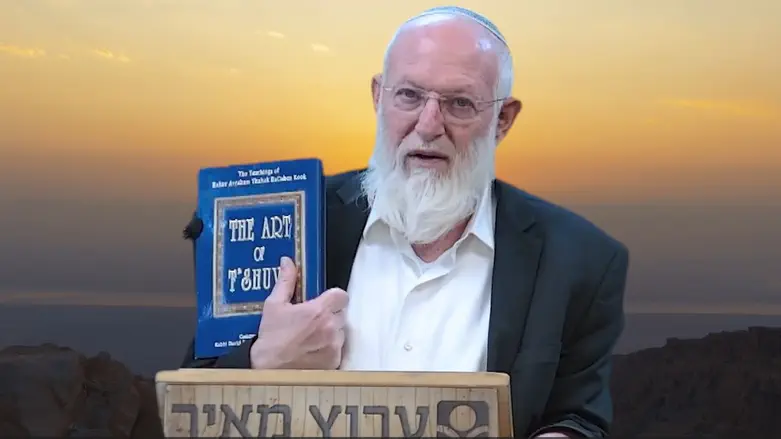
For parts 1 and 2, click here
In Rabbi Kook’s all-encompassing understanding of the universe, Teshuva is required when a person fails to achieve his full potential. In a sense, this is a sin against being his true self - in not giving expression to all of the strengths and talents with which the Creator imbued him. Rabbi Kook beckons:
“Rise, ascend for you have great strength. You have wings of spirit, the wings of mighty eagles. Do not deny them lest they deny you. Seek them, and they will be revealed to you.
Yes, the garments of imagery are precious and holy to us. We need them, as do all who look upon the world with boundaries, especially in the spiritual realm. But whenever we approach a life of understanding, we must not deviate from the upper point, from the unknowable light that pulses within the knowable, from the flow of emanation from the Infinite Light itself” (Orot HaKodesh I, p. 83).
It is noteworthy that Rabbi Kook uses the word “imagery”. In our Teshuva workshop we employ imagery to imagine who we are presently and who we could be. Let me take you through this process of exalted Teshuva. The willingness to change and grow is not always an easy matter.
Human beings have a propensity to safeguard the comfortable and familiar, even at the expense of personal stagnation. However, this can lead to inner frustration, anger projected out at others, and other undesirable traits. Try to contemplate on the following questions and to answer them honestly. Take the trouble to write down your responses. The exercise may seem juvenile but it can help free you from the box you have fashioned for yourself.
First, let’s try to uncover your inner gifts, sensitivities, talents, and strengths which you may not sufficiently value. Hopefully this will lead to activating them. It may be needed skills, unique ways to seeing, life experiences which could help others. So ask yourself: “What inner gifts do I possess that others need? What comes easily to me that others seem to struggle with? What are some examples of instances when I helped another person or my community? What kind of pain do I understand better than most people? When do people seek me out and what are they looking for? What skills and talents have I worked hard to develop that others might take for granted? What do I love doing that makes me feel useful, connected, or alive?”
The Talmud states: “Great is Teshuva for is brings healing to the world” (Yoma 86A). Teshuva is not merely penitence over personal transgressions. Our Teshuva influences our families, our community, and the world. Try listening to the pain of our generation. Take the time. Sit quietly. What pain do you hear? What do the Jewish People need at this moment. If you were a physician, what remedy would you prescribe for the world?
You are not just an individual. You are a soul planted in a generation. The Teshuva of our time isn’t only about personal elevation. It’s about hearing the cries around us, even the silent ones. Here are a few guides toward reflection:
What troubles you when you look at the Jewish People today? What part of our national soul feels forgotten, neglected, or exiled? What do you think people are craving for that no one talks about out loud? What fears, distractions, or lies are blocking our collective return? Where do you see great potential? Where is there great apathy?
Once again, not a whole lot of value will be gained by merely reading these questions. Writing the answers will deepen the potential for internal change and action.
List 3 specific needs you see in your community or the wider Jewish world. Name a population you feel needs to be cared for. Write a sentence that begins: “The Jewish people are missing………. , and I can’t stop noticing it.”
The next set of questions are designed to help you find you part in the Redemption of Israel. This involves translating internal awareness to external contribution. You are not the solution to every problem, but there is likely one doorway in which your gifts and your nation’s pain meet perfectly. That’s your niche to fulfill. It doesn’t need to be loud. It needs to be real. Ask yourself:
Where do my strengths directly meet something the Jewish People are lacking? Where have I been too hesitant, too quiet, too small? What might I risk by stepping forward? What’s the smallest, most honest beginning I could take toward contributing my share today? What’s one thing I keep waiting for someone else to do when maybe I’m the one meant to start it?
Rabbi Kook writes: “We must awaken the rebirth of Israel with all the forces concentrated in the nation: With all its Torah, all its faith, all its virtues, all its goodness, all its wealth, all its strength, all its thoughts, all its song, all its inner power, all the warmth of its life, all its intellect and education, all its drive and victorious genius. All the lights hidden within hermust be drawn from the vault of concealment into the light of life.”
If you are still following this exercise, you’ve mapped your gifts, listened to the pain of our people, and begun to identify where those meet. Now, it’s time to articulate a vision, something you can hold onto when the noise of everyday living returns, when the clarity fades, and when you’re tempted to shrink away from the task of reaching your full potential.
30-Year Vision
What do I want my life to have stood for? What legacy of impact and values do I want to leave behind?
10-Year Vision
Who do I want to have become? What communities, institutions, or voices should I be shaping or serving?
5-Year Vision
What spiritual, emotional, and practical foundations should I be building now so that I am aligned with that 10 and 30-year vision?
1-Year Vision
Where do I need to be spiritually and practically a year from now?
If I could serve with joy, consistency, and courage, what would I be doing one year from now? Who would I be impacting or guiding? What would change in them? What would my daily life need to look like to support this vision emotionally, spiritually, physically? What fears or limitations do I expect to face and how might I prepare for them with compassion and strength?
What action can I take this week to get started?
Workshop Summary:
You’ve walked with us through these pages of Teshuva with body and soul, fear and love, captivity and calling. You’ve listened closely. You’ve answered bravely. You’ve returned to places in yourself and within the Jewish People, places you may have forgotten were still alive.
This is the beginning of a deeper return. May you ascend, step by step, from one level of Teshuva to the next: From Teshuva of the body, grounded in action and awareness, to Teshuva of the soul, where fear becomes fire. From Teshuva of the soul, aligning your core with the nation where your heart expands to help others.
From Teshuva born of fear and trembling to Teshuva born of love, of revival, of union with the whole. May your journey continue. May your steps be measured and steady. And may your Teshuva echo far beyond yourself into the life of our nation and the unfolding Redemption.
“The Mashiach shall come to Zion and to those of Jacob who return from transgression, says Hashem” (Yeshayahu 59:20).