

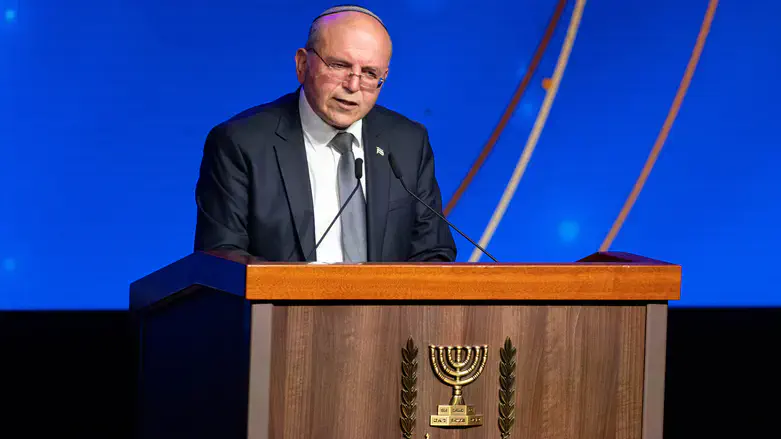
Former National Security Council head Meir Ben Shabbat, now president of the Misgav Institute for National Security and Zionist Strategy, is pushing back against claims that recent developments—such as recognition of a Palestinian state and the adoption of Hamas' narrative by parts of the international community—represent a "diplomatic collapse" for Israel.
"Of course we would have preferred a different approach, especially from friendly nations whose leaders understand Israel's sensitivity to humanitarian concerns and international law, and who know that the situation in Gaza is the result Hamas has deliberately sought," Ben Shabbat told Israel National News.
"Hamas not only uses civilians as human shields for its operatives, it also intentionally causes them suffering to generate international sympathy and negative public opinion against Israel, with the aim of exerting global pressure that disrupts Israel's military efforts and strengthens Hamas' grip on the territory and incoming aid."
Ben Shabbat added, "Unfortunately, some countries fall prey to Hamas' manipulation. The world finds it easier to identify with the suffering of the weaker side. Israel gains sympathy only when its mutilated citizens' bodies dominate news broadcasts, and even then, it is short-lived. The horrors of October 7 were quickly forgotten. Leaders criticizing Israel must understand that their conduct encourages terror elements to exploit civilian suffering. Accepting demands to halt the war because of civilian casualties—caused by terror groups—only strengthens that method, which will not be limited to Gaza."
Commenting on the recent Dutch intelligence report that labeled Israel a "problematic state," Ben Shabbat said: "The importance of Israel's international relations is undeniable—for our economy, science, security, and many other interests. Labeling Israel in this manner is a declarative step that may be followed by concrete measures across different fields. Moreover, such a step encourages others to follow suit. While we should not exaggerate the severity of these developments, we must not take them lightly. Israel must utilize all diplomatic and informational tools, including close cooperation with the Trump administration, which has provided meaningful support in these matters."
Addressing the recent declarations of Israeli ministers as persona non grata by several countries, Ben Shabbat stated: "Beyond the personal damage to those ministers, this stains the State of Israel and its government. Such steps are typically directed at dubious regimes or individuals. These cases must be handled by the Israeli government, not solely by the affected ministers. Immediate responses are not always required, but states making such declarations must understand there will be consequences."
Regarding French President Emmanuel Macron’s declaration of support for recognizing a Palestinian state, Ben Shabbat noted: "Macron’s initiative was not surprising. He raised the idea in December and again in April—well before the 'Gaza famine' campaign. It appears that for Macron, the gesture itself is what matters, not its content or its viability. It is doubtful he considered its implications for intra-Palestinian dynamics. Such a move will not strengthen Mahmoud Abbas or the Palestinian Authority (PA), whom Macron claims to support. The credit will go entirely to Hamas, thereby strengthening the organization."
Ben Shabbat warned: "Portraying Hamas as the party responsible for such a diplomatic gain, along with its high popularity among Palestinians and the ongoing succession struggle over Abbas' position, will hasten Hamas’ takeover of the PA, including in Judea and Samaria. Any achievement attributed to Hamas, particularly a diplomatic one, provides encouragement for terrorism. Instead of uniting around the rejection of terror, this sends the opposite message: terror pays."
"Even without Hamas," he continued, "the notion that the PA can function as a viable independent state ignores its fundamental issues—from the limited legitimacy of its leadership and internal structural flaws, to its support for terrorism and its basic inability to maintain order or address security threats. Discussions of 'reform' as a prerequisite for statehood are laughable to those familiar with the local reality. Without the support and security assistance of the IDF, it is doubtful the PA could stand on its own."
Ben Shabbat stressed that unilateral recognition of a Palestinian state has limited practical impact: "It does not address borders, and in fact, most countries already recognized a Palestinian state when it was granted observer status at the UN. The primary impact is psychological—it generates momentum and lays the groundwork for future steps."
"From a security perspective, regardless of definitions, Israel will need to maintain its current presence and take all necessary measures for its defense. There can be no compromises. Israel must retain full control over its borders and security barrier, continue striking terror infrastructure, and prevent the replication of the Gaza scenario elsewhere. After the events of October 7, Israel cannot afford further dangerous experiments. This embodies our national principle: we will defend ourselves, by ourselves."
"With respect to Gaza, the first principle is what not to do: under no circumstances should the war end due to international pressure," said Ben Shabbat. "Halting the fighting now would cast doubt on Israel's assertion that dismantling Hamas is an existential necessity. It would expose Israel to extortion and allow Hamas to regroup. We must not endanger our soldiers in Gaza to satisfy Israel's critics. Rather than defending or apologizing, we should actively promote President Trump’s voluntary emigration initiative."
"This is the real solution to Gaza’s core problems. Surveys show a high proportion of Gazans are open to emigration. This is also the scenario Hamas fears most. It would alleviate the humanitarian crisis and offer a credible response to Israel's detractors."
Ben Shabbat outlined additional steps: "It is time to completely sever internet, communication, and social media access in Gaza. Though frequently discussed, little has been implemented. These tools enable Hamas to maintain control, relay information, direct propaganda, and operate enforcement mechanisms."
"Israel should also create designated humanitarian zones—only in these areas should civilian aid be delivered. Aid must not enter zones where civilians were instructed to evacuate. These areas should be sealed off and Hamas terrorists within neutralized."
"Moreover, Israel must target Hamas leadership abroad. It is unacceptable that these leaders enjoy de facto immunity while continuing to orchestrate the group’s political activities. Neutralizing them is critical to restricting Hamas’ ability to recover after the war."
Regarding policy toward Judea and Samaria and the PA, Ben Shabbat emphasized: "Israel must continue its existing policies without concession. We should equip our allies in the Trump administration with accurate information to enable them to support us effectively."
Commenting on the battle of narratives, Ben Shabbat acknowledged: "Israel should have done more in the field of national public diplomacy. However, we must not fall into self-blame. It is unclear whether greater efforts would have significantly altered global opinion."
"What is urgently needed is effective communication with the Israeli public, which is currently confused and uncertain about the direction we are headed. To enlist the public for a prolonged and difficult campaign, the government must clearly explain its policy, justify its strategy, and strengthen public confidence in the justice of our cause. Only then will many Israelis become voluntary ambassadors for Israel’s message."
"And in these days of Tisha B’Av mourning—also a time of anti-Israel propaganda—it would be appropriate to prominently broadcast October 7 footage on television and social media. Even if it does not sway world opinion, it will at least reinforce our understanding of why dismantling Hamas is essential. If we are unwavering in this mission, the world will ultimately accept it."