

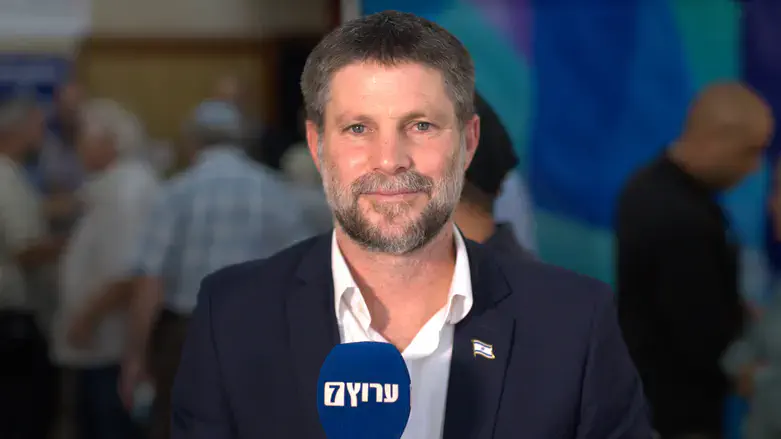
Finance Minister Bezalel Smotrich acknowledged in an interview with Arutz Sheva - Israel National News that he is not fully satisfied with recent operations in Gaza, but he believes progress is being made toward achieving the stated objectives.
“The reality on the northern border has significantly improved due to the war, and the trend is toward further improvement,” Smotrich said.
“We dismantled Hezbollah’s infrastructure. There is a real chance of fully disarming Hezbollah through the Lebanese government. Iran is fed up with this pathetic proxy. The IDF won’t leave the five positions it currently holds inside Lebanon. The Shiite villages haven’t been rebuilt as previously promised — and they won’t be. The era of looking from Kiryat Shmona and seeing Hezbollah scouts watching your home is over. That won’t happen again. Residents are returning to a completely different security reality,” the minister declared.
When asked whether he is satisfied with the military's accomplishments in Gaza, Smotrich admitted there is room for improvement. Still, he affirmed: “We are moving forward and are determined to achieve all the goals of the war: the complete destruction of Hamas, the return of the hostages, and, with God’s help, much more than that. We remained in this government because we are doing many good things — including in Gaza and its aftermath.”
Smotrich addressed his primary focus: rebuilding after the recent conflict. “I don’t like the word ‘rehabilitation.’ We want growth — much, much more significant,” he said, speaking of the future of Israel’s north.
“I’ve just come from a meeting with civil society organizations from across the spectrum — right and left, religious and secular, moshavniks and kibbutzniks, youth movements, community nuclei, mission groups, educators, students, and pre-army academies. There is tremendous mobilization,” he noted, referring to the government’s decision to allocate 100 million shekels to civil society groups leading the strengthening of the north.
He also cited a 12-billion-shekel allocation for northern development, along with an additional 3 billion shekels for areas slightly farther from the border. This is in addition to decisions made at the last cabinet meeting to support towns and villages within 0-9 kilometers of the security fence.
However, he expressed frustration with the exhausting bureaucracy that slows progress and implementation.
Despite that, Smotrich is convinced that in one year, more people will live in the north than did before October 6, 2023, and that in five years, the region will be thriving, offering better education, healthcare, employment, and welfare.
“I’m moved by the energy here in the north — hundreds of families are arriving, hundreds of social entrepreneurs want to launch countless projects. This is the people of Israel. When we say ‘Am Yisrael Chai,’ it means the people are alive with creativity and vision.”
Smotrich said the conflict in the north forced the government to engage seriously with the region, to initiate programs and allocate budgets. “I’m convinced that sweetness will emerge from bitterness, and that out of this war we will break forward.”
He added that in his view, there is no competition between national missions, and it's a mistake to claim that only after dealing with Judea and Samaria should the north be addressed.
“We are developing the north on an unprecedented scale — just as we are establishing 11 new towns in the Negev and investing in Judea and Samaria. All of the Land of Israel is ours.”
Focusing on the north, Smotrich said: “We need more and more families. There are initiatives from pre-army academies, students, educators — but we need families. We need children in the schools, kindergartens, and playgrounds. Come north. We passed a government resolution to sell land plots for 100,000 shekels, including development costs — and if you’re a reservist, just 50,000. There’s nothing like this anywhere. Come to the north.”
He concluded the interview by praising Keren Kehillot (Communities Fund), which leads the national and social religious community initiatives across the country: “The startup pioneers of this massive social enterprise are Keren Kehillot. Everyone has seen how great this is and has joined in. Today, we are funding them with 100 million shekels annually, in education and settlement. They deserve nothing less than a deep bow of respect.”