
Parashat Mattot records, inter alia, Israel’s riposte to the conflict with Midian, which was itself recorded in the two parashot Balak and Pinchas: “Hashem spoke to Moshe saying: Avenge the Children of Israel’s vengeance against the Midianites; afterwards you will be gathered unto your people” (Numbers 31:1-2).
G-d hereby informed Moshe that he had but one final task to fulfil in this life, after which he would die.
Now there are certainly plenty of reasons to delay a military campaign: training the troops, advanced training for the commandos, sending forth scouts on reconnaissance missions, gathering intelligence on the enemy, analysing the intelligence, launching raids to attrit enemy forces, waiting for the appropriate season with advantageous weather... valid reasons are legion.
Moshe could easily have prolonged his life by delaying this military campaign by months, even by years.
His alacrity in obeying G-d’s charge, even though he knew that he was thereby hastening the end of his own life, was the very epitome of מְסִירוּת נֶפֶשׁ, self-sacrifice.
Yet something is puzzling:
The Moabite-Midianite spiritual attack on Israel happened at the end of Parashat Balak (Numbers 25:1-9), followed immediately by Pinchas’s slaying of Cozbi and Zimri, the Midianite princess and the Jewish tribal leader who were consorting in public. Pinchas’ killing of these two immediately stopped the plague, and no more Jews died.
Then came the census (26:2-65), the tangentially-connected episode of the five daughters of Tzlof’chad (Zelophehad) demanding their portion in the Land of Israel (27:1-11), Moshe’s conferring leadership onto Joshua (vs. 12-23), the commanding of the festivals and their accompanying sacrifices (chapters 28 and 29), and laws of oaths and vows (chapter 30).
Only after all these did G-d command Moshe to wage this war of vengeance against the Midianites.
If this war was so urgent, then why did G-d delay the command to go to war until now, after so much happened in the interim? Moshe could convincingly have told G-d: You were not in much of a hurry to command this war, so why should I be in a greater hurry than You?! “Do not be overly righteous” (Ecclesiastes 7:16) - “more righteous than your Creator” (Kohelet Rabbah 7:1).
G-d told Moshe to “avenge the Children of Israel’s vengeance”, and Moshe told the Jewish nation to “attack Midian to avenge Hashem” (Numbers 31:3). So was this war to avenge Israel (as G-d told Moshe), or to avenge Hashem (as Moshe told the Children of Israel)?
- This war was a war for Kiddush Hashem, Sanctification of the Name of G-d. And since Israel is G-d’s nation, His ambassadors, His delegates, His representatives to the rest of humanity, G-d’s vengeance and Israel’s vengeance are actually one and the same thing. From G-d’s perspective the war against Midian was Israel’s vengeance, from Israel’s perspective it was G-d’s vengeance.
And before going out to war, every Jew - not just the soldiers in the field but every son and daughter of Israel - had to know who they were and what they were fighting for.
With this perspective, we perceive that each of these seeming interruptions reinforced Israelite identity.
The census inevitably strengthened everyone’s family and tribal identity, reminding everyone of their history and background, and their descent from Abraham and Sarah, from Isaac and Rebecca, and from Jacob and Leah, Rachel, Zilpah, and Bilhah. This census infused every Jew with his personal, family, tribal, and national history.
Every Jew was thus inspired by knowing that he was an integral component of the nation.
As much as the census inspired the nation by reminding them of their past, Tzlof’chad’s five daughters demanding their portion in the Land of Israel inspired every Jew with hopes for the future, the vision of imminent Jewish sovereign independence in their homeland.
Then Moshe conferred leadership onto Joshua, guaranteeing continuity for the nation’s future.
Of course there was also another aspect - less pleasant, best left unspoken in the preparations for the impending war: A good commander, whether political or military, has to have a lieutenant, a potential successor who can take over his mission in the event that he becomes incapacitated or dies.
The second-in-command, the deputy commander, the vice-president, the crown prince - these ensure that when the time comes, there will be a smooth transition of power, that the nation will not be left leaderless. And approaching this war, Moshe had already been told by G-d Himself that he would die immediately thereafter.
Moshe did not yet know that G-d would grant him another several weeks in this world, time he would use to bid a long and loving farewell to the nation he loved and had served so faithfully for so long. Before embarking on his last battle, he publicly appointed Joshua as his successor - painfully aware that once the final soldier would strike the final blow in the impending war, he might be gathered unto his people forthwith.
And then G-d commanded the festivals and their accompanying sacrifices. There is little that anchors a Jew more securely in his national identity than the festivals and their concomitant sacrifices.
The Tamid, the twice-daily offering (Numbers 28:3-8), is a constant reminder of the Jew’s connexion with G-d.
Shabbat (vs. 9-10) reminds the Jew, week by week, that “you were a slave in Egypt and Hashem your G-d took you out from there with mighty hand and outstretched arm” (Deuteronomy 5:14).
Rosh Chodesh, New Moon (vs. 11-15), reminds us of our emancipation from Egyptian slavery, our charge by G-d to take control over our own time by calibrating our own calendar instead of being subservient to slave-drivers - the first national mitzvah that G-d ever gave us (Exodus 12:1-2).
Then come Pesach and Shavuot (Numbers 28:16-31), thoroughly synthesising and integrating our national history with our homeland. Pesach both celebrates our redemption from Egypt and marks the beginning of the barely harvest in Israel; Shavuot both celebrates the Giving of the Torah and marks the end of the barley harvest, the beginning of the wheat harvest, and the season of the first fruits in Israel.
Then come Rosh Hashanah and Yom Kippur (29:1-11), teaching the unique and intimate relationship between the Jew and his G-d.
Then Sukkot, which again synthesises and integrates our national history with our homeland. It both celebrates our desert wandering, and also marks the end of the harvest and of the agricultural year in Israel, hence the name חַג הָאָסִף, the Festival of the Harvest (Exodus 23:16, 34:22).
And then, having completed the annual cycle of the Jewish calendar, in the opening paragraph of this week’s parashah (Numbers 30:2-17) G-d commands the laws of oaths and vows, ingraining the precepts of honesty and personal responsibility.
I suggest that the census, Tzlof’chad’s daughters demanding their inheritance in Israel, Moshe’s conferring leadership onto Joshua, the festivals and their accompanying sacrifices, and laws of oaths and vows did not constitute an interruption between Midian’s attack and Israel’s response. Rather, these were all crucial components of preparation for Israel’s military response.
It is axiomatic that a soldier who knows what he is fighting for will fight far more tenaciously than a soldier who fights merely under orders. The soldier who has an intimate connexion with his nation, who loves his nation, the soldier who is steeped in his nation’s history and destiny, will inevitably fight far more ferociously in their defence and to avenge the spilt blood of his brethren.
Similarly, the non-combatants who remain in the camp - the women, the children, the men who for whatever reason were not conscripted - will maintain far higher morale when they understand what their brothers, husbands, fathers, sons, and friends are fighting for.
As every soldier who has ever fought on the front lines will testify, civilian morale at home has a direct impact on morale on the battlefield.
So these events were just as important to Israeli victory against Midian as training the troops, reconnaissance missions, intelligence-gathering, and the like. A nation which knows what it is fighting for, a nation which is united within itself, a nation whose general population supports its army, an army which has full trust in its national leaders - this is an army with an insuperable advantage.
Half-a-century ago, on 21st February 1975, Ephraim Kishon, Israel’s national humourist and one of the world’s most widely-published satirists, published an article in the Israeli daily Ma’ariv (https://www.makorrishon.co.il/nrg/online/11/ART/862/443.html). Though Kishon’s regular column in Ma’ariv ran for decades, this particular article became one of his most memorable and widely-quoted pieces.
Under the title הַכִּפָּה הַסְּרוּגָה (“The Knitted Kippa”), he bemoaned the deterioration of Israeli society, its loss of values, its growing fragmentation, alienation between parents and children - and observed that “the first signs came from abroad, during the years of plenty. The Israeli traveller discovered, to his great satisfaction, that world Jewry showers great support on the successful Jewish state... But more accurately, the parents are Zionists, the children not. When they, the children, are active Zionists, there is no need even to scratch them to discover that they are a religious family. They learn Hebrew out of principle, they send their children to Jerusalem out of thousands-years-old calling, both in the State’s glory-years and in its lean years. One gets the embarrassing feeling that the anachronism of kashrut and Shabbat-observance are the guarantors of true love of Zion, independent of victories”.
And then, Kishon the satirist bares his soul:
“The satirist is beginning to get confused...the humourist is happy to admit his mistake. It is too late for he himself to become religious...but he freely admits that the ideas which he sees as old-fashioned have produced better Israelis, that the stubbornness of religious parents, which he derides, has made better youth, that the kosher kitchen has proven to be a stronger spiritual institution than the fortresses of intellect and progress”.
3,297 years ago, before despatching the Children of Israel on their war of vengeance against Midian, G-d infused them with the spiritual reinforcements necessary for victory - their national identity, their sense of history, their understanding of their destiny.
And Parashat Mas’ei, the final parashah in the Book of Numbers, inscribes Jewish history and destiny on the Land of Israel:
The name מַסְעֵי, Mas’ei, meaning “Journeyings”, is taken from the opening words:
אֵלֶּה מַסְעֵי בְנֵי־יִשְׂרָאֵל...
“These are the journeyings of the Children of Israel who left the land of Egypt…” (Numbers 33:1). The Torah gives a précis of our desert wanderings, listing the 42 places in which we encamped during those 40 years (vs. 1-49).
These 42 stations correspond to the 42 lines in each column of a Sefer Torah (Sof’rim 2:11), to the 42 Levite cities in the Land of Israel (Kli Yakar on Numbers 33:1), and to the 42 letters in the concealed Name of G-d (Malbim on Numbers 33:5).
And immediately after, G-d gives us the borders of the Land of Israel which we are poised to inherit.
G-d, the Torah, and the Land of Israel are inseparable from each other. Just as we cannot inherit the Land of Israel without G-d and the Torah, neither can we inherit the Torah without G-d and Land of Israel.
G-d has written His own Name on Jewish history and destiny, and on the Land of Israel. There can be no complete Torah without the Land of Israel, just as there can be no Land of Israel without Torah.
We invariably read Parashat Mas’ei (or Mattot-Mas’ei) during the Three Weeks of mourning for the destruction of our Holy Temple and our Land, to tell us that Torah outside of the Land of Israel is inevitably lacking and defective.
We live today in one of the most blessed of generations - a generation in which we have inherited our Land again, and in which every Jew has the unprecedented opportunity to come home to Israel, there to live the Torah as G-d intended it to be.
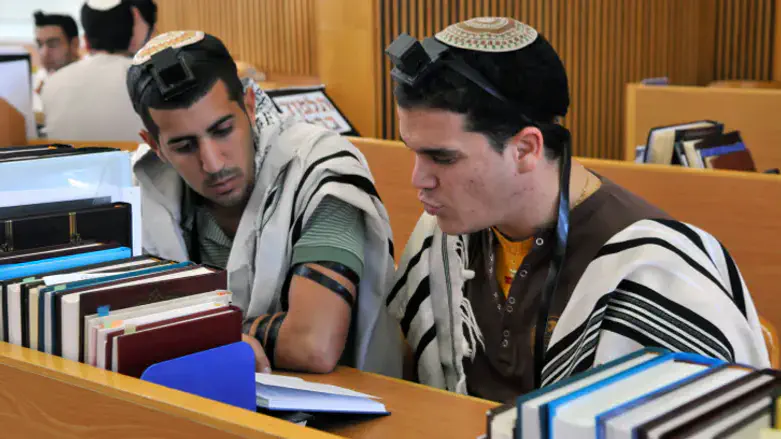
It is no coincidence that today, in Israel, the religious soldiers prove to be the most dedicated fighters. An ever-growing percentage of combat soldiers, officers in the elite commando units, combat pilots, and the like wear kippot.
These are the soldiers into whose hands the security of State of Israel is best entrusted - the soldiers who understand best what it is they are fighting for.