
The International Sociological Association, founded under the auspices of the UN in 1949, has suspended the Israeli Sociological Society. The suspension comes ahead of the Sociological Forum in Rabat. Just days earlier, the International Sociological Association had issued a statement of solidarity with Iranian scholars in response to a “request from the Iranian Sociological Association”.
Belgian university rectors have launched an “urgent appeal” to the EU to expel Israel from the Horizon research program. The Belgian initiative is supported by 4,500 European academics, who in turn have signed a petition to expel Israel and presented it to Ursula von der Leyen.
“Protect Iranian scientists from attack”, headlines the journal Nature, referring to scientists working on the regime’s atomic bomb. Meanwhile, Israel is counting the damage done by Iranian missiles to its universities.
It all started with a ballistic missile aimed at the Weizmann Institute of Science in Rehovot, southeast of Tel Aviv, and continued with two attacks on Ben Gurion University of the Negev, to the south. Iranian missiles damaged Tel Aviv University and Tehran raised alarm at the Technion.
At the Weizmann Institute, named for the chemist whose 1915 discovery of a revolutionary process for producing acetone for gunpowder helped Britain’s war effort in World War I and who would become Israel’s first president, a scientist pioneered amniocentesis (the now ubiquitous method of prenatal diagnosis). His fellow scientists developed the multiple sclerosis drug Copaxone, Ada Yonath conducted the work on ribosomes that won her the 2009 Nobel Prize in Chemistry, and three scientists received the Turing Award in computer science.
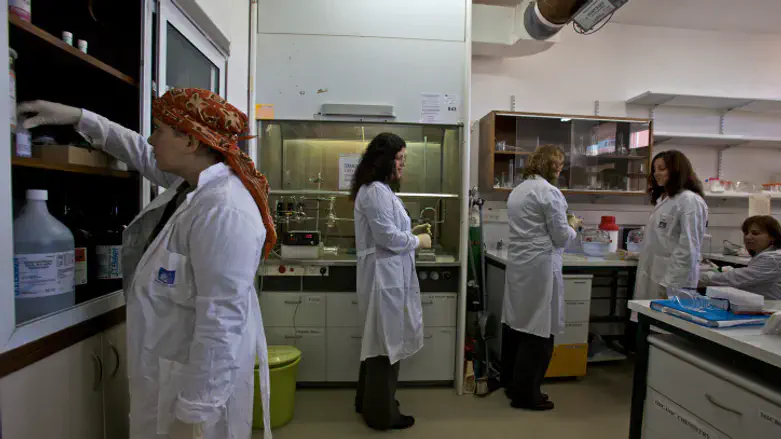
But 40 to 45 laboratories in various buildings were destroyed and 20 others were damaged by Iranian ballistic missiles. Shock waves damaged 40 buildings across the campus. The institute estimates the physical damage at $300 million to $500 million.
In Be’er Sheva, the missile that hit the Soroka Medical Center also severely damaged the nearby Ben Gurion University. “The entire medical school was damaged; we don’t know how we will be able to teach there again, and six laboratories were completely destroyed,” says Daniel Chamovitz, president of the Rectors’ Association.
Chamovitz divides the damage into two levels. The first is the destruction of laboratories and materials, followed by the second, Western academic ostracism. “A research building costs fifty million dollars. Add fifty to a hundred million dollars to purchase equipment. That’s billions of shekels in total damage.” In some cases, decades of research have been lost.
“I don’t know what I would do if I lost all the seed species I collected for my botanical research. It scares me to think about it.”
That happened as well. Oren Schuldiner, the chair of cell biology at Weizmann, lost thousands of fruit fly samples that he uses to map neural changes that may one day help us better understand diseases like schizophrenia and autism. The entire wing of the building collapsed. All his work from the past seventeen years was destroyed.
Much to the delight of the boycott initiated by the crazy West that wants to protect the Iranian scientists out to blow up the globe and go after life-saving Israeli research.
Giulio Meotti is an Italian journalist with Il Foglio and writes a twice-weekly column for Arutz Sheva. He is the author, in English, of the book "A New Shoah", that researched the personal stories of Israel's terror victims, published by Encounter and of "J'Accuse: the Vatican Against Israel" published by Mantua Books, in addition to books in Italian. His writing has appeared in publications, such as the Wall Street Journal, Gatestone, Frontpage and Commentary.