


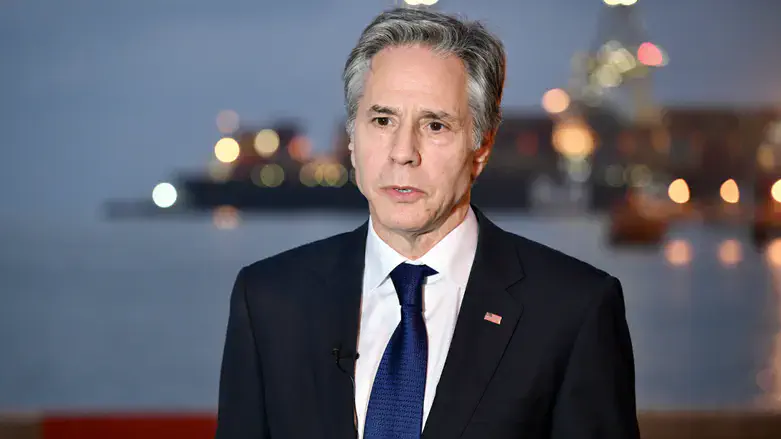
US Secretary of State Antony Blinken spoke on Wednesday with reporters at the Ashdod Port, during his visit to Israel.
On the talks for a hostage release deal, Blinken reiterated that it is up to Hamas to accept the most recent proposal made to it.
“Israel has made very important compromises in the proposal that’s on the table, demonstrating its desire, willingness to get this agreement, to get it done. Now, as we’ve been saying, it’s on Hamas. Hamas has to decide whether it will take this deal and actually advance the situation for the people that it purports to care about in Gaza. There is no time for delay; there is no time for further haggling. The deal is there; they should take it,” said Blinken.
The Secretary of State also noted that, during his meeting with Prime Minister Benjamin Netanyahu earlier in the day, “We also spent some time talking about something that’s been a priority for President Biden from day one, since October 7th and since the conflict between Israel and Hamas, and that is trying to make sure that people who’ve been caught in this crossfire get the assistance they need, the humanitarian assistance they need. And this has been, as I said, a priority for the President from day one. It’s been a focus of every trip that I’ve taken to the region, and this is now, I think, my seventh since October 7th.”
He praised Israel for “meaningful progress” in the entry of humanitarian aid to the Strip in recent weeks.
“Yesterday we were in Jordan. Some of you saw the trucks being loaded in Jordan. They went through Erez for the first time today, and that’s very important because that’s direct access to the north of Gaza. And this is the result of a very important collaboration involving Israel, involving Jordan, involving as well the United Nations. We have our own maritime corridor that is probably a week away from being operational. And here in Ashdod, the – Israel’s primary port, we’re now seeing a real flow of assistance that is going to the people in Gaza,” said Blinken.
He also said that "the progress is real, but given the need, given the immense need in Gaza, it needs to be accelerated, it needs to be sustained. And as we focus on all of the necessary inputs, the number of trucks that are moving, what matters the most is the impact, and we’re focused on measuring that, making sure that people are actually getting what they need, that it’s being delivered to them. One of the remaining challenges is making sure that when assistance gets through it can be effectively distributed within Gaza, and we have to make sure that it’s not interfered with or impeded by Hamas.”
Asked by a reporter about a possible Israeli operation in Rafah and whether Israel has provided a viable plan for such an operation, Blinken said that he is focusing on a ceasefire and a hostage release deal and then added, “On Rafah itself, look, our position is clear. It hasn’t changed; it won’t change. We cannot, will not support a major military operation in Rafah absent an effective plan to make sure that civilians are not harmed. And no, we have not seen such a plan. And at the same time, there are other ways – and in our judgment, better ways – of dealing with the real ongoing challenge of Hamas that does not involve or require a major military operation in Rafah. We’ve been talking with the Israelis about that; we’ll continue those conversations.”
A reporter asked Blinken about comments by Netanyahu that he would do a major assault on Rafah with or without a deal.
“I’m not going to speak for him. I’ll let him speak for himself. All I can tell you is that what we discussed today, among other things, was getting this agreement which involves an immediate ceasefire, hostages home, and then working to build on it. And that’s what we talked about today. So let’s see if we can get this done,” Blinken replied.
“Look, I think this is something that the whole world is watching, and if Hamas actually purports to care about the Palestinian people and wants to see an immediate alleviation of their suffering, it will take the deal. If it doesn’t, I think that’s further proof that it doesn’t care a bit about the Palestinian [people],” added the Secretary of State.