
Whether Parashot Mattot and Mas’ei are read together (as they are this year, as in most years) or separately (as they are in less than one-quarter of years), both are invariably read during the Three Weeks – the period from the 17th of Tammuz to the 9th of Av during which we mourn for our lost independence and devastated Land.
This is surely not coincidental: when Chazal set the annual Torah-reading cycle towards the end of the Second Temple period, they divided up the Torah such that certain parashot always coincide with specific junctures of our calendar.
Parashat Mas’ei opens with a précis of Israel’s journey from Egypt to the threshold of their Land:
“These are the journeys of the Children of Israel, who went out from the land of Egypt in their legions, led by Moshe and Aaron…They journeyed from Ra’amses in the fifteenth days of the first month…while Egypt were burying those whom Hashem had smote – every firstborn…and the Children of Israel journeyed from Ra’amses and encamped in Sukkot, and they journeyed from Sukkot and encamped in Eitam…And they journeyed from Eitam and paused at Pi ha-Chiroth…and encamped before Migdol…”.
On and on it continues. Numbers 33:1-49 lists the 42 stations in which the Children of Israel encamped:
Ra’amses;
Sukkot;
Eitam;
Pi ha-Chirot;
Marah;
Eilim;
Yam Suf (the Red Sea);
Sin Desert;
Dofkah;
Alush;
Refidim;
Sinai Desert;
Kivrot ha-Ta’avah (Graves of Lust);
Hateizrot;
Ritmah;
Rimon Peretz;
Livnah;
Rissah;
Keheilatah;
Mount Shefer;
Haradah;
Mak’heilot;
Tachat;
Terach;
Mitkah;
Chashmonah;
Moseirot;
B’nei Ya’akan;
Chor ha-Gidgad;
Yotvatah;
Avronah;
Etziyon Gever;
Tzin Desert, which is the same as Kadesh;
Hor ha-Har (Mount Hor);
Tzalmonah;
Punon;
Ovot;
Iyyei ha-Avarim (also called Iyyim);
Divon Gad;
Almon Divlataymah;
Harei ha-Avarim (the Passes through the Mountains);
Arvot Moav (the Plains of Moab), on the east bank of the River Jordan, facing Jericho.
It is here, in Arvot Moav, where we conclude the Book of Numbers, that the nation will remain for the rest of the Torah, for the rest of Moshe’s life, and until Joshua will lead us across the Rover Jordan to begin the next phase of our national life, the genesis of national sovereign independence in our homeland.
The obvious question arises: Why does the Torah list all 42 of these stations? What does this list add to our knowledge or understanding? After all, we don’t even know where most of these places are, so telling their names doesn’t even enable us to plot the path of the Exodus from Egypt to Israel.
Rashi addresses this, by citing Rabbi Moshe the Preacher (an 11th century scholar, Rosh Yeshiva of Narbonne):
“Why were these journeys written? – To make known G-d’s lovingkindness. Because even though He had decreed upon them that they would wander aimlessly through the desert, you can’t say that they were constantly wandering ceaselessly from journey to journey throughout the 40 years and that they had no rest.
“After all, there were no more than 42 journeys; subtract from these 14, all of which were in the first year before the decree…, and subtract another 8 journeys which were after Aaron’s death…in the fortieth year.
“Consequently, in all those 38 years they made only 20 journeys”.
So according to Rashi, following his predecessor Rabbi Moshe the Preacher, the Torah lists these 42 journeys to demonstrate that the desert trek was not all that terrible.
Immediately after listing these 42 journeys, G-d commands us to extirpate all idolatry and idolaters from the Land of Israel (Exodus 33:50-56), and then proceeds to delineate the borders of the Land (34:1-15).
And then G-d commands that, since the Tribe of Levi was to have no Tribal inheritance in the Land of Israel, they were to be given instead 42 Levite cities (35:1-8).
The Kli Yakar (Rabbi Shlomo Efrayim, Luntchitz, Lvov [Lemberg], and Prague, 1550-1619) posits that these 42 Levite cities correspond to the 42 desert journeys:
“The 42 [Levite] cities correspond to the 42 stations wherein Israel encamped, in all of which they were temporary dwellers [גֵּרִים]; thus 42 cities were given to the Levites, who had no share in the Land” (commentary to Numbers 35:6).
So according to the Kli Yakar, the 42 stations are a paradigm for the Land of Israel.
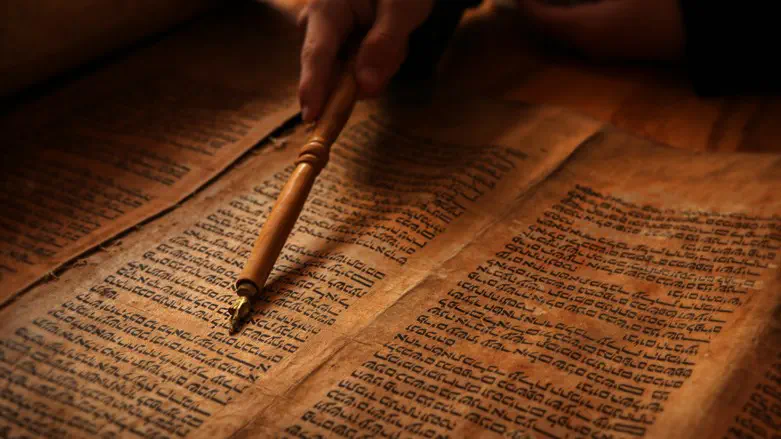
The Talmud offers a very different significance: The standard Sefer Torah [Torah-scroll] has 42 lines in each column, and these 42 lines correspond to the 42 journeys (Soferim 2:11). And this is indeed the Halachah in practice (Aruch HaShulchan, Yoreh De’ah, Laws of Sefer Torah 273:22).
So according to the Talmud, the 42 stations are a paradigm for the Sefer Torah.
There yet another significance to these 42 stations, perhaps the most powerful of all: In Kabbalistic thought, they correspond to the 42 letters in the Concealed Name of G-d (see, for example, the Malbim on Numbers 33:5).
This, too, has actual practical Halachic significance: Because these 42 stations correspond to the mystical 42-letter Name of G-d, they must be read in one single Aliyah, we are forbidden to pause between them and break them up into two or more Aliyot (Magen Avraham 428:8, Mishnah Berurah 428:21, Kitzur Shulchan Aruch 78:4, Aruch HaShulchan, Orach Chaim 138:4 and 428:6).
This needs a Halachic clarification, because almost all printed Chumashim indicate that the second Aliyah (Levi) is called up at Numbers 33:11, which does break up the 42 journeys into two separate Aliyot.
(This does not apply in a year in which the two Parashot Mattot and Mas’ei are read together, as they are this year 5783, as they are in most years: in this double-Parashah, all 42 journeys are included in the fourth Aliyah without a break.)
In practice, almost all congregations read through without a break until the end of verse 39, and then call up the second Aliyah (Levi) for verse 40, in order not to break up the 42 journeys.
The mystical 42-letter Name of G-d is expressed in other places too:
For example, the first Blessing of the Amidah (the Standing Prayer, also called the Shmoneh-Esrei), contains 42 words. It begins with the letter ב of the word בָּרוּךְ, and concludes with the letter ם in the name אַבְרָהָם. The gematria (numerical value) of ב is 2, and the gematria of מ is 40, so this 42-word Blessing nestles between two letters whose value is 42.
Similarly the first paragraph of the Shema (without the first line itself) contains 42 words.
The Written Torah begins with the letter ב of the word בְּרֵאשִׁית, and the Oral Torah (Mishnah) begins with the letter מ in the word מֵאֵימָתַי. Again, the gematria of ב is 2, and the gematria of מ is 40, so the initial letters of the Written Torah and the Oral Torah allude to G-d’s mystical 42-letter Name.
The first paragraph of the Shema contains the injunction: “These words which I command you this day shall be on your heart, and you shall teach them to your children, and you shall speak of them when you sit at home and when you are journeying along the way and when you lie down and when you get up”.
One of the inferences of the phrase וְדִבַּרְתָּ בָּם (you will speak of them) is that we are commanded to speak of בָּם – both the Written Torah (the ב of בְּרֵאשִׁית) and the Oral Torah (the מ of מֵאֵימָתַי). Again, the בָּם whose gematria is 42, alluding to God’s mystical 42-letter Name.
So here we have three allusions of the 42 desert journeys: the 42 Levite cities in the Land of Israel, the 42 lines in each column of a Sefer Torah, and the 42 letters in the mystical 42-letter Name of G-d.
G-d, the Torah, and the Land of Israel are inseparable from each other. Just as we cannot inherit the Land of Israel without G-d and the Torah, neither can we inherit the Torah without G-d and Land of Israel.
G-d has written His own Name on Jewish history and on the Land of Israel, He has inscribed His Name on His Torah and in our prayers. There can be no complete Torah without the Land of Israel, just as there can be no Land of Israel without Torah.
We invariably read Parashat Mas’ei during the Three Weeks of mourning for the destruction of our Holy Temple and our Land, to tell us that Torah outside of the Land of Israel is inevitably lacking and defective.
We live today in one of the most blessed of generations – a generation in which we have inherited our Land again, and in which every Jew has the unprecedented opportunity to come home to Israel, there to live the Torah as G-d intended it to be.