

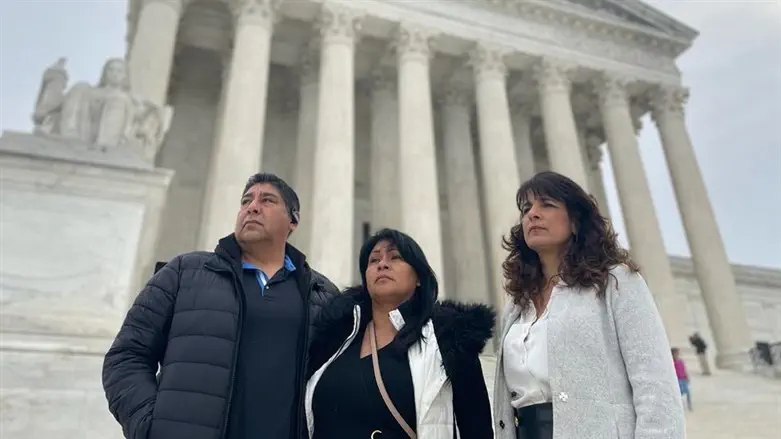
The US Supreme Court will hear two cases today this week in which the immunity granted to online social networks for content published on their platforms. will be examined.
Today (Tuesday), the court will hear arguments in Gonzalez v. Google, which was filed by the family of Nohemi Gonzalez, and American college student who was one of the 130 people who were murdered by terrorists affiliated with ISIS in the Paris nightclub shootings 2015. The lawsuit was filed with the aid of the Shurat Hadin organization and its President, Attorney Nitsana Darshan-Leitner.
The Gonzalez family maintains that terrorist and extremist organizations took advantage of social media to spread incitement ad that the algorithms used by Google for Youtube draws people towards content which radicalizes them into committing acts of terrorism.
In particular, Youtube is accused of hosting videos posted by individuals and organizations affiliated with ISIS which included extreme content such as beheadings, and which were recommended to certain users due to the way the Youtube algorithm functions.
At the heart of the case is Section 230 of the Communications Decency Act of 1996, which grants online platforms immunity from prosecution for the content posted to them by third parties on the basis that the companies are merely platforms and not a "publisher or speaker" of the content.
About 100 'friend of the court' briefs have been filed in relation to the case, including from states, senators, large media corporations and human rights organizations.
A group of Israeli defense officials, including former Defense Minister Moshe Ya'alon, former Police Commissioner Roni Alsheich, former National Security Adviser Yaakov Amidror, Director of the Institute for National Security Studies (INSS) Tamir Hayman, former Director-General of the Strategic Affairs Ministry Yossi Kuperwasser, and former Chief of the Mossad's Counter-Terrorism Division Haim Tomer, submitted their professional opinion to the court that social networks play a decisive role in encouraging and aiding terrorist attacks around the world.
The Gonzalez family sued Google under the Anti-Terrorism Act, alleging that the company had provided "material support" to terrorist and terrorist organizations through its platforms.
Google and other social media companies have warned that changing the status enjoyed by these companies under Section 230 would fundamentally alter the internet as it has existed for the last three decades.
Attorney Nitsana Darshan-Leitner, President of Shurat Hadin, said in a statement outside the court: “After seven long years in which the case has been going on in the US courts, it is time for justice to be done. Social media has become a tool in the hands of terrorist organizations without which almost no terrorist attack is carried out. The sophisticated algorithms that generate billions of dollars for social media platforms have become fertile ground for inciting violence and terrorism, for raising resources for terrorist organizations, and for targeting individuals who will join the circle of terror and carry out attacks. We hope that the composition of conservative judges in the US Supreme Court will reduce the immunity of the social media giants and do historic justice to the victims of terrorism.”
Tomorrow, the Supreme Court will hear a similar case, Twitter v. Taamneh, in which the complainants make similar accusations that Twitter's platform provided "material support" for an ISIS terrorist attack which was committed in Turkey.