

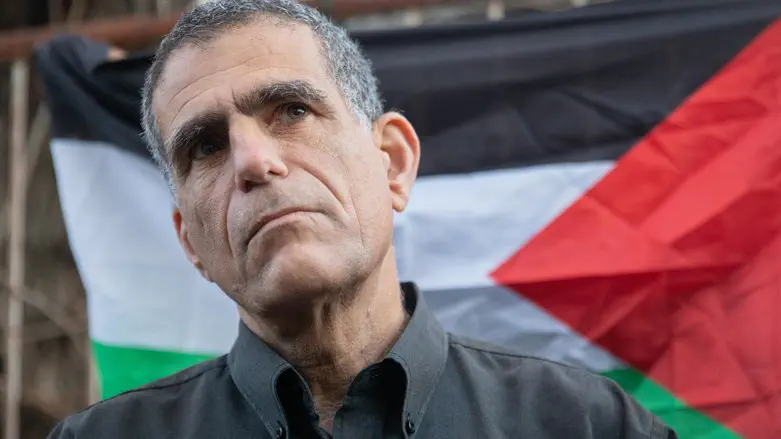
MK Mossi Raz (Meretz) suggests that, in an agreement with the Palestinian Arabs, there will be an exchange of territories and Israel will transfer uninhabited territories in Israel to a future Palestinian state, and possibly territorial waters as well.
In an interview with the Israeli Arab website Kul al-Arab, Raz was asked what issues concern Meretz in the upcoming elections, to which he replied, "Everything is concerning. First and foremost, the possibility of Netanyahu returning is concerning. The possibility of Ben Gvir being with him is concerning. These are two very important things. Also concerning is the possibility that the Israeli left and the Palestinian citizens of Israel will not be sufficiently represented in the Knesset."
Raz explained the decline in support for Meretz in the Arab sector by saying, "Meretz is the same Meretz, what has changed is the State of Israel, and within it the Arab society. The State of Israel today is more religious, more traditional, there was a wave of Aliyah from Russia which we failed to reach out to. If in 1996, the majority of Arab society voted for Labor and Meretz, Arab society has since changed and votes for the Arab parties. It is not Meretz that has changed. We remain the same party that calls for partnership and equality.... today we have two Arab MKs and an Arab minister, much more than in the past. There are also four Arabs in the top ten spots on our slate. On this issue, Meretz came closer than any other faction to being an Arab Jewish faction."
Raz expressed support for the possibility of forming a government with the Joint List and with Ra’am, led by Yair Lapid, or with outside support from those parties as was the case in the Rabin government.
Raz supported the idea of two states, saying, "Just as Jews and Arabs can live together in the State of Israel in Nazareth and Nazareth Illit, so it may be possible to live in the State of Palestine as well. I mean, I don't think that every settlement that is built will necessarily have to be dispersed... what I suggest is that the Israeli government discuss with the PLO, which is the representative of the Palestinians, or any other representative that the Palestinians choose, and reach an agreement... The fact that the settlement is a war crime is clear, it is clear that it is against international law... It should be the fruit of negotiations... I am not enthusiastic about it. I am saying in advance, I would prefer that the settlers in Ariel return home."
On the issue of the future border, Raz advocated an exchange of territories. In this regard, he said, "1967 borders with an exchange of territories like, for example, what we drafted in Geneva. I do not see Israel vacating the Ramat Eshkol neighborhood in Jerusalem or Ma'ale Adumim or Beitar Illit or Modi'in Illit. On the other hand, the Palestinians can be given uninhabited territories in Israel... perhaps in the (territorial) waters."
Raz also said that Israel should hold a dialogue with the elected Palestinian Arab leadership. "I think Israel has someone to talk to, including Mahmoud Abbas, and the leadership of the PLO... I don't think Hamas will be a representative of the Palestinian people. It controls two million people in Gaza and that is why there are talks with them, and Netanyahu even paid them money to reach agreements with them. As far as I am concerned, there is one Palestinian people, I will not determine for the Palestinian people who their leader is."
Raz did not rule out the possibility of establishing one state, but said that he does not prefer such a solution. "I'm not against it. I'll tell you what problems I do see in it. One, who decides on it? Two states I can understand, there is leadership for the Palestinians, there is leadership for Israel, they decide on our borders. I don't see a government in Israel deciding with a government in Palestine on one state, which is the abolition of Israel and Palestine and they will call it Israstine or whatever. Secondly, the Jewish people and the Palestinian people have a right that cannot be given to any other people and that is the law of return."
"The Jews want, rightly in my eyes and I understand why it hurts the Palestinians, that a Jew can return to Israel. The Palestinians want, rightly in my eyes and I understand why it hurts the Jews, that the Palestinian can return. The only way to do this is by dividing into two states. Palestine will get whoever it wants and Israel will get whoever it wants. If you make one state, who will be accepted? Whoever the majority decides? If the majority, which is currently Jewish, decides to accept only Jews and not Palestinians, and if the majority will be Palestinian and decide to accept only Palestinians and not Jews, you have a big problem with that."