
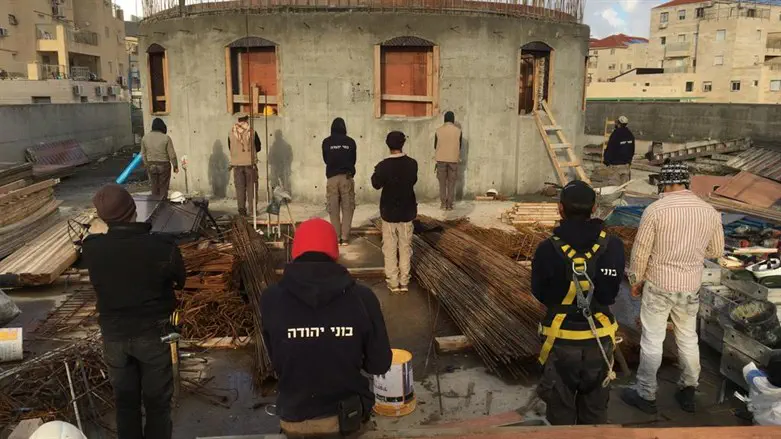
We read in our Parasha of a number of several seemingly unrelated Mitzvot which are juxtaposed:(22:6-12)
-’If a birds nest happens to be before you... and the mother is roosting on the young birds or the eggs..you shall send away the mother, and take the young for yourself..;
-If you build a new house, you shall make a guard rail for your roof..;
-You shall not sow your vineyard with a mixture..;
-You shall not plow with an ox and a donkey together;
-You shall not wear wool and linen together.’
Our Sages, as Rashi brings, derive an important connection between these Mitzvot:’ If you have fulfilled the Mitzvah of sending away the mother bird from her nest, you will eventually build a new house, and fulfill the Mitzvah of the guard rail, because fulfilling one Mitzvah leads to another. You will also, then, come to possess a vineyard, a field, and fine clothes’. Therefore, these passages are juxtaposed.’
Rav Yosef Salant offers a beautiful insight into this:’We learn from this, that as a reward for ‘sending away the mother bird’, not only is one rewarded to merit to build a new house, but that the greatest reward is that he will then be able to fulfill the Mitzvah of erecting a guard rail- and that only because one needs to have a new house to fulfill this Mitzvah, does he merit to have a new house.
‘The guard rail is the Mitzvah alluded to by Rashi, as ‘the Mitzvah you merit to perform’, by having performed the Mitzvah of sending away the mother bird.
‘This, too, is what ‘leads’ to you having, as is set out in this passage, a vineyard, a field, an ox and a donkey, and new clothes- all so that you can fulfill the Mitzvot relating to them, not as independent material rewards.
‘How truly wondrous is the chain, of Mitzvot, one leading to another, and another..!
‘However, as a corollary, if one builds a new house, and does not perform the Mitzvah of erecting a guard-rail, he will not merit that his new house endures, as the only reason he merited the new house was to enable him to perform the Mitzvah of a guard rail; the new house is not in itself a reward for the Mitzvah of sending away the mother bird- only a means to an end: to being able to perform the Mitzvah of the guard rail.
‘It follows, that the guard rail is in reality the guardian of the house, that it should remain in his hands!.’
The Netzi’v deduces the following teaching from the Mitzvah of erecting a guard rail immediately after ‘if you build a new house’, first noting that, of course, this Mitzvah applies equally to one who purchases an old house.
‘In choosing to specify a ‘new house’, ‘ the Torah comes to teach that one who builds a new house should do so on the foundation of a Mitzvah, right from the outset.
‘The Zohar Hakadosh expounds:’For this reason, we are commanded להכין:to prepare the house on the Mitzvah of the guard-rail’’.
Rav Shimon Schwab proffers another reason for the reward for ‘sending away the mother bird’, being the opportunity to perform the Mitzvah of erecting a guard rail: ’The Mitzvah of ‘sending away the mother’, arises only ‘if a bird nest HAPPENS to be before you’; thus, the reward for performing this Mitzvah which comes before you, unexpectedly, is, appropriately, that you be spared from accidental mishaps, which might ‘happen before you’, such as someone falling from your roof- and this by you having merited to the Mitzvah, of erecting a guard rail.’
Rav Chaim miChernowitz sweetens this message, asking: ’Why does the Torah here command that a guard rail be erected when you build a ‘new house’. Surely, as our Sages teach, it applies equally to an old house, that one purchases from another?
‘The answer is, that it comes to teach us what should be our first, and principal, intention, when building a new house: that it gives us the zechut to perform Mitzvot- specifically here, the Mitzvah of erecting a guard rail.
‘This is why the Torah states: ’If you build a new house’, immediately, fulfill the Mitzvah and ‘make a guard rail for your roof’.
‘You might ask: What possible difference could it make to Hashem, if you have this thought at the outset, or later, as long as , you eventually erect it?
‘There IS a critical difference: one who serves Hashem out of love, yearns for the opportunity to express his love, by seeking to give nachat ruach to Hashem, by performing His Mitzvot.
‘By his alacrity to perform this Mitzvah, he lives his ‘need’- and measure for measure - his love will surely be reciprocated.’
The Ktav Sofer adds a halakhic dimension to our subject, bringing the query of our Sages: ’When one builds a new house, what bracha is he to recite? Answer our Sages: he has to pronounce the bracha שהחיינו: Who has given us life, so as to give nachat ruach to our Creator.
‘But surely this is obvious, as all the Mitzvot we perform, are to give nachat ruach to Hashem!
‘It needs to be said here, for if one’s purpose in building a new house is purely for material and hedonistic ends, this bracha should NOT be recited.
‘Only one who builds a new house so that he can fulfill the Mitzvah of erecting a guard rail, and a mezuzah, intending that his new house be a place of assembly for scholars, and like purposes, is entitled to pronounce the שהחיינו bracha, thanking Hashem for giving him the opportunity to perform Mitzvot.’
A parting message from Rav Avigdor Nebenzahl: ‘Our Sages, noting that the Torah here states, that one should erect a guard rail on the roof of their house ‘so that you will not place blood in your house if a fallen one fall from it’, expound that the words ‘the fallen one’, means that it has already been decreed from Above that he is to die.
‘You might therefore ask: Since it has been so decreed, what difference does it make if he falls from your roof, or dies in another place?
‘Answer: True, his fate is sealed, and by taking the precaution of erecting the guard rail, you have not altered his fate, BUT you should aspire to always be amongst those who bring salvation to the world, and not part of the punishment regime.’
לרפואת נועם עליזה בת זהבה רבקה ונחום אלימלך רפאל בן זהבה רבקה, בתוך שאר חולי עמנו.