
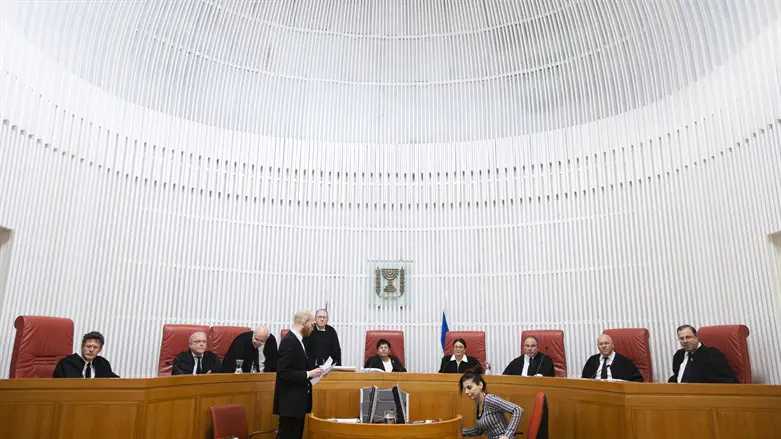
This week, at the eleventh hour, Israel’s Supreme Court issued a very intelligent ruling. It granted an emergency petition filed by a Haredi family on Monday, to prevent the autopsy of a four-year-old boy who is believed to have been killed by a relative over the weekend.
The boy was brought to a Jerusalem hospital on Shabbos after reportedly having being strangled by his mentally unstable 27-year old uncle. The young boy r”l died several hours later.
Police originally announced that they would seek to have an autopsy on the young boy and widespread protests broke out across Eretz Yisroel. At least five protesters were reportedly arrested.
The family had immediately objected to the proposed autopsy, as there was no pikuach nefesh (life-threateniing) need for it - but a local court ruled in favor of the police.
The local court ruling and the police announcement sparked protests by citizens loyal to the Torah across the country.
The family then filed an urgent appeal to the Supreme Court to prevent the autopsy. The Supreme Court overruled the lower court and the burial happened in Jerusalem on Monday afternoon.
Israel’s Supreme Court is situated in the Givat Ram section of Yerushalayim. It consists of 15 judges (including a president) who are appointed by the President of Israel after having been nominated by Israel’s Judicial Selection Committee. The current President of the Supreme Court is Esther Hayut.
Some people question why Jewish law is opposed to autopsies. In this short essay, a brief overview of the “whys” is offered.
THE MULTIPLE LAW SYSTEM IN THE US AND THE STATE OF ISRAEL
In the United States, residents generally face three varying sets of laws. There are federal laws, state laws, and local laws. In the State of Israel, there are only two sets of laws: Federal laws and local government laws.
Generally speaking, mature, intelligent citizens view their laws with a sense of pride and duty. Observing them is not viewed as some onerous burden. Meticulous observance of the law is a matter and source of tremendous pride.
But Jewish citizens of each country have an additional set of laws.
They are the laws of the Torah, a tradition of laws that has been observed since Sinai. When facing the tragedy involved in an intimely death of a family member, Jews are often requested tok submit their family member to an autopsy. The problem is that often, this request is diametrically opposed to one of their deepest values – the observance of Judaic tradition.
In the rest of this essay we will explore five Jewish legal beliefs and traditions. These traditions are, in fact, immutable laws.
We must keep in mind that observant Jews would feel as uncomfortable violating these laws as they would feel supporting an enemy combatant of the country in which they lvie. It is wrong to undermine the laws of one’s country, and it is wrong to undermine the laws of the Torah. Just as there exists patriotic fervor and feeling in the nation’s laws – there is a patriotic fervor and deep feeling in regard to Jewish law. All believing citizens should feel a duty to G-d, country, and family. G-d always comes first in this formula.
QUICK BURIAL
The first law deals with the obligation incumbent upon all Jews to bury the deceased body as expeditiously as possible. The book of Genesis tells us that Man was created in the Divine image. It is a matter of utmost import in Jewish law never to insult the Creator by leaving His Handiwork unburied in a state of indignity and disgrace. Maimonides describes immediate burial as a sacred obligation incumbent upon all of Israel, at all times and in all places.
An autopsy takes time and perforce delays the preparation of the body for burial. It is a delay which flies in the face of our duty toward G-d.
DISGRACING THE BODY
The second law deals with disgracing the body. The Talmud (Bava Basra 154a) deals with the prohibition of disgracing or defacing the human body. This is a separate issue from the obligation of immediate burial mentioned above.
BENEFITTING FROM THE BODY
The third law deals with a prohibition in ever benefiting from the deceased human body. The Talmud in numerous places (Sanhedrin 47b, Avodah Zarah 29b, as examples) describes how it is reprehensible to ever derive benefit from a deceased human body. The only time an exception to this can be made is to directly save a human life. However, to derive any physical benefit from a body is something that should be avoided at all costs.
THEFT OF THE BODY
The fourth law deals with the notion of theft. The human body is sacred and belongs to no one but G-d. We cannot deface, cut open, and or examine the body of a deceased family member. The bodies of our family members are not ours to examine, cut open or explore even in an autopsy. The issue is one of out and out theft as explained in the Talmud (Gittin 20a, Kiddushin 17a – see also Ran Nedarim 47a).
SENSITIVITY TO THE SOUL
Finally, the fifth issue deals with sensitivity. Jewish tradition tells us that the soul is in a state of anxiety and anguish until it is buried in the ground. The more it sees its body being explored, cut, etc. the more agitated the soul becomes.
One of the most basic ideas in which a society can be judged lies in how that society treats the helpless. Does our society abuse the weak, the elderly, the children – in short, those who cannot speak up for themselves? If so, this does not bode well for us. By the same token we cannot abuse the soul in its most fragile state.
The ideas expressed in this article may seem new to the uninitiated. But these beliefs, customs and traditions lie at the core of the Jewish nation. Whenever they are violated they cause extreme stress and anguish to observant Jews.
The laws of Jewish tradition are every bit as important to observant Jews as the laws of the nation. The Supreme Court of Israel did the right thing in overruling the lower court.
It is hoped that this short monograph enabled the reader to appreciate this perspective a bit deeper. The best way to do so is to appreciate the loyalty displayed here to G-d, Whose laws contain long term wisdom beyond the immediate, and not just to country or family. Doing so will be the first step in understanding and empathizing with our fellow man as well.
The author can be reached at yairhoffman2@gmail.comIsrael's