
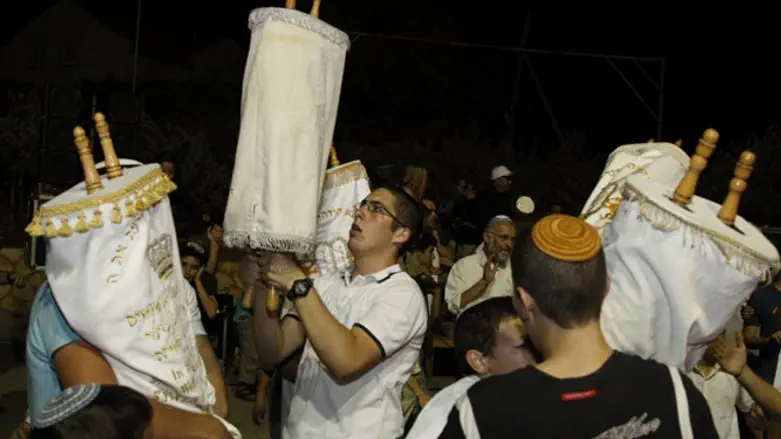
With the upcoming holiday of Simchat Torah, the weekly Torah portion of Vezot Habracha will be read (in many congregations, over and over again). The two prominent episodes are the recounting of the blessings for the various tribes, along with the passing of Moshe. When we focus on his final statements to the Jewish people, one word sticks out (Devarim 33:29):
“Fortunate are you, O Israel! Who is like you, O people whose salvation is through the Lord, the Shield Who helps you, your majestic Sword! Your enemies will lie to you, but you will tread upon their heights”
The beginning of the verse seems to be a declaration of praise to the Jewish nation, the idea that they are “fortunate”. Rashi tries to elucidate this point:
“After Moses specified the blessings to Israel, he said to them, ‘Why do I have to specify all the details? In general: Everything is yours!’”
The explanation is quite odd. Moshe just finished an elaborate and specific listing of blessings for each of the tribes. The entire set of verses are an incredible display of poetic power, relaying significant ideas and prophetic insights concerning the various tribes. Rashi, though, seems to downplay any sense of importance. Moshe did not actually need to launch into any specifics. Why? “Everything is yours”. Should we therefore consider the previous blessings superfluous? And the comment of “Everything is yours”: what does this even mean?
There is an explanation offered by various Midrashim which attempts to clarify the concept of “fortunate”. In this version, the Jewish people are gathered around Moshe. They ask Moshe what the ultimate good in the future will God be bestowing upon them (assuming this question takes place after receiving the various blessings). Moshe responds by pointing to the concept of olam haba, the World to Come. The Jewish people truly are “fortunate”, as this has been set up for them.
We thus see two attempts at understanding the declaration of the Jewish people being “fortunate”. What idea is being expressed by each?
The distribution of blessings to each of the tribes must be viewed as a critical point in the evolution of the Jewish nation. The essential idea of a blessing, at least as presented in the Torah, concerns a relationship between humanity and the surrounding world. When the pleasure of the physical world can function as a means towards an increased service to God, humanity can achieve the peak of existence. Of course, when the enjoyment of the physical world is the result, meaning seeking out pleasure for the sake of pleasure, humanity abandons its objective for existing.
As mentioned above, within the blessings were important concepts related to each of the tribes. They pointed to specific ways in which the surrounding land and environment would be of great benefit to the overall growth of each tribe. Each tribe, then, could see a specific path to benefiting from the blessing. However, the result could very well be a sense of exclusivity in the realm of each blessing. One tribe might view its blessing as only pertinent to them. Competition and jealousy might emerge, as “value” would be place on who had which blessing. The blessings would lose their primary goal, reverting to commodities.
Moshe, then, was returning to the essential idea of a blessing. The blessings are for the betterment of the nation. Of course there was an importance in specifying each one! Yet it was critical to understand they originated from one source, so to speak. There was a solitary underlying idea of blessing coursing through the entire sequence, and while each tribe had its own blessing, there really was only one concept that tied them all together. While each blessing may have had its own expression, according to Rashi, they all shared the same objective. Indeed, the benefits of the blessings were there for everyone.
The Midrashim point to something else. Hearing all the various blessings paints a picture of a truly blissful life. If the Jewish people followed the path laid out by God, with the physical world “responding” to this expression of worship, they would reach the pinnacle of existence. What more could there be? Moshe is addressing this assumption. Indeed, for this world, there is a peak.
However, it is incomparable to the greatest state of existence, namely in olam haba. While there are disputes among Jewish theologians as to the specific parameters of this reality, to all it represents the truest reality for the individual. No matter how wonderful life here may appear to be, the ultimate reward awaits us in olam haba. Yes, the blessings portend for a wonderful life here; yet we cannot appreciate the idea of wonderful when we contrast it to what awaits us.
Reflecting back on these points, the importance of Moshe’s final words cannot be underestimated. While the blessings serve a foundational role for the Jewish people, they can be easily misconstrued and misunderstood. Many societies today place great emphasis and importance on the hedonistic outcomes one can achieve from the physical world. Success and prosperity breed a distorted view of the dangers the realm of the instinctual present. Understanding the role of the blessings, and where the highest plane of existence resides, helps focus the Jewish nation on the appropriate outlook.