

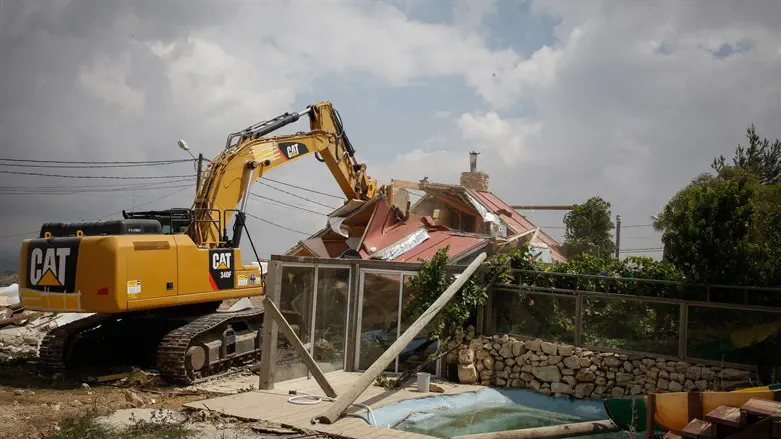
The neighborhood of Netiv Ha'avot, part of the community of Elazar, was demolished in 2018 after Supreme Court judges ruled that due to the fact that around two percent of the land on which it was built was of disputed ownership, the homes were illegal.
In their decision, the justices wrote: "There is no one who disagrees that all the buildings were built illegally, without any zoning permit for the outpost, and without receiving the necessary permissions ... It is the state's obligation to enforce the zoning and building laws as required."
After being evicted, the fifteen families were allotted a sum of money to build equivalent homes elsewhere and meanwhile, provided with temporary housing. The families were supposed to receive the lump sum of money within a few months, along with a portion of land on which to build - a similar settlement to that reached with the families of Amona, who rebuilt their community in Amichai.
However, in the case of Netiv Ha'avot, the state has yet to determine the location of the rebuilt community, preventing the families from constructing their new homes. The money the families were supposed to receive from the government has yet to be distributed, some of it being deposited with the Gush Etzion Regional Council, until such time as the government decides where the families were to be relocated.
The government justified its decision, saying that withholding the funds "ensures that the residents of Netiv Ha'avot would leave their temporary homes when required to," and that "the funds will therefore remain intact and will not be used up before fulfilling their designated purpose." One key problem with this decision was, however, that construction costs have risen considerably since 2018, and the amounts allocated to each family are no longer sufficient for building similar properties to the ones destroyed.
According to a report in Israel Hayom, the Prime Minister's Office has now decided to release most of the withheld funds, conditional on the approval of the Justice and Finance Ministries, allowing the families to invest in real estate. In return, the families are required to commit to leave their temporary homes within two years of receiving the ownership permits for their new permanent homes. The report cites MK Nir Orbach of the Yamina party as being behind the new policy.
Furthermore, families accepting the offer will be required to sign away any further claims on the government related to their homes.