


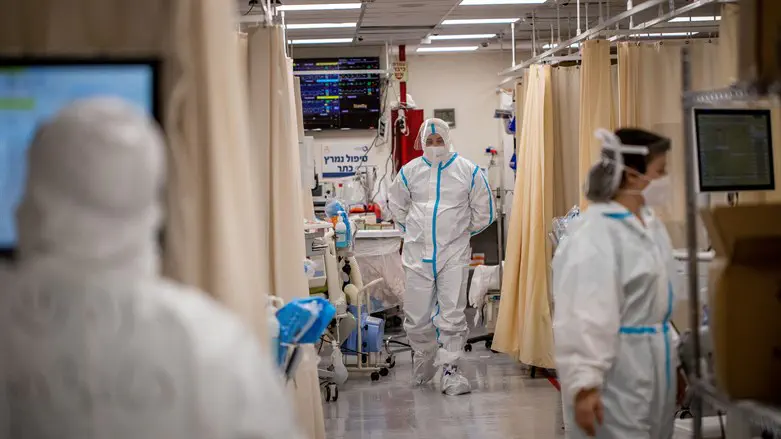
The waves just keep coming and the headlines are verging on the apocalyptic - but is the panic grounded in reality? A new report (to be published in full in Friday's edition of Israel Hayom) suggests that hospitals, far from being close to collapse, are actually coping admirably with the challenges posed by the Omicron variant of coronavirus. One by one, hospital directors offered welcome reassurance that with the knowledge they have amassed over the past two years, they are ready to deal with the situation, despite the public perception that things are getting out of control.
All the same, there appear to be a number of areas of concern, such as a possible shortage of ICU beds if the number of seriously ill COVID patients rises exponentially (which has yet to occur), staff exhaustion, and also frustration with members of the public who are seen as too lax with regard to wearing masks and maintaining social distancing.
"I've heard about projections of fifty thousand new cases each day," said Dr. Yaron Muscat, director of Meir hospital in Kfar Saba, "but I don't think we're going to reach numbers like that. However, if we do, and if we send everyone into quarantine, the country won't be able to function. We've made preparations to be able to conduct large numbers of tests for hospital staff; if many test positive, it will make our work a lot harder, but right now, at the beginning of the wave, we're managing. If and when there is a sharp increase in the number of cases in the general population, then there's going to be a corresponding increase among healthcare workers, and that is problematic and not something we can prevent from happening."
Initial data coming out of South Africa have indicated that although Omicron is extremely contagious, it is far milder than Delta; subsequent data have confirmed this. According to Professor Yoram Weiss, director of Hadassah hospital in Jerusalem, "The number of people who are critically ill is rising, but slowly. This strain is more infectious but less virulent. As the numbers of those infected rises, there will naturally also be a rise in the number of people with severe illness who need to be hospitalized, and if we had been dealing with such infection rates with the Delta variant, we would have been in a very difficult position. Right now, those who are critical condition are mainly the unvaccinated," he added. "The statistics show that those who have been vaccinated twice, and certainly those who have had three doses, enjoy significant protection against critical illness."
Dr. Eran Rotman, director of Beilinson hospital in Petah Tikva, emphasized that, "In our hospital, there's no pressure, no sense of panic - and no reason for people to get all stressed out. We are prepared, and we can deal with this wave. Each wave has its own characteristics and has to be dealt with in its own way. But we're not seeing seriously ill COVID patients being admitted - what we are seeing is people being admitted for other reasons and then testing positive for COVID. At the end of the day, we're going to reach herd immunity," he predicted, "and living with COVID will just become part of daily life."
Dr. Shlomi Kadosh, director of Soroka hospital in Be'er Sheva, struck a different note. "Even if the government can't make up its mind, the general public still should show a sense of responsibility," he said. "I find it distressing to see people failing to do their part, not being meticulous in wearing face masks, in social distancing, in refraining from large gatherings. It's terrible that people think it's okay to go to parties or events in enclosed spaces. People have to demonstrate responsibility, but there's a feeling that they have stopped thinking about each other and about the people who are going to end up paying the price - those who end up in hospital. I'm a fan of Hapoel Be'er Sheva," he added, referring to his home town's football team. "But I weighed the risks and decided not to go to their games. Everyone has to make his own risk assessment, and not look for excuses provided by this minister or that one on the evening news."