


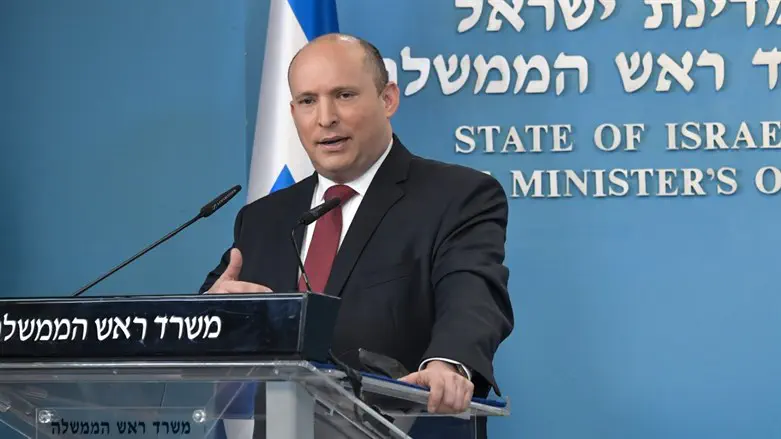
Prime Minister Naftali Bennett said Tuesday that the overarching goal in the fight against the Omicron variant is to avoid closing the economy and that is the purpose of the decision made today to change the isolation policy.
"Today there is a significant turnaround in the campaign against the Omicron, and it is growing here with us after five weeks. With the coronavirus, each strain is different and requires a different preparation. The Omicron is a very contagious strain, we still do not know its lethality, although there are pretty good indications that it is significantly better in terms of serious cases. However, it is clear that if the extent of the infections is much greater, we will reach a very high level of critically ill patients," Bennett said in a briefing to reporters.
The Prime Minister added that "what has developed in the last two weeks and more so in recent days, mainly based on watching what is happening abroad, is an understanding that if we continue the current isolation policy against Omicron, even for vaccinated people who come in contact with the infected, we will be in de facto lockdown. Because a lot of citizens will be in isolation - and every time they leave - as soon as they meet another infected person, they will enter further isolation."
He notes that "the main reason it was so important to me five weeks ago to close the skies of Israel to foreigners was to buy time to see, understand, learn, develop the right strategy and carry out preparatory actions. During this period we bought time to build the strategy because the alternative is either to go to an effective lockdown based on the level of infection, which does not achieve the goal we want, or to reach the wrong strategy."
Therefore, from now on, any person with a green pass who comes in contact with an Omicron patient, comes out of isolation after one negative test. "Anyone who has a green pass, which means fully vaccinated or immunity and is protected from relatively serious illness, and has been exposed to a verified carrier should approach being tested, wait until the result and assuming it is negative he can continue as usual, although he must be careful not to go to crowded places. Yes, you can go to school and to work, even if it is a little crowded. On the other hand, those who are not vaccinated and are exposed must enter a week of isolation. The new policy applies to everyone from the age of five and up in a sweeping manner."
Bennett pointed out that this is a preventative measure that can not stop mass infection. "This policy will not prevent the significant increase we are likely to see in infection. It will help a little, because vaccines reduce the rate of infection, certainly fresh vaccinations do. We will also see this in the schools in the early stages of isolation and that is the picture at the moment. My goal and the goal of all of us is to enable the economy to continue to function."
Bennett added that the travel restrictions would likely be lifted soon, as the number of Omicron cases in Israel is expected to reach a level where restricting travel will no longer reduce the rate of infection.
In Bennett's opinion, there is cause for concern from gatherings at the end of the civil year, and the law enforcement system will work significantly to increase the enforcement of the green pass requirements and the obligation to wear masks in public settings.
Another issue that worries the prime minister is the inability of Diaspora Jews to come to Israel, and the opening the skies will change the situation. Bennett's associates say that the issue of world Jewry is very important to him and he is interested in acting so that Jews from around the world can visit Israel again.