
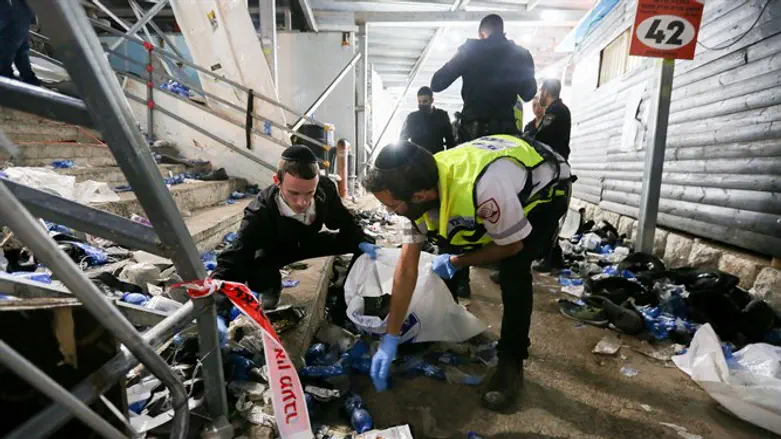
Six days after the traumatic events surrounding the disaster that occurred on Lag Ba’omer in Meron, members of United Hatzalah returned to the scene in order to attempt to process the difficult sights and horrific experiences they endured that night.
Ariella Sternbuch of Channel 13 reported on the visit and spoke with several Hatzalah volunteers.
“Our volunteers have been in constant contact with psychologists ever since that night,” related Ushi Shlomovitz, a Hatzalah division head. “They told us that it’s important to revisit the scene, to take them all back there to where it happened – it’s part of the emotional process they need to go through, to let out all their feelings that they’re still holding inside.”
Dozens of volunteers arrived that night, traveling together on specially arranged buses. First they gathered together and lit candles in the form of a “45” and a Star of David, and then they sang together, songs of connecting to G-d and reinforcing their faith.
Following that, they stood clustered around a rabbi, who spoke words of encouragement and then instructed them to “Repeat after me, three times: Mechilah, selichah, kapparah,” requesting forgiveness and atonement from the 45 people who died in that place.
Later on, some of the volunteers recounted to Channel 13’s reporter some of what they went through last Thursday night through to Friday morning, many of them breaking down and sobbing as they spoke.
“I ran over to here, where we are now, and started trying to resuscitate someone,” one volunteer related. “He was lying on the ground, and as I was doing that, I saw another volunteer running past with a thirteen-year-old boy in his arms. I thought to myself that he must have fainted from the crush of people there, but then I noticed that his head was lolling back, just hanging, and I realized that the boy was dead.”
“Did you think, even at that point, that maybe he could still be saved?” asked Sternbuch.
“Yes, I did – but I couldn’t reach him in any case,” the volunteer replied.
At midnight, the Hatzalah volunteers sat down together at the place where that Friday morning, the bodies were laid out in long rows and once again they recounted their experiences.
“I was right here, trying to resuscitate someone, and they kept bringing more and more bodies out, and at one point I just lost count – I remember shouting that I was trying to save the sixth person.” The volunteer wept, and others in the group wept with him as he recalled: “I said over the radio, I think there are around 15 resuscitations here, and Mendy told me – Chaim, there are over 30 people dead.”
“It’s like it’s still happening – it’s like I’m still there, experiencing it over and over,” he said.
Another volunteer related: “We were just running from one person to the next, you don’t know where to turn first, and then someone grabbed me and cried, Bentzi, it’s my brother, I can’t, I can’t, I’m begging you – and you don’t know what to do.”
“I went down to where we’re sitting now, and we’d already brought out 15 people, 15 dead, and then I saw them taking out the Englard boy [Moshe Nosson Nuta Englard z”l] and he [another volunteer] was crying and screaming, he’s such a young boy, I need a paramedic, quickly, get me a paramedic!
“It’s something totally incomprehensible. At such a moment, your brain is working at warp speed.”
Later that morning, pictures started to circulate of people still missing, people whose families were still trying to locate their loved ones, and the volunteers recognized some of the people they had tried to save.
“I saw a picture of a fourteen-year-old boy, they were looking for him. I remembered his face, and trying to save him. [It was Moshe Levy, obm.] There was another picture of a father of nine. They were still there, his family, still looking for him. I can see his face before me. [This was Dovid Kroiz, obm.]
“I see their faces by day and by night, when I go to sleep and when I wake up, when I eat – their faces never leave my mind.”
Sitting on the “steps of death” as they have been named, the volunteers sang together and tried to gather strength from one another and from the holy words of the songs, songs of yearning for the ultimate redemption, as they released their pain and anguish at what they lived through.
“I still keep asking myself – did we do enough? Maybe I should have fought harder to save lives – and I know it’s a natural reaction. We did everything we could.”
CLICK HERE TO HELP THE FAMILIES OF THE MERON TRAGEDY VICTIMS TO VAAD HAEABBANIM
CLICK HERE TO HELP THE FAMILIES OF THE MERON TRAGEDY VICTIMS TO KUPAT HAIR