

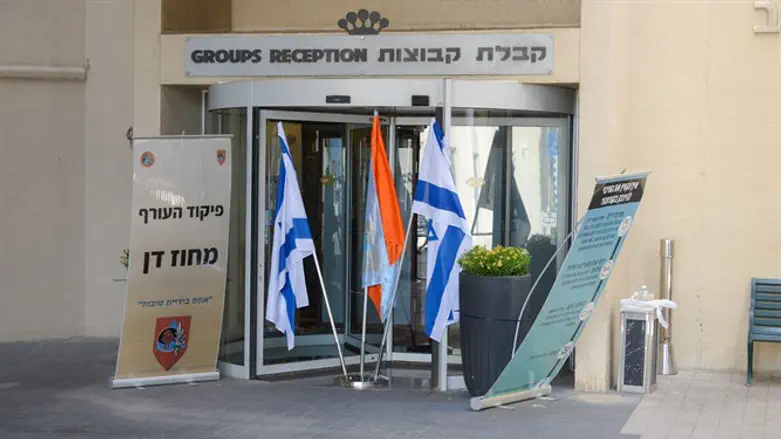
Prime Minister Binyamin Netanyahu has ordered the Defense Ministry to transfer all Israeli citizens arriving in Israel from abroad to quarantine in “Corona Hotels” or in other locations that have been converted for the purpose.
The prime minister also decided that if it was possible for the Defense Ministry to obtain a sufficient supply of test kits, they should test every single person entering the country for coronavirus, and he told the Finance Ministry to allocate an immediate budget for this purpose.
Defense Minister Naftali Bennett already made a similar proposal a few days ago, asking that all those arriving from abroad should be transferred to the “Corona Hotels,” but Netanyahu rejected his idea at the time.
Health Minister Yaakov Litzman said: “In light of data showing that a significant number of those arriving from abroad are not meticulous about entering quarantine, the decision to transport them from Ben Gurion airport directly to quarantine locations under the supervision of the Defense Ministry is the correct one.”
Minister for Internal Security Gilad Erdan addressed the Knesset, clarifying the role of IDF soldiers who have been sent to patrol the streets and help enforce the closure. “We had to ask for help from the IDF in order to bolster the police presence and create more deterrence in public areas. I want to stress that these soldiers that you’re starting to see on the streets have not been granted the authority of the police. They are not actively enforcing the guidelines, and they should not be interacting with citizens. Their role is simply to constitute a presence, for the purposes of deterrence.”
Erdan also mentioned certain incidences of lack of adherence to the closure guidelines, specifically in the haredi community (although many other breaches have occurred). “There are sectors of the population which have certain specific characteristics, and I don’t think this is the time to be pointing fingers. Every sector in this country has its specific characteristics that we should respect, and as far as possible we should try to customize guidelines in order not to cause unnecessary hardship. When it comes to the religious sector, and particularly the haredim, we have to take into account the fact that their lives revolve around community to a far greater extent. Not just the synagogues, but also the festival meals and so forth. And of course, we have to remember that they live in much more crowded conditions.”
Erdan noted that “the high incidence of infection in religious and especially haredi population centers means that we have to have enhanced enforcement in such places, and this is already happening. This level of enforcement is unprecedented, and if we have to impose a total lockdown, we have the ability to do it right away. If we take that route, we will certainly need to make use of the IDF to bring food and medicine to every single home, and also to compile lists of thousands of people whose work is defined as essential [and who would be exempted from the lockdown].”
Yesterday, the mayor of Bnei Brak warned that trying to enforce a lockdown on the entire city of Bnei Brak, home to almost two hundred thousand people, would not only not help but would actually be counterproductive, as many people would not abide by the rules. “We can’t build a huge ‘Bnei Brak Prison’” he said. “It’s simply not realistic, and turning Bnei Brak into a ghetto is unthinkable.”