

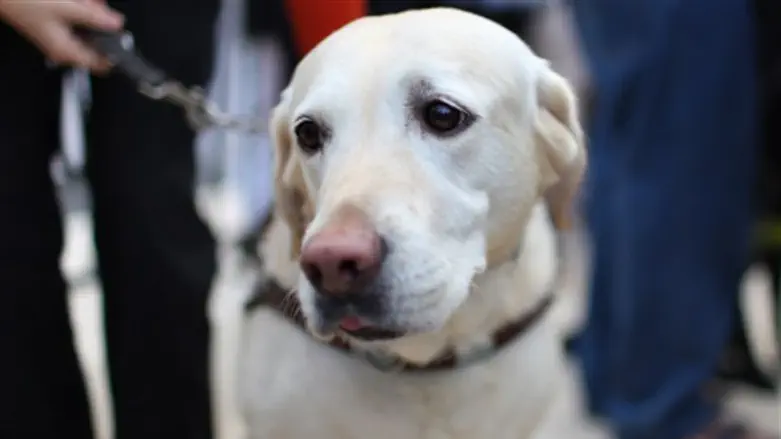
Ora Darsha called for a taxi one rainy, yet the driver wouldn't let her on when he arrived at her location. The reason? He was worried that her seeing-eye dog would ruin his new car.
The driver now has bigger things to worry about: After the Commission for Equal Rights of Persons with Disabilities filed a lawsuit on Orah's behalf, the Jerusalem Magistrate's Court ordered the taxi driver to pay her 10,000 shekels ($2624) in compensation.
According to the lawsuit, led by Attorney Gilat Ben-Zaken, the driver's refusal to service a blind woman constitutes wrongful discrimination in providing public services, based on the Equality Act.
The Equality Act explicitly states the basic rights of people with disabilities to join in an equal manner and participate in all areas of life, as well as an obligation to provide an appropriate response to their special needs in a way which would allow them to live their lives with maximum independence, privacy, and dignity.
The Equality Act also states that it would be improper discrimination to prevent persons with disabilities access to a public place, or a part thereof, or to refuse service to a person with disabilities, or to prevent him from using or enjoying a public service.
The courts are allowed to rule in favor of a person with a disability even without proof of wrong. The law prohibiting discrimination against people who need a seeing-eye dog states, inter alia, that the rights of a blind person to enter a public place or to use any facility therein may not be limited. Seeing-eye dogs act as a substitute for their owner's lack of sight. The blind person may not be barred from public transportation because of his seeing-eye dog.
Ben-Zaken claims that the defendant's behavior ran counter to the purpose of the Equality Act to allow a person with disabilities to use public transportation freely.
Moreover, there are situations where a taxi is the only way a person with disabilities can move from place to place. The lawsuit claims that the denial of this right seriously harmed the plaintiff's freedom of movement, as well as her right to dignity and equality.
In his ruling, the court accepted the Commission's position, stating that the defendant had violated the provisions of the Equality Act, by not agreeing to provider her with a service because of her disability and her accompanying seeing-eye dog. As a result, the court ruled a compensation of 10,000 shekels in her favor, and demanded that the defendant pay the court costs. In deciding the size of the fine, the court took into account the man's apology to Ora after the incident.
Avrami Torem, Commissioner for Equal Rights of People with Disabilities, said that "the verdict is an important milestone in the struggle for equal rights for people with disabilities in general, and to eradicate the unacceptable phenomenon of discriminatory acts against blind persons accompanied by seeing-eye dogs in particular. On all public service providers, each has a responsibility to provide service to people with disabilities too."