

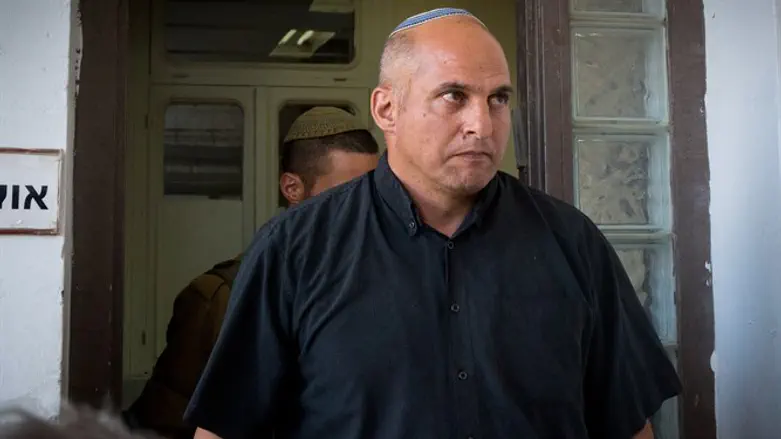
In today's continuation of the trial of Elor Azariya, the soldier in Hevron who shot a wounded terrorist on grounds that the terrorist still posed a threat, the military court in Yaffo has reconvened for the testimony of the Security Commander of the Jewish quarter in Hevron, Lieutenant Colonel (Reserves) Eliyahu Liebman.
At this point in the trial, Military Prosecutor Lieutenant Colonel Attorney Nadav Weissman has the opportunity to cross-examine Liebman, while using a presentation.
Weissman tried to clarify Liebman's conduct at the scene. "If you heard that the terrorist was still alive, how could you, as a lieutenant colonel in reserves, not tell every soldier to move away immediately?"
Liebman responded, "In the video, you see me move from point to point in order to examine the event. There is a difference between my arriving and finding that there are only junior officers at the scene, as opposed to my finding a company commander at the scene. If everyone bothers him and tells him how he is to manage the incident, it would be catastrophic."
Liebman later remarked, "If the terrorist moves, he needs to receive a bullet in his head. When a fighter identifies danger on the field, he acts independently to remove the threat."
In reaction to the prodding of the prosecutor, Liebman added sharply: "You're heaping serious blame on me, but I'll answer you anyway even though you don't deserve it." Liebman then asked the prosecutor if he himself had ever been at the scene of an incident of this nature; the judges disqualified the question.
The military prosecutor again asked Liebman why, if there was a threat, he did not act in a way befitting a military officer. Liebman shot back, "I suggest the prosecutor get some popcorn and cola and get out of the movie in which he's living. This is somebody who was never at any [terrorist] incident and was never responsible for the lives of others."
The prosecutor didn't let up on Liebman, and continued for a third time, "how is it that you, with all your experience, didn't act?" Liebman responded, "the problem exists is only in your mind."
The prosecutor presented Liebman with a document according to which the Brigade Commander had ordered not to bring an explosives expert to the scene of a stabbing. Liebman responded, "I don't recognize this document, and there have been many times that I disagreed with the brigade commander. It appears that he felt pressure from the video [of the incident in Hevron]."
"There were times in which the battalion commander and senior leadership disagreed with the fighters, medics, security forces in the field and explosives experts," Liebman added.
Liebman explained to the prosecutor, "when I say that I feel danger, that doesn't necessarily mean that I have to raise my hands and shout. The prosecutor is trying to mislead the court. According to the questions that you're asking, it's clear that you've never been at the scene of a [terrorist] incident and that your pulse has never been above 200. Maybe in the workout room. I don't have to shout when there's danger, I can feel danger without doing anything. I have more than 25 years experience [on the scene of security incidents]."
The prosecutor showed a video clip in which the terrorist could be seen covered in a bag. "Why didn't you warn anyone?" he asked Liebman.
"I saw a bag, and I assumed that professionals had already checked, and that there was no longer a threat," Liebman said, adding, "there have been many incidents in which nobody shouted about a threat. You don't have to shout about it. You don't have to go crazy and shout about a threat, unless you want to be put away."
"I remind the prosecutor that although I am a Security Commander, at the same time there is a company commander in the field, as well as a brigade commander, therefore there is no need for me to warn everyone about something which is already understood," Liebman added.
The prosecutor suggested: "Maybe the answer is simpler, that you didn't think at all about the possibility of an explosives belt - neither you nor those around you."
Liebman noted that "Since the prosecutor is asking me an unprofessional question [about something] that never happened, [I will answer that] I was in the field and I felt danger. It's unacceptable that a man without any experience and connection to reality is telling me how I felt."