
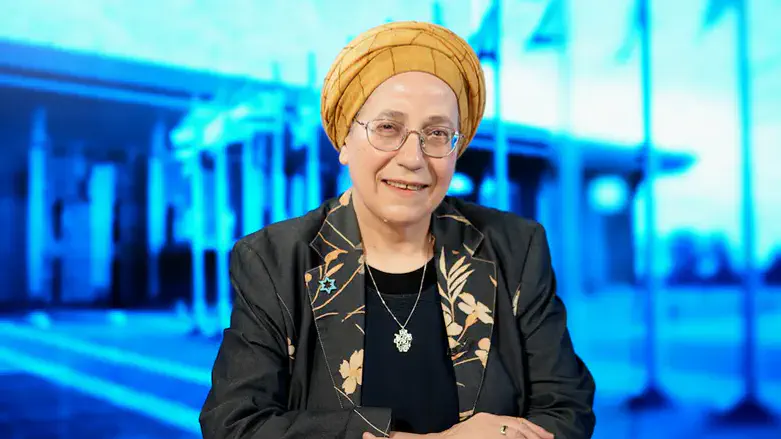
Settlements and National Missions Minister Orit Strock is backing Prime Minister Benjamin Netanyahu's proposal to allow Gadi Eisenkot to serve first in a rotation arrangement for the premiership, and is not ruling out a unity government being formed without her party.
In an interview at the Arutz Sheva studio, she explains why, despite her deep disagreements with Eisenkot, she views the formation of a broad government as an act of national responsibility, given the alternative of a government dependent on the votes of the Arab parties.
Commenting on the rotation proposal, Strock says, "I think this is a courageous, generous step, a step of national responsibility on the prime minister's part. It is not easy to make such a decision". She says Netanyahu's willingness to forgo the premiership at the start of the term, despite heading the party that received the most votes among the Jewish and Zionist public, reflects the gravity of the danger he sees in the political alternative. She adds, "He is willing to make a sacrifice himself for the sake of the State of Israel".
Strock notes that her party's chairman, Finance Minister Bezalel Smotrich, took part in numerous discussions with Netanyahu and encouraged him to advance the initiative. However, she makes no secret of the fact that a unity government is not her preferred option, saying, "A unity government is not our first choice. We think a right-wing government that implements right-wing policies is better, as we have done for nearly four years".
The minister makes clear that significant disagreements are likely to arise even in a broad government that does not rely on the Arab parties. She points primarily to the differences between her security outlook and Eisenkot's, recalling their disagreements when he served as a member of the war cabinet. She alleges that Eisenkot tried to block a series of military moves, including expanding the fighting to Rafah and Lebanon and taking action against Iran.
Alongside the security disagreements, Strock also notes differences over diplomatic policy, particularly Eisenkot's positions on the future of Jewish communities in Judea and Samaria. Nevertheless, she believes there is room for dialogue among the Zionist parties, even if not all of them can ultimately join the government that is formed.
Addressing Knesset members in the change bloc, she says, "Form whatever government you will, even if I am not in it", provided that it does not depend on the votes of the Arab parties. Asked whether the Religious Zionist Party could remain outside the government, she replies that this depends on the agreements reached, declining at this stage to spell out her party's red lines.
She explains, "Political life has taught us that if you want successful negotiations, you conduct them behind closed doors, not in the media". She adds, "We are, of course, a party with principles, with a clear path, and we will not be able to agree to everything".
Strock warns that some on the far left view a government dependent on the Arab parties not as a political necessity, but as a desirable model. She says they seek to recreate the political circumstances that allowed the Rabin government to advance the Oslo Accords, and she fears they are trying to lead Eisenkot and his partners in a similar direction.
She appeals to Knesset members in the change bloc who, she says, do not share that worldview, urging them to uphold the principles they have previously expressed. Among other examples, she cites statements by Matan Kahana and Sharon Sharabi against relying on the Arab parties. She urges them, "Stand by the principles you stated-not ones I stated, ones you stated".
Alongside her opposition to relying on the Arab parties, Strock stresses that, in her view, the desired political partnership is based not on origin or ethnicity, but on attitudes toward the State of Israel. She calls on everyone who sees the state as an asset to be preserved, developed and defended to come together and find the common ground needed to form a government.
Later in the interview, ahead of a security cabinet meeting on the Gaza Strip, Strock outlines her position on initiatives being advanced by the Board of Peace headed by Nickolay Mladenov. She says the 15-point roadmap drawn up in recent months fundamentally changes Trump's plan for Gaza and could allow reconstruction of the territory to begin without Hamas first disarming.
Strock, who notes that she opposed Trump's plan from the outset, argues that the new framework further weakens the demand to demilitarize Gaza. She says she and Smotrich proposed that the prime minister refrain from moving ahead with implementation of the plan while this framework remains under consideration, and continue military operations against Hamas. She stresses, "Nothing moves until everything is demilitarized", adding that she expects an update from the prime minister at the cabinet meeting.
Toward the end of the conversation, Strock also addresses the coincidence of two dates today: November 29, the anniversary of the UN resolution on the partition of the land, and 19 Kislev, the anniversary of the death of Rabbi Moshe Tzvi Neria. She discusses the connection between Israel's national rebirth and the spirit Rabbi Neria instilled in generations of religious Zionist students.
Strock recalls the day Rabbi Neria died, when she sought to consult her teacher and rabbi, Rabbi Chaim Druckman, about protest activities ahead of the handover of Bethlehem to the Palestinian Authority. After repeated attempts to reach him, Rabbi Druckman told her that, following his teacher's death, he was unable to speak.
Strock recalls, "Rabbi Druckman spoke endlessly. From the moment he got up in the morning until he went to sleep in the early hours, he was constantly speaking, giving lessons, talking to people, receiving visitors. How could Rabbi Druckman be unable to speak?" She adds, "It was a profound lesson for me to see how deep the bond was between him and Rabbi Neria".