

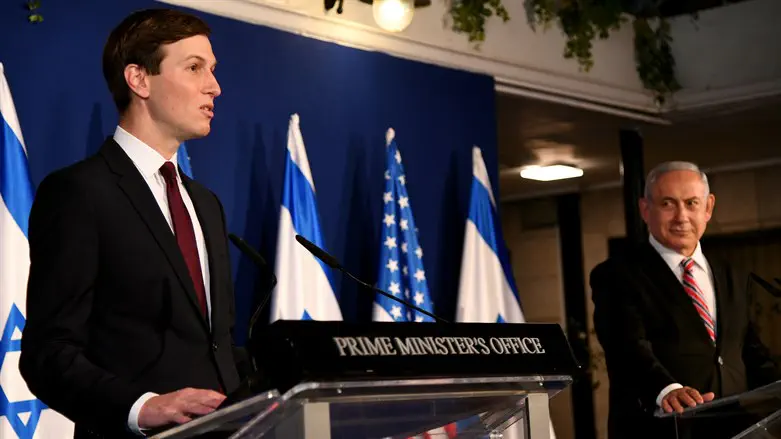
When a diplomat’s signature project stalls, the easiest move is to find a scapegoat. In his recent interview with New York Magazine, U.S. special envoy Jared Kushner chose Israel. Speaking alongside President Donald Trump’s push for Prime Minister Benjamin Netanyahu to advance the Board of Peace’s agenda, Kushner warned that Israel stands at a “fork in the road" and risks sliding toward “global-pariah status" if it does not shift its approach in Gaza.
That warning is not statesmanship. It is deflection.
As a chief architect of the Board of Peace-an initiative meant to oversee Gaza’s reconstruction and post-war governance-Kushner has watched his ambitious blueprint bog down in reality. Rather than confronting the structural flaws of his own framework, he has turned his fire on Jerusalem, echoing talking points that ignore the security facts on the ground.
First, there is the accusation that Israel is blocking humanitarian aid from entering the Strip. Anyone paying attention to visual reports coming out of Gaza can see markets stocked with food and basic goods-hardly the image of a sealed-off wasteland. What Kushner’s narrative conveniently omits is what happens once trucks cross the border. Hamas has consistently hijacked, hoarded, and resold incoming aid at inflated prices to fund its operations and maintain control over the population. Blaming Israel for supply bottlenecks while ignoring Hamas’s systematic theft turns reality upside down.
Even more detached from security realities is the claim that Israel is obstructing the Board of Peace’s disarmament roadmap. A disarmament plan only works if the armed faction actually intends to disarm. Hamas has shown no genuine willingness to surrender its weapons unilaterally. On the contrary, the group has used every pause and diplomatic opening to recruit new fighters, reassert control, and rebuild its arsenal-including unmanned aerial capabilities that directly threaten Israeli airfields and air defenses. (Supposedly, there is some movement on the disarmament issue - time wiill tell if it really happens.)
Yet Kushner seems to expect Israel to treat this threat as business as usual. Under his vision, Israel is essentially being asked to keep both an enemy garrison and its civilian supporters supplied while that very same enemy rearms and plans yet another murderous invasion of Israel. No sovereign nation-least of all one still recovering from the atrocities of October 7-would accept such a suicidal arrangement.
Most jarring of all is Kushner’s willingness to aim personal barbs at Benjamin Netanyahu, suggesting the Israeli leader doubted Washington’s ability to broker deals and is standing in the way of progress. For an envoy who prides himself on transactional dealmaking, lecturing a wartime prime minister on existential security is remarkably tone-deaf.
There is also an undeniable irony in Kushner casting stones at Netanyahu’s leadership. In Israel, the long-running criminal cases against Netanyahu have steadily lost momentum and credibility - in fact, just a few days ago, the court suggested that the prosecutors scrap the first two of the three indictments.
Meanwhile, back in Washington, an incoming Democratic-controlled Congress is already preparing sweeping investigations into Kushner’s own web of foreign business dealings, defense-sector investments, and potential conflicts of interest while serving as an unconfirmed envoy.
Israel does not need lectures about becoming a “pariah" from an envoy trying to salvage a stalled legacy project. True peace in Gaza will never be built on wishful thinking, unverified promises from terror groups, or pressure on America’s only democratic ally in the Middle East. It requires confronting Hamas as it actually is-not as Jared Kushner wishes it would be.