
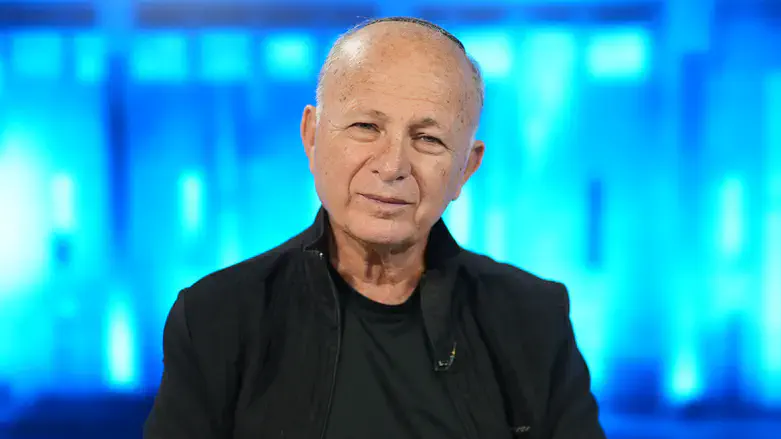
Media executive and commentator Moti Shklar, former director-general of the Israel Broadcasting Authority and the Second Authority for Television and Radio, expressed dismay during an interview at the Arutz Sheva studio over concessions by the opposition bloc to the haredi parties in coalition negotiations.
Shklar urged Naftali Bennett not to repeat past mistakes and to seize the opportunity to demonstrate genuine repentance. He said Bennett now faces a test of his values and leadership, requiring him to decide whether to honor his commitments to the public even at the cost of remaining in the opposition.
Shklar referred to Maimonides' definition of complete repentance, explaining that it is tested when a person encounters the same circumstances in which he previously failed, faces the same temptation and succeeds in overcoming it.
Shklar said Bennett has already acknowledged his mistake regarding the gap between his promises and his actions, and now has an opportunity to prove that he has learned the lessons and will honor his commitments under the alliance of those who serve.
Shklar said, "He has an opportunity here to come forward and show that this is truly who he is. I believe it is". He said standing by his principles, even at a political cost, would establish Bennett's fitness to lead Israel in the future, adding, "If he does not do this, he is missing an opportunity".
Shklar, who supported the opposition bloc, did not conceal his deep disappointment with its leaders' conduct and the promises being made to the haredi parties in talks to form a government. He said, "I am not just appalled; I am hurting, wounded, angry, frustrated and somewhat despairing". He explained that his support for the bloc stemmed in part from his belief that its members would put values first.
He said the commitments made to the public on haredi military enlistment were not ordinary election promises, but concerned the foundations of Israeli society. He asked, "The haredi issue is not merely a political argument over one budget or another, but a fundamental question of outlook. What is Zionism? What does mutual responsibility mean?".
Shklar criticized the willingness to retreat from principles the bloc's leaders had advocated for years. He warned of the long-term consequences of haredi non-enlistment for the economy, security and mutual responsibility within Israeli society.
As an alternative to a narrow government, Shklar presented the formation of a unity government as the central goal both political blocs should pursue. He said that after years of disputes and deep divisions in Israeli society, a window of opportunity has now opened to reduce polarization and renew the partnership among different segments of the population.
During the interview, Shklar also called on Religious Zionist Party chairman Bezalel Smotrich to work toward a unity government and demand that Prime Minister Benjamin Netanyahu agree to serve second in a rotation arrangement. He said Smotrich should demonstrate the same determination he had shown in advancing his policies in Judea and Samaria, and make clear to Netanyahu that national unity justifies a significant political concession.
Shklar also addressed the argument that the religious-Zionist public is repeatedly asked to make concessions for the sake of unity. He said that even if the demand is unfair, responsibility for Israel's future sometimes requires making concessions and being the responsible adult.
Toward the end of the interview, Shklar, a graduate of the Mercaz HaRav Yeshiva, addressed his opposition to forming a government reliant on Arab parties. He clarified that his opposition stems from those parties' positions on the character of the State of Israel, rather than their members' national identity.
He said that if a Zionist Arab party were established that did not challenge Israel's definition as the nation-state of the Jewish people, he would have no objection to political cooperation with it.
For Shklar, the test now facing party leaders is their ability to put Israel's interests ahead of a political victory for one camp or another. He believes Naftali Bennett still has an opportunity to prevent the formation of a narrow government and prove that he has learned from past mistakes.