
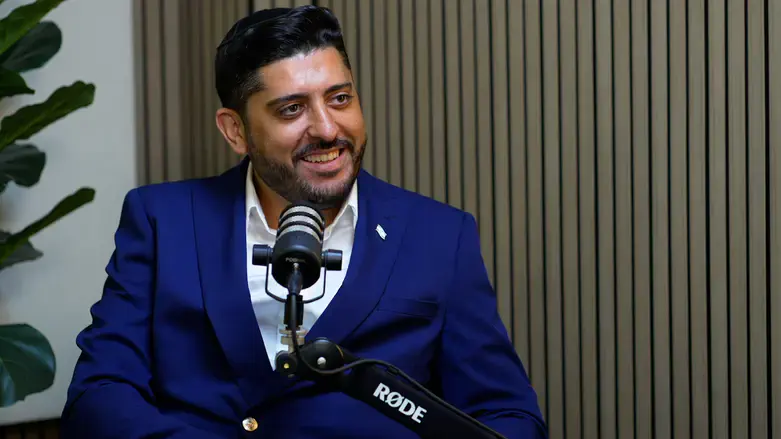
Businessman Adam Shitrit appeared on Arutz Sheva's "Behind the Status" for a conversation with Yanki Goldhaber about business, politics, faith and family.
He explained why he turned down offers to enter politics, how his upbringing influences his decisions in business and charitable work, and how he and his family are coping with the death of his brother Eyal and commemorating him.
Shitrit said he had received several offers to enter politics, including ahead of the most recent elections, but declined because of his lack of trust in the system. "There is no truth there. No truth", he said. "What they say and what they do on the ground are as different as black and white. Before the elections they say one thing, and after the elections it becomes something completely different".
As an example, Shitrit pointed to shifting attitudes toward the haredi parties during coalition negotiations. "People sold their souls for a seat", he said, explaining that he does not want to take part in a system in which, in his view, promises change according to political needs.
Shitrit then turned to the assistance available to families in distress. He said he encounters about 20 cases a week through his charitable work, including people who have already approached welfare services. If given ten minutes with Prime Minister Benjamin Netanyahu, he said, he would ask him to increase welfare funding, adding, "I don't think he is aware of what is happening".
Asked about his achievements, Shitrit listed his two daughters, the synagogues he has established and the Torah scrolls he has dedicated. He also spoke about car financing deals he declined when he believed the customer would be unable to meet the repayments and could lose the vehicle. "The business mind says, do the deal. The heart says, no, we need to look at the whole picture".
Later, Sheetrit recalled his childhood in Be'er Sheva. After the Shabbat meal, his father, Max, would ask him to read Psalms, lying with his eyes closed and correcting his son from memory. Only as an adult did Sheetrit understand that this was his father's way of instilling in him a love of Torah, and he said those lessons continue to guide him today, including in his work.
Sheetrit said that on the night of the Meron disaster, he was at the gathering marking the anniversary of Rabbi Shimon bar Yochai's passing with his brother Eyal and their mother. He was praying near the site of the disaster, unaware of what was happening beyond the partition, and they were evacuated from the area only hours later. He said he has not returned to Meron since.
Three years later, he received word that Eyal had collapsed at his business. Sheetrit was nearby and rushed over, finding rescue personnel performing CPR on his brother when he arrived. "No one can prepare you for being told that your brother has fainted, for being told that your brother has died", he said.
Of everything he heard that day, Sheetrit particularly remembers the question his sister-in-law Sivan asked, "What, is that it? What do I tell the children?". He said he has not been able to enter the business where his brother collapsed since then. "I don't have the emotional strength to enter that business".
While the resuscitation efforts were underway, Sheetrit prayed and pledged to dedicate his spiritual merits to saving his brother. After Eyal's death, a rabbi he spoke with told him that his very willingness to give for his brother's sake had value. Since then, Sheetrit and his family have dedicated charitable activities and Torah initiatives to the elevation of Eyal's soul.
Asked how he would want his brother to see him today, he replied, "If Eyal is watching me on Arutz Sheva, I want him to know that his little brother is carrying on and trying to be much better and to help in many places".