

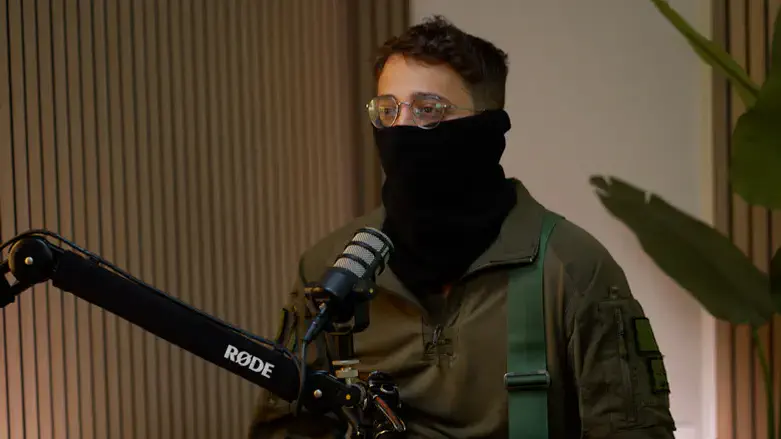
When Capt. A. was wounded in the leg during fighting in the Gaza Strip, he knew from the outset that he wanted to return to commanding troops. Even when his wound became infected and his commanders struggled to assess when he could resume operational duty, he did not give up.
In an interview with Arutz Sheva marking the day honoring wounded IDF personnel, Capt. A., commander of the Mahsar company in the 401st Brigade's 601st Combat Engineering Battalion, discusses the fighting, his injury, his determination to return to the battlefield and the next generation of IDF soldiers.
On October 7, A. was attending the officers' course at the Bahad 1 training base. As reports of the terrorist attack came in, he and his fellow cadets were rushed to the Gaza border communities, where he witnessed harrowing scenes.
He recalls, "So much chaos, so many frightened people, so many civilians, so many soldiers, so many wounded people. This is something I never believed would happen. It caught all of us unprepared".
He later took part in fighting in Judea and Samaria and the Gaza Strip. He vividly remembers entering Gaza for the first time, the uncertainty and the sense of responsibility that accompanied him throughout the fighting.
He says, "Little by little, you get used to the fighting, you get used to the fear, but the sense that you understand this is a war we have a duty to fight is something that keeps you going".
In June 2025, during an operation in Gaza, A. was wounded in the leg by enemy fire. Despite his injury, he remained fully conscious, returned fire, reported over the radio and helped coordinate his evacuation.
In the months after his injury, he faced a difficult recovery. What troubled him most, however, was the fear that he would not be able to return to his position.
He says, "The moment I was wounded, I told them I wanted to return and asked them to keep my position open for me".
When his battalion commander told him that his prolonged recovery might prevent him from returning, A. struggled to accept the news. Even the infection that developed in his wound did not change his decision.
Two weeks later, he approached his commander again and told him firmly, "I'm coming back, no matter what".
Today, he is back in the Gaza Strip, this time as commander of the Mahsar company in the 601st Combat Engineering Battalion. His new role includes operating drones, robotic systems and remotely controlled equipment designed to reduce the risk to soldiers' lives.
For A., the transition from the armored corps to combat engineering and technology is a fascinating professional challenge. His sense of mission, however, remains unchanged.
Whenever he passes the Gaza border communities on his way into the Strip, he is reminded of the events of October 7 and the significance of the mission entrusted to him.
Ahead of the enlistment of new combat soldiers in the engineering and armored corps, Capt. A. offers them a message, "I think the next generation of the IDF is entering a very significant period in the military. I think the mission has not yet been completed, and there will be more challenges along the way".