
The special committee on repealing the broadcasting reform, chaired by MK Meirav Ben Ari, approved a bill to repeal the reform for its first reading on Wednesday, by a vote of seven to six.
The vote followed three days of heated deliberations, during which lawmakers, government ministry representatives, professionals and civil society organizations presented their positions.
Sharp clashes erupted between lawmakers during the final session, with Communications Minister Shlomo Karhi and MK Almog Cohen (Likud) among those removed from the room.
The session opened with a heated exchange. MK Yitzhak Kroizer (Otzma Yehudit) criticized the advancement of the bill, arguing that it amounted to "trampling and shredding" rather than amending legislation.
MK Eli Goldschmidt questioned why a series of laws needed to be repealed swiftly while talks on forming a unity government were underway.
MK Almog Cohen was later removed from the session after repeatedly interrupting. Cohen argued that the move abandoned bereaved families, prompting MK Michal Negri (Beyachad), whose son was killed on October 7, to respond, "I am from one of those families, and don't tell me who is being abandoned."
Several combat veterans with post-traumatic stress disorder who attended the session also interrupted, calling for a government not to be formed with supporters of terrorism.
A confrontation later erupted between committee chair Ben Ari and Communications Minister Shlomo Karhi, who said he represented his ministry's professional staff and asked to continue speaking. Ben Ari called the minister to order three times. Karhi responded, "Call me to order a fourth time, too. It won't help you."
After the third warning, the committee chair ordered him to leave the room. Karhi protested the decision and criticized Knesset Legal Adviser Sagit Afik, saying, "Keep trampling. This is the trampling of the Knesset. This is Sagit Afik trampling the Knesset. This is political legal advice."
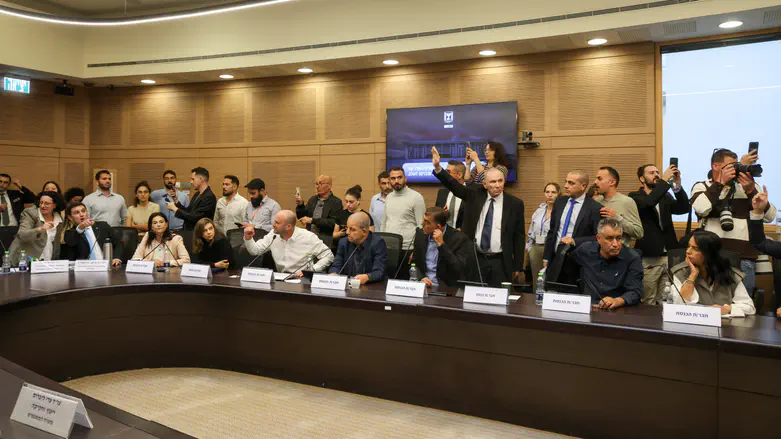
Ben Ari rejected claims that opponents had not been given enough time to present their positions. She said the committee had held lengthy deliberations over three days, allowing all sides to present their views. She made clear that anyone attempting to disrupt the session through a filibuster would be removed from the room.
At the end of the session, the bill was approved by seven votes to six. The committee's approval allows the bill to proceed to its first reading in the Knesset plenum. Repealing the reform still requires completion of the legislative process.
The committee's deliberations also addressed questions about the implications of repealing the reform for the media market. Communications Ministry Deputy Legal Adviser Ziv Giladi explained that repealing the law would restore the previous requirement to invest in original productions, which applied to cable and satellite companies but not to internet-based broadcasting services.
The issue of international companies, including Netflix and Disney, also arose during the session. Ben Ari recalled that the Folkman Committee had recommended requiring them to invest in original productions, and noted that the next communications minister would have to address the matter.
Justice Ministry representative Adi Libros explained that viewers' increasing shift to internet services created a need for a new regulatory framework, as a significant share of activity in the sector was not covered by existing regulations.
MK Kroizer warned that repealing the reform without examining its provisions individually could create an even more problematic situation. Ben Ari responded that the next communications minister could advance the necessary amendments, arguing that the reform itself had failed to provide an adequate response.
Odelia Kadmi, representing the civil society organization Koach Hit'arvut, criticized the pace at which the repeal was advancing and noted that the previous Knesset had held 74 meetings on the reform. She said, "You are seeking to destroy this with a single stroke," and called for lawmakers to wait for a High Court of Justice ruling and the establishment of the Economic Affairs Committee.
By contrast, Zulat Institute Executive Director Einat Ovadia argued that the reform advanced by Karhi had not been ready and had benefited parties with close connections and Channel 14. She said the Knesset had the authority to repeal legislation without waiting for a court ruling.
The legal wording of the repeal was also discussed. Retired Justice Hanan Melcer proposed explicitly stipulating that, once the reform was repealed, the law in force before its enactment would apply, to prevent a legislative vacuum.
Deputy Attorney General Avital Sompolinsky and the committee's deputy legal adviser, Masada Matzlawi David, agreed that the matter would be examined as the bill was prepared for its second and third readings.
The confrontation in the committee took place a day after Karhi sent a sharply worded letter to Knesset Legal Adviser Sagit Afik, arguing that she was allowing the opposition to advance the repeal through an expedited process, contrary to positions she had expressed in other cases.
The minister compared the move with Afik's opposition in June to waiving the mandatory waiting period before a vote on a bill to repeal the kashrut reform. He wrote, "When the same rules are applied strictly to one side of the political spectrum and abandoned entirely when the other side advances legislation, this is no longer legal advice but a political position."
Karhi demanded that lawmakers be presented with all the provisions the bill seeks to repeal, that a detailed discussion be held on the implications of the move, and that no vote take place until the shortcomings he had identified were addressed.