
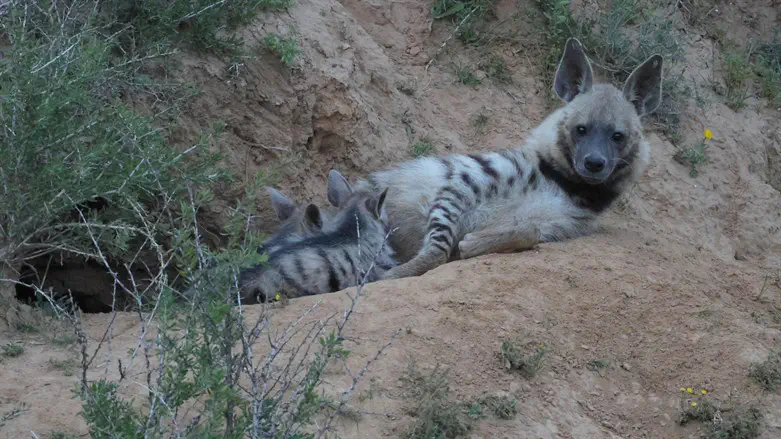
Residents of Modi'in-Maccabim-Re'ut have been dealing in recent days with an unexpected visitor: a hyena spotted roaming the city's streets and entering residential yards. In one reported incident, the hyena killed and ate a dog in a yard, heightening residents' concerns.
In an interview with Arutz Sheva - Israel National News, zoologist Dr. Haim Moyal, a lecturer at the Levinsky-Wingate Academic Center, explains that despite their intimidating appearance and reputation, hyenas generally prefer to avoid people.
He says, "Hyenas would rather not be in arpeas inhabited by people, although in the small hours of the night they will roam places where food is readily available."
According to Moyal, construction encroaching on open spaces is shrinking hyenas' natural habitats and pushing them to seek food in residential areas as well. He believes this is also happening in Modi'in-Maccabim-Re'ut. Dr. Moyal explains, "They live alone except during the breeding season. This is a wary and shy animal, even though it is a predator. It will also eat fruit and anything it can make use of."
Regarding the hyena documented in the city, he believes it is an individual displaying unusual behavior, unafraid to enter yards and streets in search of food. He says the hyena may be "suffering from a certain personality problem", which is why it keeps returning to areas inhabited by people.
Alongside the concern its presence has caused, Dr. Moyal emphasizes the hyena's important role in maintaining the ecosystem. He stresses, "Hyenas are nature's sanitation workers. They clear carrion from the natural environment. That is mainly what they eat, so it is wrong to demonize this animal." He adds, "They are indeed predators, but predators can eat small and injured animals, as jackals do as well."
According to Moyal, hyenas carefully mark their territories and tend to drive unfamiliar individuals away. During the breeding season, however, individuals encounter one another, and in spring, females can sometimes be seen accompanied by two cubs.
As for the danger to people, Dr. Moyal explains that in most cases a hyena will prefer to flee when it encounters a person, especially in an urban setting that is not its natural environment. However, he warns that it is a predator with exceptionally powerful jaws and can be dangerous if provoked.
He says, "It has incredible jaws, the strongest of any predator we have in Israel. It can be dangerous to people if they provoke it, but usually it will flee and there will be no contact." He believes the Israel Nature and Parks Authority is working to locate the hyena spotted in Modi'in and remove it from the urban environment.
During the interview, Dr. Moyal also addressed an incident several weeks ago in an unrecognized Bedouin community, where a hyena was filmed caught in a trap and stoned to death. He says hostility toward hyenas is partly linked to beliefs and stories associated with the animal over the years. He notes that various cultures have circulated legends about hyenas luring people into caves and their ability to dig into graves and remove bodies.
Moyal explains that some of these stories are rooted in actual hyena behavior, such as digging in shallow graves while searching for food, but beliefs developed around them that portrayed the animal as particularly menacing. He notes that the spotted hyena, which lives in Africa and is not found in Israel, has also become the subject of stories and legends because of its unusual calls.
Dr. Moyal stresses that the hyena is an endangered wild animal, making it particularly important to protect it and avoid harming it. He says that, unlike foxes, hyenas are rarely found to have rabies. However, this does not eliminate the need for caution and for keeping a distance from wild animals.
At the end of the interview, he stresses that one of the most important ways to reduce the entry of hyenas and other animals into residential neighborhoods is to avoid leaving garbage and food scraps in open spaces and around homes. He says this can make urban areas less attractive to wildlife while helping protect an animal that plays a vital role in nature.