

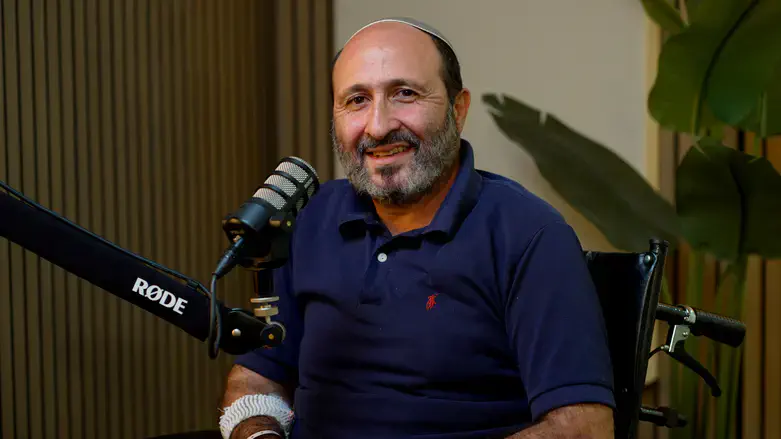
Six months have passed since Boaz Saluk, 55, was wounded by a Hezbollah explosive drone in southern Lebanon, but his road to recovery remains long.
After two and a half months at Rambam Hospital, he moved to rehabilitation at Hadassah Mount Scopus in Jerusalem, where he is coping with a complex nerve injury in his leg and the prospect of a prolonged recovery.
In a special interview at the Arutz Sheva studio, as part of the "Marching and Saluting" initiative organized by Ammunition Hill and the Ministry of Heritage for the 5787 National Day of Appreciation for Those Wounded in Israel's Wars and in Terrorist Attacks, Saluk spoke about his daily challenges, his family's support and his hope of returning to an active life and military service.
Saluk arrived for rehabilitation at Hadassah Mount Scopus in early August, where he was found to have nerve damage affecting sensation and movement in his foot. He said doctors had also raised concerns about serious complications resulting from the loss of sensation.
About a month ago, he underwent complex surgery to graft a nerve taken from another part of the same leg, in the hope of restoring sensation and, later, movement.
He explained, "You have to understand that nerves can be connected. They take a nerve from elsewhere in the leg and use it to make a very delicate and complex connection". He said nerve regeneration is slow, with the medical estimate he has been given putting average growth at about one millimeter a day.
He said, "We are now in a very serious race between muscle degeneration and the rate at which the nerve grows", but immediately added, hopefully, that recovery is faster in some cases. He added, "I assume I'm one of those cases".
Despite his optimism, Saluk does not hide the difficult moments. He said, "I won't lie, there are ups and downs. It's not all roses. There are low moods, questions and fears. But the overall direction is positive, a direction of hope".
The most emotional moment in the interview came when he spoke about his wife, who has been by his side since his injury. His voice broke, and he struggled to hold back tears.
He said emotionally, "I have an amazing family. I have a wife who hasn't left my side in the hospital for six months". He added, "My son, who is here with us, came to take her place. This is the first time she has agreed to leave, because she realized that things at home also need attention".
Alongside his family, he described the support provided by his fellow soldiers. He said, "My battalion commander visits me once a week. You ask yourself, how does that help? It helps; it gives you strength. Yesterday, a member of my team whom I hadn't expected to come visited and told me how much they miss me and feel my absence. All these things give me strength".
Despite his serious injury, Saluk is already planning his return to military service. He said his battalion commander had arranged a new role for him that would allow him to continue contributing even if he cannot return to combat.
He explained, "Once you become a combat soldier for the Land of Israel and the people of Israel, once you understand what that means, you can't sit at home and say your friends will do it". He added, "I sit at home and it eats away at me. Even now, after paying this price".
At the same time, he understands that he must leave behind the combat role he once knew. He said, "There is a realization that I need to draw a line under my role as a combat soldier. It's time to support the fighting. It's still difficult, but this is a life of meaning".
Saluk, an educator who spent years teaching Talmud and serving as a class educator at a yeshiva, also misses his students and the yeshiva routine. He said, "I feel like a newborn baby. I need to gradually return to the general routine of life, and only then to the details".
He said his students remain in touch and are waiting for his return, but he now understands that returning to teaching will take time. He said, "Right now, I'm taking care of my body. I haven't even started taking care of my emotional well-being. I need all my mental strength to deal with the pain, the treatments and making progress".
During the interview, he also revealed a severe psychological episode he experienced five days after his injury, when a hospital visit triggered vivid memories of the incident.
He recalled, "I started seeing the bleeding injury on a loop. Just my legs shaking and bleeding. It wouldn't stop". He said that with help from his family and professionals, he was able to get through the episode, and he now receives weekly psychological treatment.
Ahead of the day of appreciation, Saluk sought to draw attention to wounded people who cannot stand before an audience and tell their stories, particularly those coping with post-traumatic stress disorder.
He stressed, "Even those who come to give talks, when they go home, you don't know what happens to them". He added, "And there are those who don't give talks, who don't speak and who aren't invited because they can't speak. We need to see how we can help them".
At the end of the interview, he shared a message about the meaning he hopes to give the day of appreciation. He said the wounded need not only gestures of compassion, but also a sense of unity and shared hope.
He said, "I want to feel that my people are united around this. Not to pity us. We weren't wounded so that people would feel sorry for us; we were wounded so that the people of Israel could rebuild, so that the people of Israel would have hope, so that the people of Israel would flourish".
He concluded with one wish, "On this day, I want to see the people of Israel joyful, flourishing and happy, united with us".