
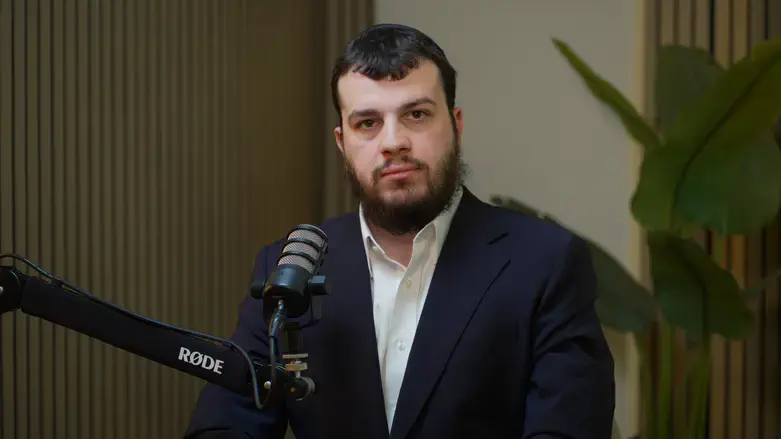
Haredi journalist and commentator Shneur Weber, 30, joined Hadar Miller's podcast at the Israel National News-Arutz Sheva studio for a discussion about the Israeli media, haredi society, the election results and concerns over renewed unrest in mixed Jewish-Arab cities.
Weber, who began his journalism career at 16 and now appears on numerous media outlets, said he views his work as a mission. He said, "I try to do meaningful work in the media and give a voice to those who are heard less often".
He said his appearances on programs that do not share his views sometimes involve confrontations and prejudice. He said, "I join panels and everyone piles on me. They see someone with a haredi appearance and come with stereotypes. But once I open my mouth, things usually change completely".
He said his greatest satisfaction comes from encounters on the street with people who feel their views are not represented in the media. He said, "When people tell me, 'You say what I feel and what I think,' that is a moment of satisfaction for me".
He later discussed the year he spent as a Chabad emissary in Antwerp, Belgium, and expressed deep concern about the future of Jewish communities in Europe and the United States.
He said, "I think there is no future for Jews there. I don't understand how people still delude themselves into thinking they can continue living there". He said he had also encountered antisemitic hostility during visits to the United States over the past year, adding, "There is almost nowhere you don't feel afraid to walk the streets. I myself have had slurs shouted at me".
The conversation became particularly charged when the two, both residents of Lod, discussed the possibility of renewed unrest in the city following political developments.
Weber warned that, in his view, an increase in the Arab parties' political strength could also have consequences on the ground. Referring to the unrest during Operation Guardian of the Walls, he said, "There is a simmering pressure cooker here that blew up in our faces".
Miller described a video she had posted about the volume of the muezzins' calls to prayer in the city and responses she received from Arab social media users, including the statement, "We were here before you and will be here after you. Get used to it".
Weber argued that people who do not live in mixed cities struggle to understand residents' feelings. He said, "I invite those people to come to Lod, to come to Lod and understand what happened here during Operation Guardian of the Walls".
He later sharply criticized parties seeking to form a government with the support of the Arab factions. He said such a development could harm the state's Jewish identity.
He warned, "Either we wake up now, just before it is too late, or the State of Israel as we knew it will gradually disappear".
A substantial portion of the discussion focused on haredi military conscription. Weber argued that parties that had focused on the issue during the election campaign quickly changed their positions after the results were published.
He said, "They exploited this issue for cynical political purposes", adding, "The election results hadn't even been announced, and everyone was already saying: Let's exempt the haredim from conscription".
Miller stressed that reservists' hardships and the public debate over sharing the burden are real and painful, but distinguished them from the political use of the issue. Weber agreed and argued that recent developments had exposed the gap between political declarations and a willingness to compromise.
Discussing the negotiations United Torah Judaism held with the Eisenkot bloc, Weber said it was right to hold the talks, even if there was no genuine intention of joining the government.
He said, "I think United Torah Judaism must negotiate with the left-wing bloc", explaining that, in his view, the talks helped expose the parties' positions on conscription and relations with the haredi public.
He was later asked about the support Itamar Ben Gvir receives among some Chabad Hasidim. Weber explained that Chabad has no standing instruction to vote for a particular party, and that the Rebbe's well-known guidance is to support the party that will safeguard three principles: the integrity of the Torah, the unity of the Jewish people and the territorial integrity of the Land of Israel.
He said some Hasidim see Ben Gvir as a candidate unlikely to compromise on these issues and therefore choose to support him.
Despite his sharp criticism and the concerns he raised throughout the conversation, Weber sought to end on an optimistic note.
He said, "I think the Jewish people see what is happening here. We have been through many upheavals, and I think we will get through this period too, which may be somewhat challenging and turbulent".
He added, "Ultimately, we will find peace and rest. We will live here in peace, and we will live securely in our land. History is on our side".
Miller replied that she feared the road ahead would still be marked by upheaval, but Weber closed with a message of hope, "May we be spared that and proceed straight to redemption. Ultimately, that is our plan".