
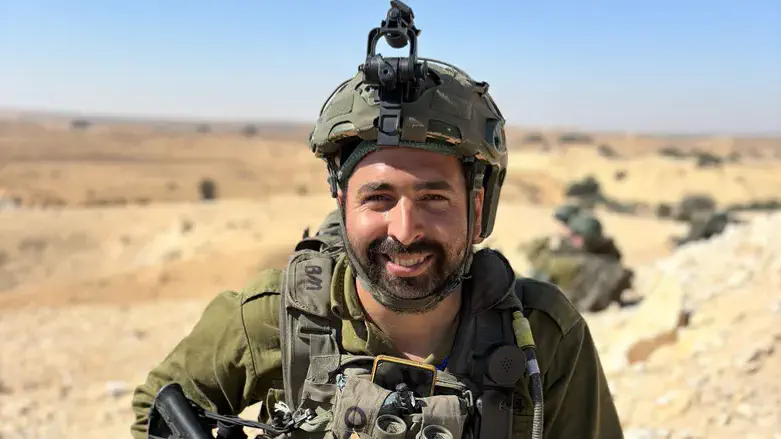
A second edition of the book "Restoring the IDF's Spirit: A Jewish Alternative to the Spirit of the IDF Document" will be launched today (Monday) in memory of Capt. Benayahu Malet, who fell in battle with terrorists near Tal in Samaria this past July.
His father, Rabbi Boaz Malet, a researcher at the Torat HaMedina study center and one of the book's contributors, spoke to Arutz Sheva about the connection between his son's work to promote Jewish settlement in Judea and Samaria and the initiative to formulate an alternative to the IDF's code of ethics.
"There is a strong connection to the work of the late Benayahu, who was an idealist", Rabbi Malet says. "Beyond his combat service in the military, he did a great deal to advance a plan for settlement and the dismantling of the Palestinian Authority through action on the ground. He was a very prominent activist in the hilltop communities".
The venue chosen for the book launch also holds special significance for the family. "The location chosen for the launch is 'Yahish Zion', a hilltop to which Benayahu opened an access route. There is a Torah study center there headed by a brother of his widow, my daughter-in-law Esther", his father says.
Rabbi Malet sees a connection between Benayahu's efforts to change the situation on the ground and the work of the Torat HaMedina study center, which seeks to reexamine the values guiding the IDF and how they are expressed in the Spirit of the IDF document.
"The Torat HaMedina study center works through Torah scholarship and a proposed alternative to the IDF's code of ethics to steer the country toward redemption and remove obstacles preventing the military from achieving its objectives", he explains.
He says that since the outbreak of the war, the study center's researchers have examined a range of questions concerning combat ethics and Jewish law, including the release of terrorists, attacks on hospitals used as hideouts by terrorists, harm to the remains of fallen IDF soldiers, and respect for the dead. Their examination of these issues led the researchers to conclude that the broader approach underlying the military's code of ethics needed to be reviewed.
"Through our examination of issues of warfare and Jewish ethics, we saw the need to address something broader: the IDF's code of ethics", he says.
Rabbi Malet strongly criticizes the existing document, arguing that it does not give sufficient weight to the pursuit of victory and a decisive outcome. "We saw fundamental 'bugs' in the IDF's operating code. Fortunately, it was the soldiers on the ground who shaped the way the fighting was conducted, rather than the code of ethics, which does not seek victory and needs to be changed".
He adds that, in his view, some of the document's problems also concern the relationship between the military and the political leadership. "This is a code that subordinates the military to the authorities rather than to the government, as stipulated by law, which could undermine democracy", he argues.
He also criticizes the identity and positions of those involved in drafting the code of ethics. "It makes no sense for the person writing the IDF's code of ethics to be someone who supports refusal to serve, someone with extreme views toward Israeli society, the state's right to exist, and its right to wage war".
To illustrate his approach, Rabbi Malet recalls a conversation with his son during one round of fighting, when Benayahu was serving in Gush Etzion and commanding soldiers conducting routine security patrols in villages.
According to his father, Benayahu said that during the first few days, troops entering the villages were met with stones and other objects thrown at them. Rather than continue the patrols in the same manner, Benayahu decided to change tactics: wherever stones were thrown, the soldiers would leave their armored vehicles and continue patrolling on foot.
His father says the change brought the stone-throwing to a halt, and the method was subsequently adopted by other platoons. Commanders understood that a physical presence on the ground could be more effective than passing quickly through a village in armored vehicles.
Rabbi Malet sees the story as an expression of the spirit that guided his son and of the view that meaningful change can begin among frontline soldiers and eventually influence the entire system.
"In the field of Torat HaMedina, too, there is an awakening from below", he says. "The team of researchers and scholars at the study center believes that we should put forward our proposal, and others-leading Torah authorities and other figures-will come and offer their proposals, and the state will consider what the Spirit of the IDF should look like".
One of the central issues Rabbi Malet seeks to highlight is the need to strengthen soldiers' morale. He says Jewish tradition places great importance on this, as reflected in the address delivered by the priest anointed for war, intended to encourage soldiers before battle.
In his view, a soldier who is not fully convinced of the justice of the war may be more vulnerable to psychological harm. He therefore considers it particularly important that the code of ethics address not only restrictions on the use of force, but also the meaning and justification of the fighting.
"The Jewish people are modest and compassionate, and using weapons does not come naturally to us. Therefore, the purpose of the Spirit of the IDF should include addressing exceptional circumstances in which weapons are not used, but primarily it should address fighting spirit and soldiers' identification with the justice of our cause", he says.
During the interview, Rabbi Malet was asked whether drafting an alternative to the Spirit of the IDF document at a Torah study center rather than within an official military framework could leave soldiers facing tension between a worldview that strengthens their morale and the orders they receive from their commanders.
Rabbi Malet makes clear that the initiative is not intended to challenge the authority of the military command or replace the chain of command.
"There is no intention to replace those who give orders", he stresses. "The commanders are the ones who say what to do, but during the war we saw that the spirit was already different among the combat troops, among those on the ground. After things changed and progressed on the ground, we are saying that this spirit should also be brought into the official documents, and that progress should be made there as well".
He says the book's purpose is not to dictate a new document to the military, but to offer a basis for public and Torah-based discussion, through which the State of Israel would ultimately formulate the values that should guide its soldiers.
"We are proposing that the State of Israel formulate the IDF's combat values in a more appropriate and fitting way, including in the law itself. Currently, the law says nothing about this. Others will offer different proposals, and we will discuss them as a democratic state".
He concludes by clarifying that the initiative is intended to strengthen the military and its ability to carry out its missions, "The goal is to strengthen the IDF, not to weaken orders or the military's objectives, but quite the opposite: to encourage the military to carry out its missions as it should and as is right".